

Contents
Welcome - What this microsite is and how to use it.
Executive Summary - What happened in the room, the shift from talent platform to life platform, and the four things that are now locked in.
The Session Record* - A narrative account of how the day moved, from the direction holding under pressure to the ambition expanding beyond where it started.

*The Structured Record
The Exam Question and Strategic Objectives. The question that has governed all the work, and the objective that the room subsequently built and agreed upon.
Module One — The Strategic Choices. Nine domains where a genuine choice exists, with the recommended direction for each - based on the Talent Ecosystem model.
Module Two — The Key Decisions. The first structural commitments that must be made before the choices can be finalised.
Module Three — The Strategic Initiatives. The six near-term builds that are suggested as being necessary for the Talent Ecosystem
The Trade-offs. What each strategic choice costs, across three domains: strategic, operational, and leadership and culture.
Module Four — What Will It Take? Every condition named in the room is expressed as a genuine requirement for this to succeed.
Module Five — Notable Achievements. The five measurable supporting objectives and the specific conditions of success within each.
Module Zero — The Integrational Mindset. The strategic themes underpinning the initiatives and representing the thinking required before the framework makes sense.
Module Zero-B — Reflections on the Emerging Direction. The emerging design principles and the structural value logic that underwrite the vision.
NOTE: The framework explained in this deliverable is almost exclusively biased towards the Business of the Future. The twin track version should be developed as a result of the conclusions of this stage.
Welcome
This is the continuing working record of the strategic process. A documented account of the thinking that has been happening inside Drake International since February 2025 and before that.
It represents the current maturity of the conversations, the debates, the ideas that arrived unexpectedly, and the decisions that were reached together by the people responsible for carrying them out.
The material embraces Drake’s own development and research, interviews, mini-sessions, our own research, and, most recently, the days in Toronto in April, when Drake's leadership came together again. The session records are not verbatim accounts but represent the sum of what was discussed and decided.
The thinking is live, not concluded. Some of the language is still being tested. Some of the choices are still being made. What is here represents the state of the work at a specific point in time, and it will continue to develop through to June 4th and beyond.
Read it as a working foundation, not a finished plan. This framework requires completion and sign off for it to inform the next phase.
Executive Summary
What happened in the room:
The ambition got a lot bigger.
Drake is building a ‘life’ platform. Career is the door in.
Everything in this document sits downstream of this shift.
We came in describing a talent ecosystem platform. We left describing something wider than that, with the talent ecosystem as the entry point to the bigger thing.
Three inputs define the move.
Recruit. The Japanese conglomerate that began placing high school leavers in 1960 and, by following the same population across their working lives, grew into the second-largest HR business on earth.
Gakken. A textbook publisher that became a daycare provider, then a retirement home operator, then a funeral business. Cradle to grave. The same people, a whole life.
Ikigai. The Japanese frame for the intersection of what you love, what you're good at, what the world needs, and what you can be paid for. The room took it as more than philosophy. It felt like a product mechanic.
THE JUMPING OFF POINT TOWARDS THE VISION AND BUSINESS CASE
Put those three together, and a career becomes a door into something larger. The adjacencies come into view. Childcare and vocational re-entry. Financial well-being for portfolio and gig workers. Mental health. Eldercare. Education. Mobility. The things that decide whether someone can show up for work at all, let alone fully.
The talent ecosystem framework is still right. The horizon is bigger than it said.
Four other things are locked in.
The strategic objective moved to FY29. "Recognised" was traded for "market leading." It splits into two: a target for the platform business, a Rule of X for the business of today.
The marketplace has two sides, and we build the people side first. Free at entry. Monetise later. 100,000 users as the working benchmark.
Business of today and future business run in parallel - the dual path. The platform build needs cash, credibility and organisational stability. Only well-run existing business provides that.
Karen put it plainly:
"I don't think we have the right to do this if those businesses don't perform."
The why was named. The platform exists to help people realise their potential, in work and in life. That gives us one design test. Every adjacency, every service, every partner that wants in gets asked: Does this help someone realise their potential in work and in life? Yes, it belongs. No, it doesn't.
That energy was what fired the room on 13 April.
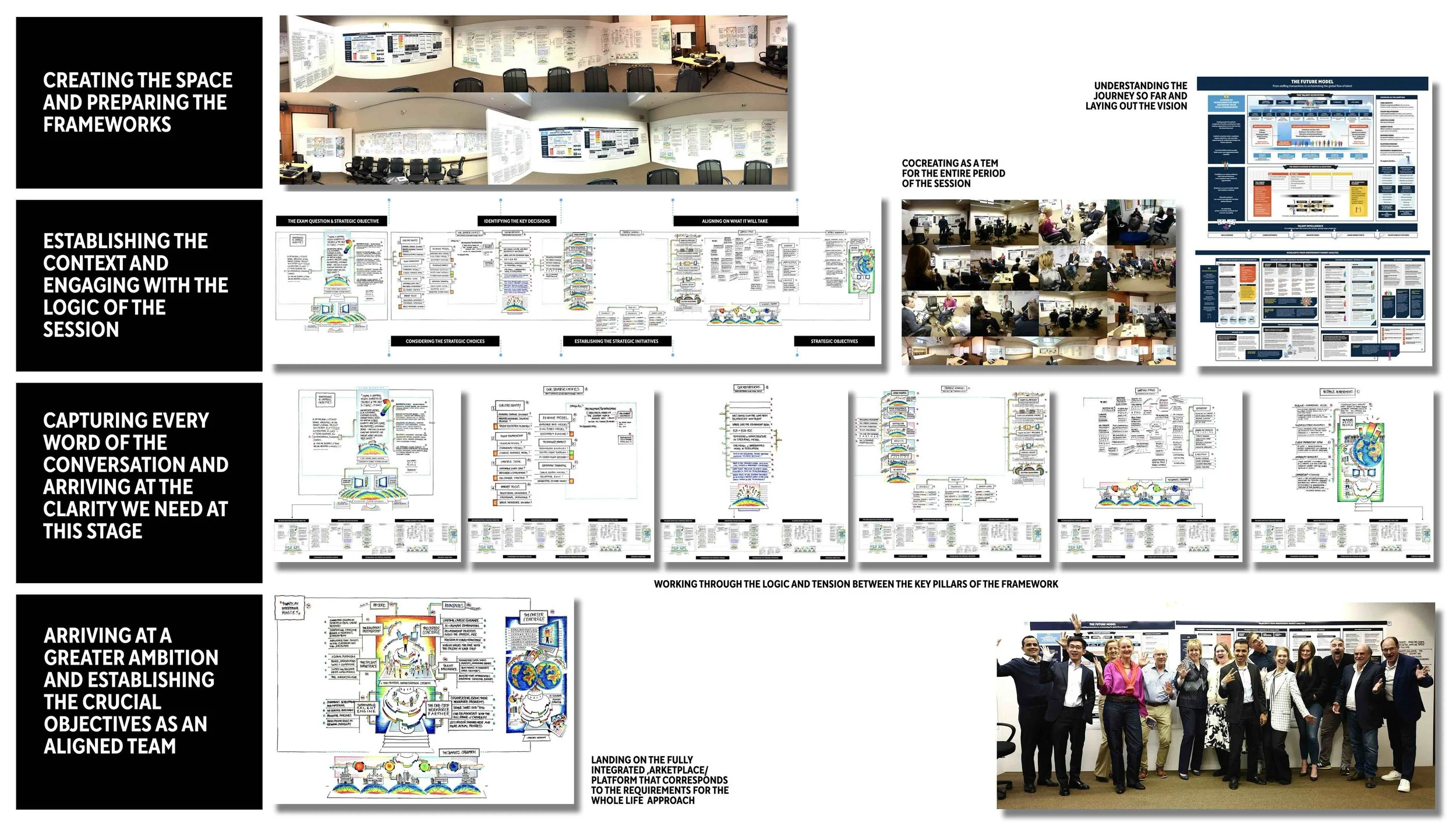
SESSION RECORD AND PROGRAMME REFERENCE
The audio transcripts hold the full record. This is the high-level narrative.
Where The Day Began
We came in with the strategic choices framework as the spine. Seven choice domains. Five critical decisions. A draft strategic objective built around Drake becoming a recognised talent ecosystem platform by FY28. The prior sessions, interviews, and survey work had been woven in.
NOTE: The framework explained in this deliverable is almost exclusively biased towards the Business of the Future. The twin track version should be developed as a result of the conclusions of this stage.
The question for the day was whether the direction would hold under pressure and whether the room would commit.
The direction held. The talent lifecycle model, the market analysis, the four-category lens and the competitive window all landed without serious challenge. The room accepted the move away from transactional staffing toward a talent ecosystem and accepted that the timing was right.
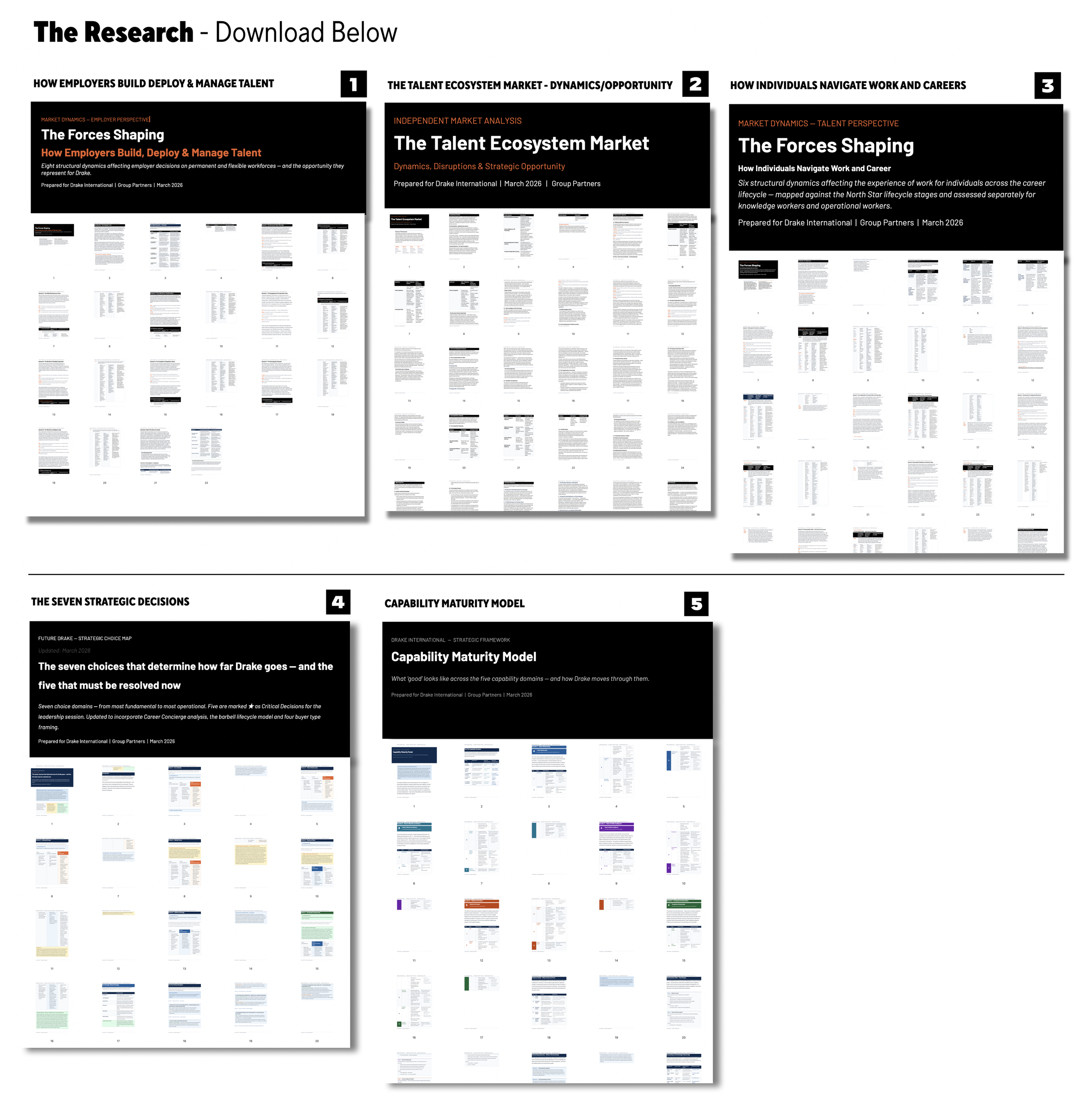
CLICK THE IMAGE TO DOWNLOAD
Then the conversation deepened. And the deeper it went, the bigger the picture became.
The Shift:
From Talent Platform To Life Platform
The biggest movement of the day did not come from a single decision. It came from three inputs converging.
The first was Recruit. A Japanese company that started in 1960, helping high school leavers find work, and that grew from a single database of people into the second-largest HR business on the planet. Dating. Travel. Temporary staffing. Executive search. All from the same population, followed across decades.
The second was Gakken. A textbook publisher that became a daycare provider, then a retirement home operator, then a funeral home. Cradle to grave. The same people, a whole life.
The third was ikigai. The Japanese idea of the intersection of what you love, what you're good at, what the world needs, and what you can be paid for. The room took it as more than philosophy. It became a powerful product mechanic. A front door that helps people understand themselves while also building the data profile that makes the platform valuable.
Put those three together, and the conclusion was hard to avoid. The talent ecosystem we'd been describing is the right starting point, but the destination is larger.
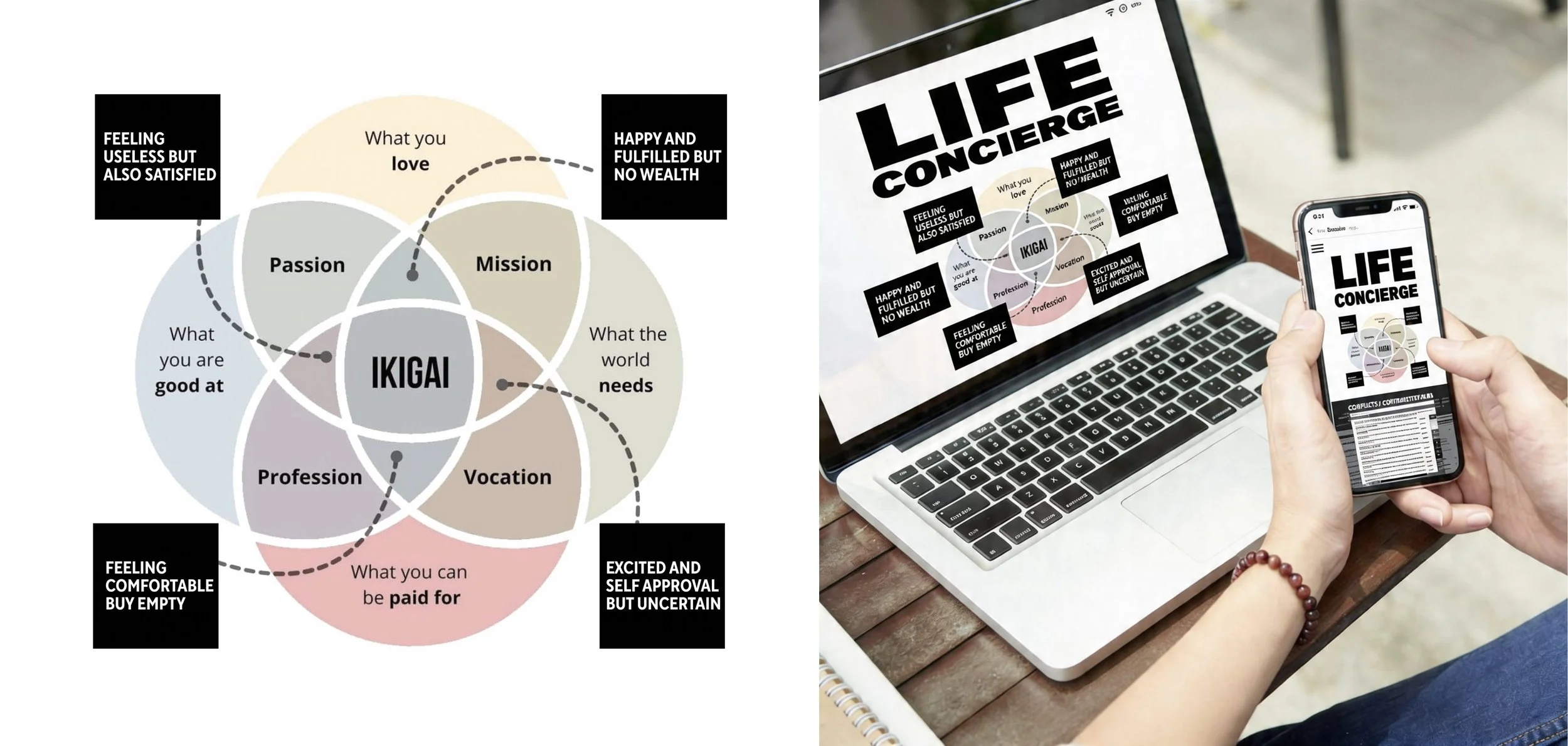
ILLUSTRATIVE UX IDEA
The Strategic White Space
No organisation has yet successfully combined:
A trusted, long-term relationship with individuals across their career lifecycle
Deep employer relationships grounded in advisory rather than transactional
Skills intelligence that spans both supply and demand in real ti
Operational capacity to place and deploy talent.
This is precisely the combination Drake's strategy describes. The white space is real, large and largely uncontested, but it will not remain so for very long.
The Destination
A platform that helps people realise their potential across their working life in its fullest sense. Career is the driver. Career is the anchor. Once you're inside, the adjacencies are real and connected. Childcare and re-entry. Financial well-being for portfolio and gig workers. Mental health and EAP. Eldercare. Education. Immigration and mobility. The things that decide whether someone can show up for work at all, let alone fully.
As someone said in the room, "Life is bigger than just your career. Maybe it's a life cycle more than just a talent cycle."
The talent ecosystem framework stays at the heart. What changes is the build principle. From day one, the platform has to be extensible, so the life platform it becomes isn't locked out by early decisions.
The Strategic Objective, Sharpened
The draft objective that opened the day read as: FY28, talent ecosystem platform, 20% of revenue from non-placement sources, 30% of major clients across three markets. The afternoon worked it over.
Four changes.
ONE: Timeline.
FY28 became FY29. The ambition warrants the longer horizon.
TWO: Revenue language. "Non-placement sources" was rejected as old language. It defines the new business by what it isn't. "Non-transactional, non-commoditised sources" was adopted, with a commitment to publish an approved list of qualifying revenue types. This matters because Kryterion, DBSA and other existing businesses may qualify under the right definition.
THREE: Structure. The objective is split into two. One target for the future platform business. One for the current business, measured by a Rule of X (growth plus profitability combined, number to be set per business unit). The dual structure mirrors the dual-path operating model that the leadership team first named during the day.
FOUR: Ambition. “Recognised" was called out as insufficiently bold. "Market leading" and "dominant" were the preferred directions. The final wording is not locked yet.
Where it stood at the end of the day: by the end of FY29, Drake operates as the market-leading talent ecosystem platform, generating at least [X]% of revenue from non-transactional, non-commoditised sources per an approved list, with the business of today measured on a Rule of X.
The Marketplace Made Concrete
The session moved the conversation from platform to marketplace. The distinction matters commercially. A platform is an architecture. A marketplace has sides, mechanics, tipping points, and a monetisation logic.
The group converged on a two-sided marketplace, with the people side built first. The logic: you attract one side to draw the other, and the people side is harder to build. Freemium and land-grab were explicitly endorsed. Build users first. Introduce monetisation later. Uber, LinkedIn and Netflix were the reference cases.
A minimum viable people threshold was raised. 100,000 users as a working benchmark, with 3-5% conversion to paying users as a working model. The MVP was defined as the marketplace itself, starting with students, parents, and early-career people.
The Kryterion database, potentially five million or more unique assessment-takers over five years, was identified as a meaningful seed asset. It isn't authorised for direct outreach under current consents. It is a signal of the scale already within reach.
A question surfaced on whether the new platform should sit under a separate corporate entity for risk, tax, and IP reasons. Left open. Phase Two agenda item.
The Dual Path
The most important commitment of the day was not about the future business. It was about the present one.
The leadership team named the dual-path model the operating frame from here on. Some people focused on running and improving the legacy business. Others focused on building the platform. Deliberate toggling between the two at the leadership level. "We don't think we have the right to do this if those businesses don't perform."
The platform build needs cash, credibility, and organisational stability. Only a well-run legacy business provides them. The ambition requires legacy performance. Without that, no platform.
The bar on legacy hardened during the day. Complacency got called out. Missed budgets are called unacceptable. The leadership team is mostly new, and the expectation is that new leaders clean up poor performance quickly, through rehiring, upskilling, and clear accountability.
Jeremy's closing framing holds. Build the platform. Leave the legacy businesses largely undisturbed. Let them plug in when the platform is ready. The traditional businesses become the premium, trusted, high-quality layer of the platform. The diamonds, not the drag.
The Why Named
Late in the day, the room landed on something that had been implicit throughout and finally got said out loud.
Karen's story from the start of the programme came back. Students are leaving education with no direction. Parents are spending significant sums on education with no assured outcome. Mid-career people have no guidance on how to change. Potential unrealised, at every stage.
The room agreed that this is why. The platform exists to help people realise their potential, in work and in life.
That gives us a design test.
Every adjacency, every service, every partner that wants in gets one question. Does this help someone realise their potential in work and in life? Yes, it belongs. No, it doesn't.
What This Means For Phase Two
The session did not change direction. It extended the horizon, deepened the ambition, and added the structural specificity that had been missing. The implications for the frameworks and for Phase Two design are real but manageable.
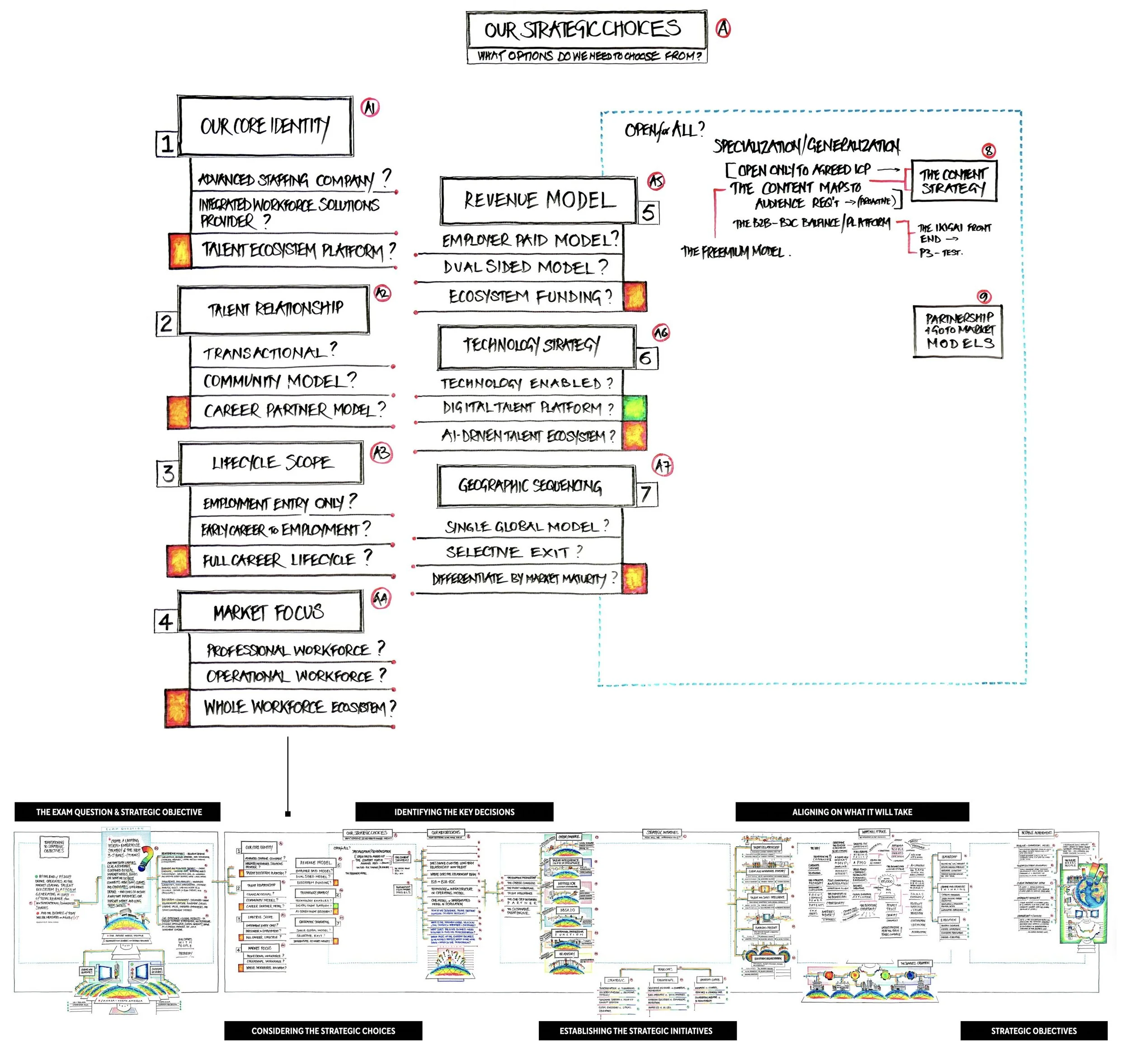
Strategic Choices.
The seven choices hold. Choice 1 (Core Identity) needs language that positions the talent ecosystem platform as the entry ring of a larger life platform.
A Choice 8 and 9 - Go-to-Market and Partnership Model and Content Strategy was added. Objective language across the framework needs to be updated to FY29, the dual-objective structure, and the revised revenue wording.
North Star. Needs a containing statement that positions the talent ecosystem as the first phase of a broader vision. The life platform frame wants talent lifecycle at the core, workforce participation enablers in the next layer, and broader life adjacencies on the horizon. "Candidate" gets systematically replaced with "people" throughout.
Career Concierge. Confirmed as the first consumer-facing expression of the platform. The seven revenue streams still stand as the MVP surface. The ikigai mechanic can be developed as an onboarding and engagement model. It connects the assessment assets to the life-design proposition in a way that is culturally resonant and commercially scalable.
Phase Two design. Three additions.
One. A design principle of extensibility, built in from day one. Implications for the user identity layer, the data model, and the partner and API architecture.
Two. The user identity record, named in session as the "electronic opportunity record." This needs its own workstream. It is what makes the plug-in model work.
Three. A governance mechanism that protects the platform from short-term performance pressure. A single bad month at the business unit level must not derail a multi-year programme. The frameworks don't yet address this. They need to.
Corporate structure. Whether the new platform business sits under a separate legal entity is still open. It needs a resolution before material investment decisions are made.
In Closing
The day produced a real expansion of ambition that didn't destabilise the work already done. The talent ecosystem framework survived intact. What changed is how far we can now see from it, and the conviction, clearly spoken in the room, about why it matters.
NOTE: New choices are likely to arise as we expand the framework to honour both tracks
Part Two
The Record Of Reference
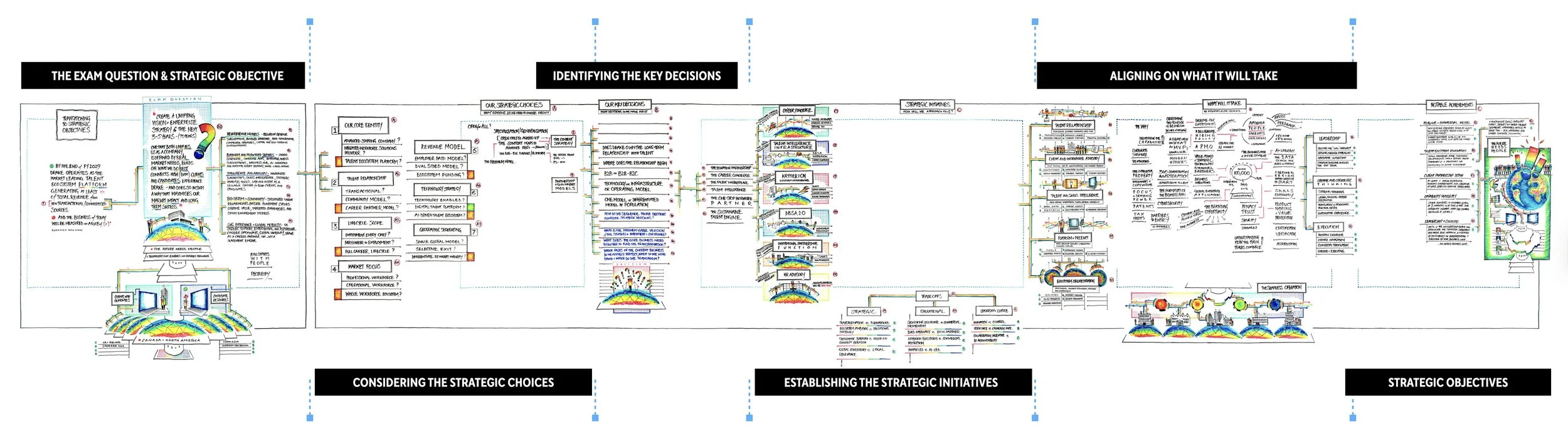
What follows is the structured record that sits beneath the narrative above. It tracks the framework sequence from the wall: from the question that started the work, through the choices and decisions the sessions produced, into the initiatives being built, the trade-offs they require, the conditions that must be in place, and the measures that will tell us whether any of it is working.
Read it in sequence for the full picture. Read individual sections as a reference.
MODULE ONE: The Exam Question and Strategic Objectives
The question that has governed all the work since February:
Create a unifying vision and enterprise strategy for the next three to five years — one that both unifies us as a company, is defined by real market needs, builds on what we do best, connects how both clients and candidates experience Drake, and does so in such a way that maximises our market impact and long-term success.
Everything on the walls is an attempt to answer that question more precisely. The conversations, the data, the debates — all of it feeds toward the same point: a strategic objective clear enough to anchor every decision that follows.
The primary objective, as agreed in Toronto:
By the end of FY2029, Drake will operate as the market-leading talent ecosystem platform, generating at least [XX]% of total revenue from non-transactional, non-commoditised sources.
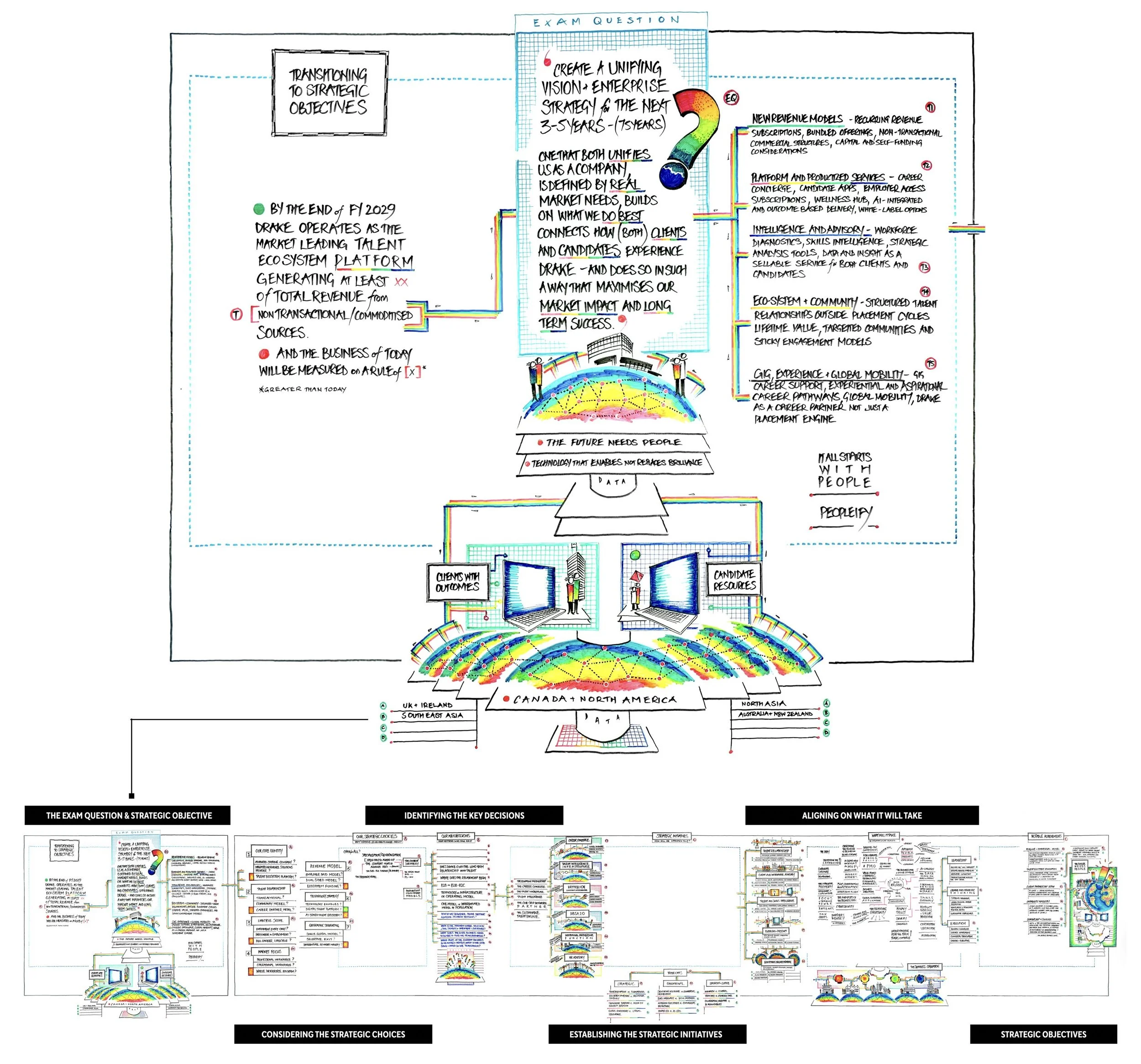
The non-transactional sources that constitute the business of tomorrow are grouped into five clusters. New revenue models, recurring revenue, subscriptions, bundled offerings, non-transactional commercial structures, and capital and self-funding considerations. Platform and productised services, the career concierge, candidate apps, employer access subscriptions, wellness hub, AI-integrated and outcome-based delivery, and white-label options. Intelligence and advisory, workforce diagnostics, skills intelligence, strategic analysis tools, and data and insight as a sellable service for both clients and candidates. Ecosystem and community, structured talent relationships outside placement cycles, lifetime value, targeted communities, and sticky engagement models. Gig, experience, and global mobility, gig career support, experiential and aspirational career pathways, global mobility, and Drake as a career partner rather than a placement engine.
The business of today will be measured on a Rule of X - greater than today. The specific number is to be set. The principle is agreed.
Two principles underpin both tracks: the future needs people. And technology that enables, not replaces, brilliance.
MODULE TWO:
The Strategic Choices We Need to Make
Nine strategic choices sit on the wall. Each frames a genuine decision, options that are all defensible, with a recommended direction drawn from the analysis, but requiring the organisation to commit.
Our Core Identity. Advanced Staffing Company. Integrated Workforce Solutions Provider. Talent Ecosystem Platform. The recommended direction is the third. The conversation confirmed it. Everything else in the strategy follows from that choice.
Talent Relationship. Transactional. Community Model. Career Partner Model. The recommended direction is the Career Partner Model, a continuous, compound relationship with the individual across their working life. This is the relationship no competitor is currently building at scale.
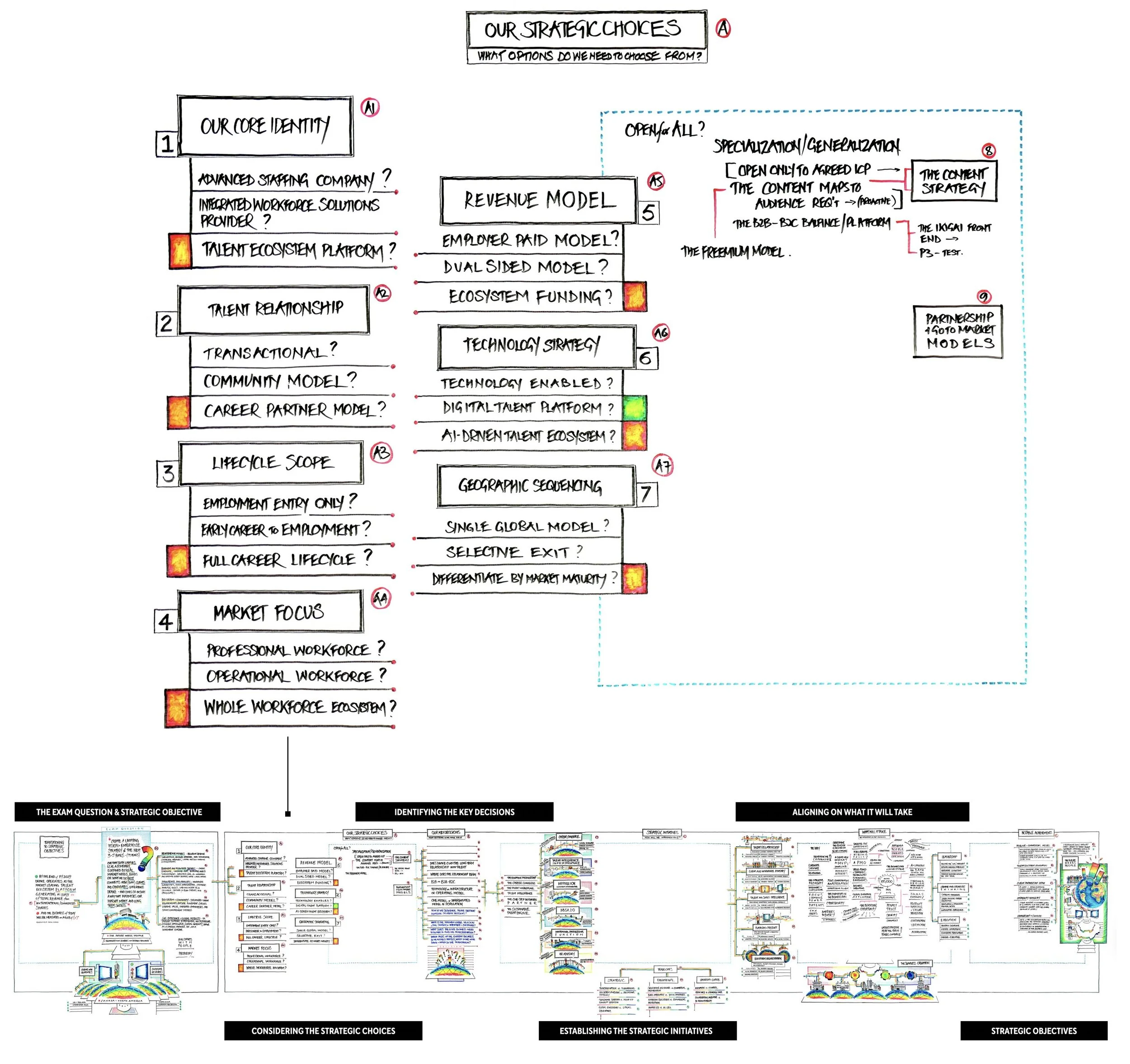
Lifecycle Scope. Employment Entry Only. Early Career to Employment. Full Career Lifecycle. The recommended direction is Full Career Lifecycle. The sessions extended this further: the ambition that surfaced is a life-stage platform that begins before employment and extends beyond it.
Market Focus. Professional Workforce. Operational Workforce. Whole Workforce Ecosystem. The recommended direction is Whole Workforce Ecosystem — the broadest scope, and the one that matches the platform architecture being designed.
Revenue Model. Employer Paid Model. Dual-Sided Model. Ecosystem Funding. The direction of travel is toward a dual-sided model that evolves toward ecosystem funding — moving beyond sole dependence on the employer as the only paying party.
Technology Strategy. Technology Enabled. Digital Talent Platform. AI-Driven Talent Ecosystem. The recommended direction is AI-Driven Talent Ecosystem — the platform that uses intelligence to anticipate rather than simply respond.
Geographic Sequencing. Single Global Model. Selective Exit. Differentiate by Market Maturity. The recommended direction is to differentiate by market maturity, identifying where conditions are most favourable and sequencing accordingly. Australia, New Zealand, and the Philippines were identified as primary build candidates.
Specialisation and Generalisation. The platform entry point must be open enough to be useful to anyone at any life stage. Specialisation belongs to the service layer — the apps within the store — not to the platform itself. The content strategy, the ikigai front end, and the P3 assessment framework all serve as the mechanisms through which the entry point functions.
Partnership and Go-to-Market Models. How Drake works with and through others — technology partners, channel partners, strategic partners, value-added partners — is a choice that shapes every other decision. Building everything internally is not the model. Creating the conditions for others to build on the platform is.
MODULE THREE:
The Key Decisions We Need to Make First
These are the first decisions that must be made (or confirmed) before the choices above can be fully executed. They are not the same as the strategic choices — they are the structural and directional commitments on which the choices depend.
Does Drake own the long-term relationship with talent? This is the foundational question. Everything the platform is designed to do depends on the answer being yes. If Drake does not commit to owning that relationship — building it, sustaining it, investing in it beyond the placement moment — the platform becomes another directory.
Decisions in Black represent direction decisions, those in Blue represent execution decisions
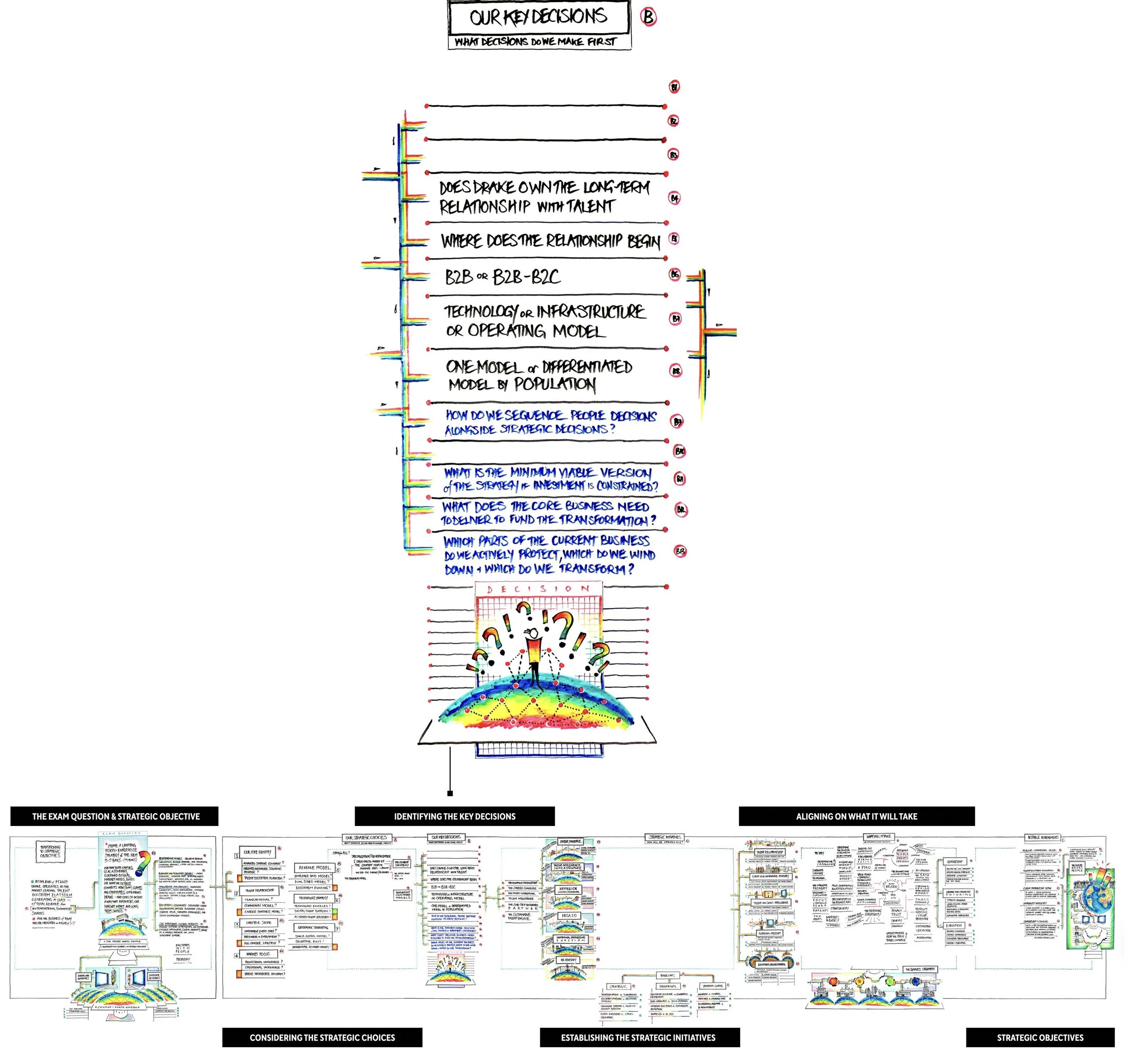
Where does the relationship begin? The sessions pointed strongly toward adolescence, before the commitments that shape a career are made. Getting in before LinkedIn, before university enrolment, before the first employer relationship — this is where the relationship has the most potential to compound.
B2B or B2B-B2C? Drake's historical model is purely B2B. The platform requires a consumer-facing orientation that the organisation has never had to develop commercially. Deciding how to manage that duality — and when to make the shift — is a structural decision with significant resource implications.
Technology build? Does Drake treat technology as the core operating model or supporting Infrastructure? If Yes, the ecosystem strategy scales. If No, rake's ambition is capped at what a human-intensive service organisation can sustain.
One model or a differentiated model by population? The platform serving a 16-year-old and the platform serving a 52-year-old in career transition are not the same experience. Deciding how much differentiation to design in from the start — versus building a common infrastructure and layering differentiation through the app store — is a product decision with architecture implications.
How do we sequence people decisions alongside strategic decisions? The organisation needs capabilities it does not currently have. Deciding when to hire for the future versus when to build from within, and how to manage the transition without disrupting current performance, requires a deliberate sequencing plan.
What is the minimum viable version of the strategy if investment is constrained? The full build is capital-intensive. The minimum viable version — the thing that can be started now, with what exists, that begins generating learning and early revenue — needs to be defined and committed to.
What does the core business need to deliver to fund the transformation? The business of today is the funding source for the business of tomorrow. The performance targets for the current operation are not separate from the platform strategy. They are its prerequisite.
Which parts of the current business do we actively protect, which do we wind down, and which do we transform? The portfolio needs to be assessed and segmented. The answer to this question determines where leadership attention and capital go, and where they stop going.
MODULE FOUR: The Strategic Initiatives
Six initiatives emerged from the analysis as the potential near-term build agenda for the Talent Ecosystem ‘core’. Each is a bridge between where the organisation is and where the platform needs it to be.
Career Concierge. The most concrete product concept to emerge from the sessions. Three component products showed the strongest signal: Future Pathways, Career Centres, and Prime 50. The career concierge is the human-facing expression of the platform's promise — lifelong career guidance at a price point and accessibility that the current market does not provide. It is the first app in the store and the entry point for the candidate-facing revenue model.
Talent Intelligence Infrastructure. The data foundation beneath everything else. Connecting DBSA, Kryterion, and the Career Concierge into a coherent intelligence layer — one that generates real insight on skills demand, career pathway viability, and talent mobility patterns. Without this, the platform is a service directory. With it, the platform becomes predictive.
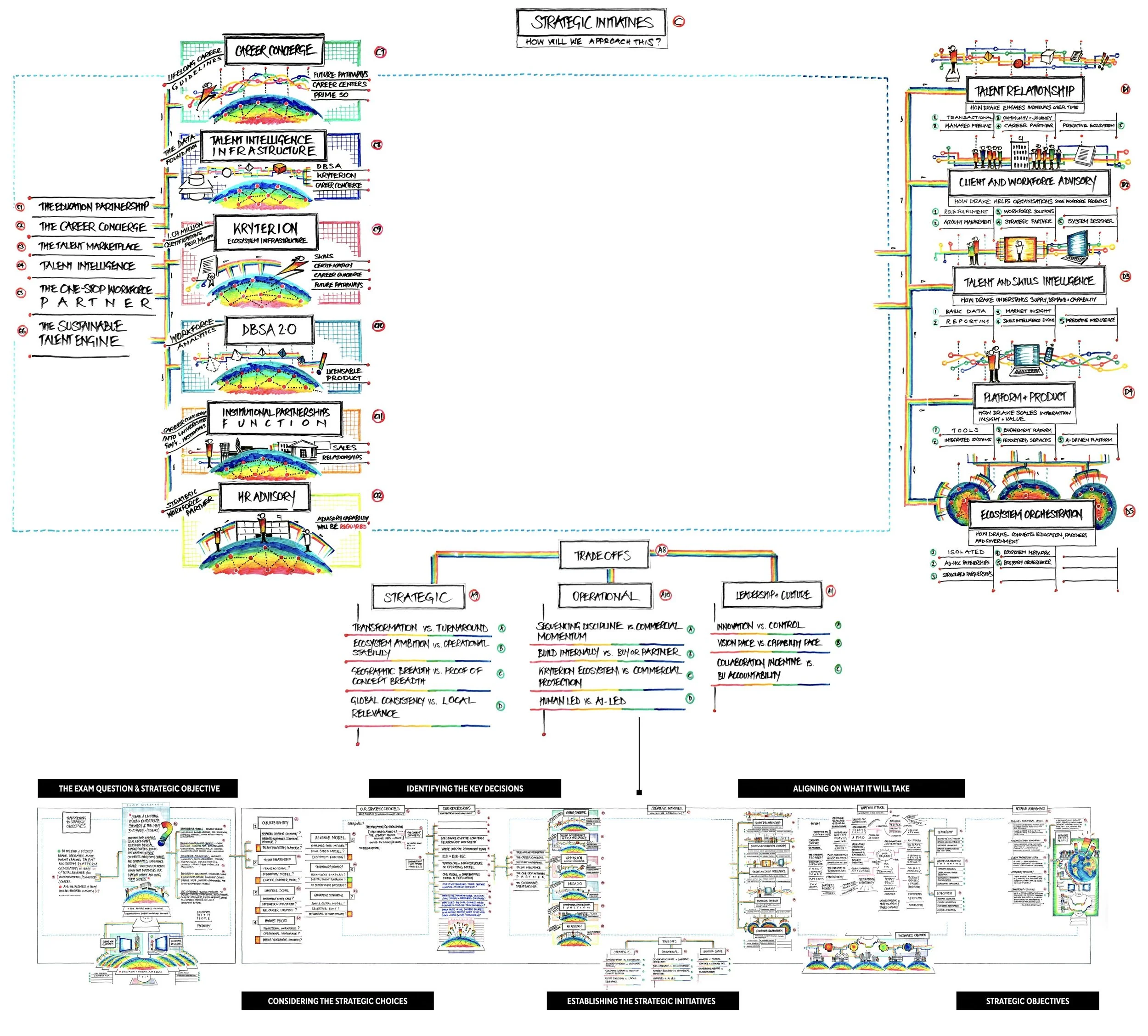
Kryterion as Ecosystem Infrastructure. Kryterion currently administers over one million certifications per month. That infrastructure, repositioned as the assessment and credentialing backbone of the broader platform, connects skills certification, career concierge services, and future pathway guidance into a single architecture. Drake's right to certify — to set standards rather than buy them — is one of its most underused assets.
DBSA 2.0. An outcomes-based workforce analytics model with significant potential as a licensable product. Currently regional and dependent on individual knowledge. Systematised and connected to the broader platform, DBSA becomes a workforce intelligence offering that serves both internal decision-making and external clients. The workforce analytics capability it represents is one that every organisation in the room identified as missing from Drake's current operation.
Institutional Partnerships Function. A dedicated capability for building and managing relationships with universities, colleges, government bodies, and industry associations — the institutions that provide access to the candidate relationships the platform needs to build. The career concierge goes into these institutions. The institutional partnerships function is what makes those conversations happen at scale and at pace.
HR Advisory. The employer-facing advisory capability that positions Drake as a strategic workforce partner rather than a role-fulfilment engine. Advisory capability will be required. The organisations that will pay most for Drake's intelligence and guidance are those that have moved beyond transactional hiring — the growth-stage builders and strategic workforce partners who want to design capability, not just fill seats.
The Trade-offs
Making a strategic choice means accepting what it costs. The trade-offs across three domains were named explicitly.
Strategic trade-offs. Transformation versus turnaround: the platform requires building the business of tomorrow, but the business of today needs to improve simultaneously. These are not the same kind of work and they pull in different directions. Ecosystem ambition versus operational stability: the scope of the vision creates pressure on an organisation that still needs to perform quarter by quarter. Geographic breadth versus proof of concept: doing this everywhere at once is not viable. Doing it with sufficient depth in one place to prove the model is. Global consistency versus local relevance: Drake operates across 15 countries under approximately 45 brands. Deciding what must be consistent across all of them, and what must flex for local conditions, is a trade-off that touches every part of the operating model.
Operational trade-offs. Sequencing discipline versus commercial momentum: moving carefully through a deliberate build sequence versus capturing commercial opportunity as it appears. Build internally versus buy or partner: the capabilities needed are scarce and expensive. Building them from scratch takes time the window may not allow. Buying or partnering compresses timelines but introduces integration and dependency risks. Kryterion ecosystem versus commercial protection: opening Kryterion's infrastructure to the broader platform creates ecosystem value but may expose commercially sensitive capability. Human-led versus AI-led: where human expertise delivers the value and where AI amplifies or replaces it is a design decision that runs through every product and service on the platform.
Leadership and culture trade-offs. Innovation versus control: the platform requires a startup's willingness to test, fail, and iterate inside an organisation with governance structures designed for predictability. Vision pace versus capability pace: the vision is ahead of the organisation's current capability. Managing the gap — moving fast enough to capture the window without moving so fast that execution fails — is a leadership problem with no clean answer. Collaboration incentive versus business unit accountability: the platform model requires the whole organisation to contribute to a shared asset. Business unit structures that measure and reward individual performance create friction with that requirement.
MODULE SIX:
What Will It Take
The sessions moved from strategy to operational honesty. Everything listed here was named by the people in the room as a real requirement — not a wish list, but a condition of success.
The why. The foundational case. People are not reaching their potential. The system fails them at every stage. The future needs people. People need a future. This is not marketing language. It is the reason the platform is worth building and the frame for every investment decision.
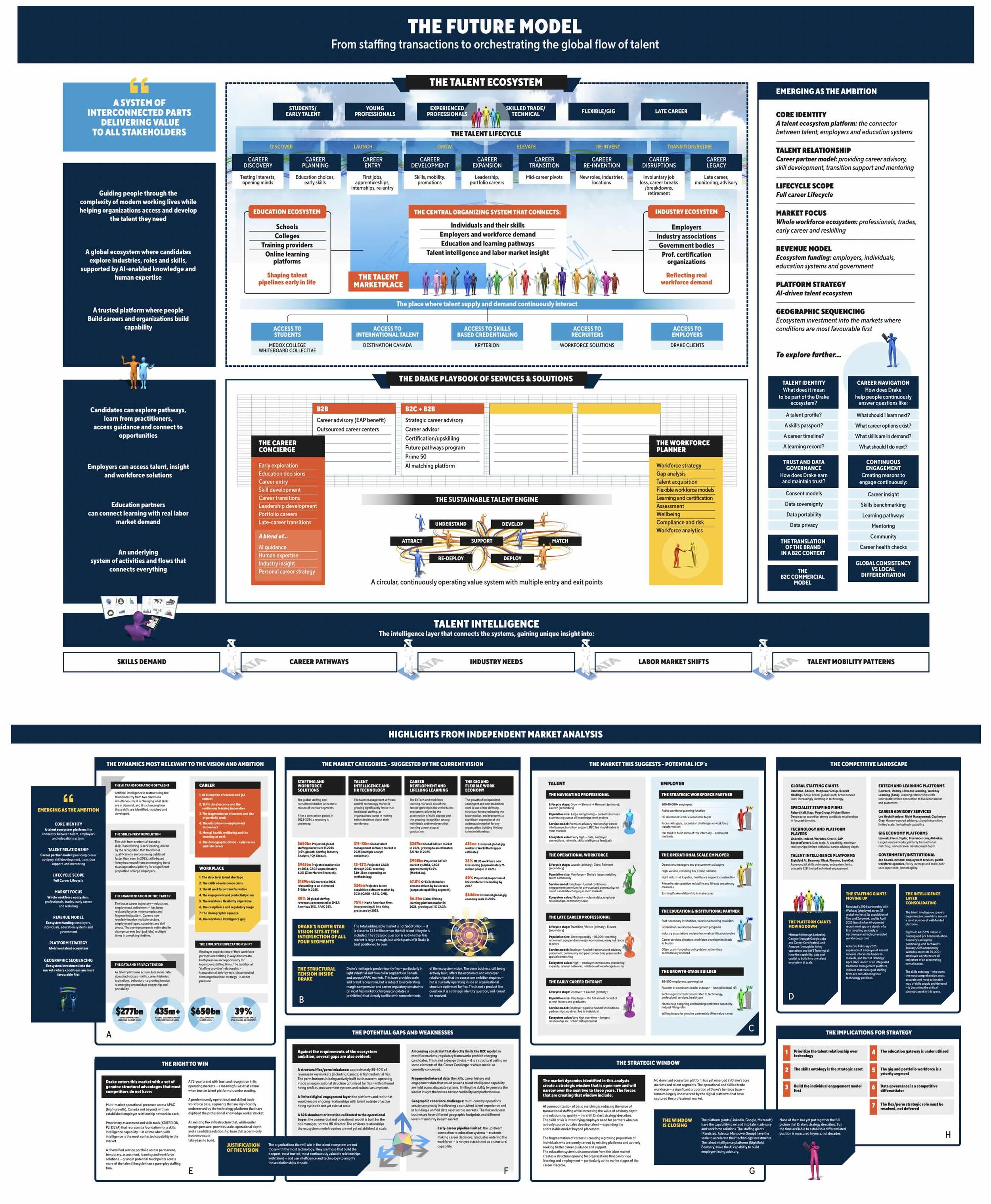
Identifying and building the capabilities. The organisation does not currently have all the capabilities the platform requires. Identifying the gaps precisely — and closing them through a combination of hiring, development, and acquisition — is a programme of work that starts now. On either side of the next visual are the capabilities suggested by the analysis. On the left are critical capabilities for the business of the future, on the right are the capabilities that will be needed to guide the organisation to that future.
Corporate structure and tax implications. Where the new platform is legally domiciled has real consequences for risk ring-fencing, tax efficiency, and the ownership of value created. Ireland was noted as a relevant jurisdiction. These decisions need specialist attention and should not be left to default.
Intellectual property. Trademarks, copyright, and patents. The platform is creating something genuinely new in a category without established precedent. Protecting that creation is a legal and commercial priority from the moment development begins.
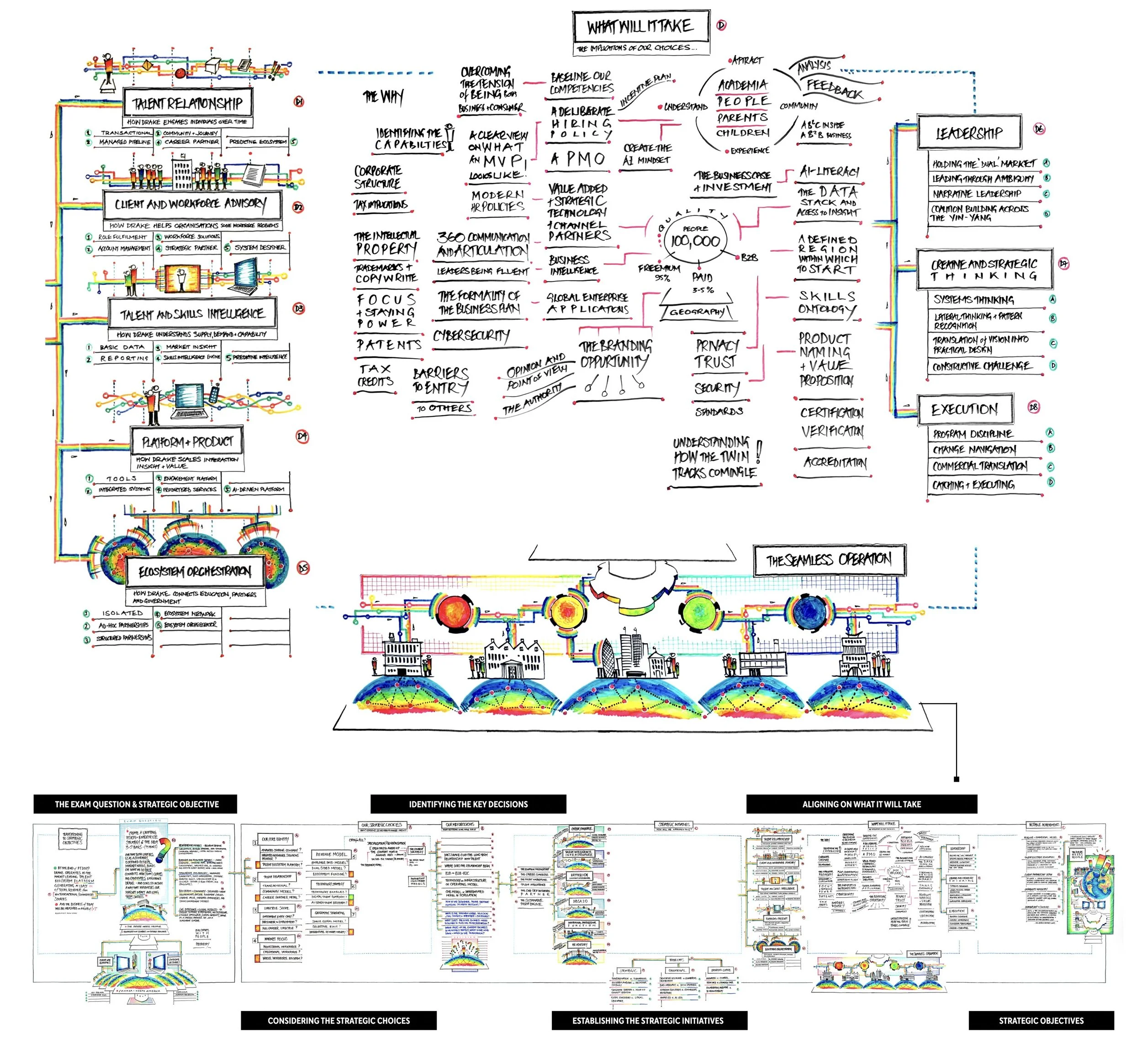
A clear view of what an MVP looks like. The minimum viable product — the thing that can be built and placed in the market now, that generates learning and early revenue, that proves the model — has not yet been fully defined. Defining it is one of the most immediate priorities.
A deliberate hiring policy. The people needed to build the platform are not all inside the organisation. Some of them are currently working for companies that Drake is about to compete with for their attention. The hiring policy needs to reflect the ambition of what is being built.
A PMO. Programme discipline. The twin-track model, running the business of today while building the business of tomorrow, requires coordinated programme management. Without it, resource conflicts and sequencing failures will slow both tracks.
Value-added technology, strategic partners, and channels. Drake will not build everything itself. The technology partners, channel partners, and strategic partners who will contribute to the platform — and through whom Drake will reach markets it cannot reach alone — need to be identified and engaged.
Business intelligence. The organisation currently makes decisions based on insufficient data about its own operations. Real-time performance visibility, workforce analytics capability, and market intelligence are all required for the platform's intelligence layer to be credible externally.
Global enterprise applications. CRM, ATS, and workforce management systems that can communicate across geographies do not currently exist at Drake. Building or procuring them is a foundational investment.
Attracting academia, parents, and children. The people side of the marketplace requires a magnet strategy aimed at constituencies Drake has never had to reach commercially. (100,000 target is now the target) The freemium model, 95% free, 5-5% paid, is the working hypothesis for how scale is built before monetisation follows.
The business case and investment. Directional approval exists. The formal business case rigour, market analysis, financial projections, investment phasing, and signals of market validation will follow and must be built. What does not need to wait for it is the first step.
Creating the AI mindset. Across the organisation, not just in the technology team. Two different capabilities: AI literacy for the workforce, and the technical ability to build AI-native products. Both are needed. Neither is present at sufficient depth.
The data stack and access to insight. Drake does not currently have a data warehouse. Building one, an engine that ingests, classifies, and makes accessible the organisation's full information asset, is the single most important infrastructure investment in the near term.
Skills ontology. A consistent definitional layer for what skills mean across the organisation and the platform. Without it, the intelligence layer produces noise rather than insight.
Privacy, trust, and security standards. Building a platform that engages with young people, holds lifelong personal data, and operates across multiple jurisdictions requires the highest standard of data governance. The healthcare mindset applies throughout.
100,000 people. The minimum viable number of people on the platform before the employer side becomes genuinely attracted. The number is a placeholder. The discipline is not.
A defined region within which to start. The platform cannot be built everywhere simultaneously. Identifying the geography where conditions are most favourable — and committing to depth of build there before breadth, is a sequencing decision with significant resource implications.
Certification, verification, and accreditation. The platform's trust layer. Drake's right to certify, to set standards for skills, behaviours, and capabilities rather than buy standards from others, is one of the most underused assets in the organisation.
Product naming and value proposition. The platform needs a name and a consumer-facing proposition that are distinct from the Drake staffing brand. What it is called, and what it promises, will shape who comes and why.
The branding opportunity. Two brands, two stories, two go-to-market strategies for a period, and then convergence when the platform is ready. How these coexist during the build phase without creating confusion or diluting either brand is a design problem that needs to be solved before either brand is taken to market.
Opinion and point of view. The authority. Being the market-leading talent ecosystem platform is a positioning ambition as much as a product ambition. Drake needs to publish perspectives on the future of work, careers, and talent. White papers, research, events, executive visibility, this is not marketing. It is the infrastructure of trust.
Barriers to entry for others. The platform being built must become progressively harder for others to replicate. Network effects, proprietary data, verified relationships, and proprietary certification standards are the mechanisms that create those barriers.
Understanding how the twin tracks comingle. The business of today and the business of tomorrow run in parallel but are not independent. The point at which they converge and the mechanism by which the best of the current business plugs into the platform need to be designed, not left to emerge.
Leadership requirements. Holding the dual market. Leading through sustained ambiguity. Narrative leadership, the ability to tell the strategy's story consistently and with confidence at every level. Coalition-building across the inherent tension between today's business and tomorrow's business.
Execution requirements. Programme discipline. Change navigation. Commercial translation is the ability to convert strategic intent into operating plans, pricing models, and revenue targets. Catching opportunities as they emerge and executing against them faster than the market expects.
MODULE SEVEN:
The Supporting Objectives — Notable Achievements
Five domains of measurable achievement, each with specific conditions of success.
Revenue and Commercial Model. First revenue recorded from at least two Career Concierge product lines in at least one market. The Career Concierge suite is live and commercially active in at least one market outside Canada. A functioning skills ontology covering Drake's top three talent segments, integrated across at least two of DBSA, Kryterion, and Career Concierge.
The twin-track framework will include a set of supporting objectives for the business of today.
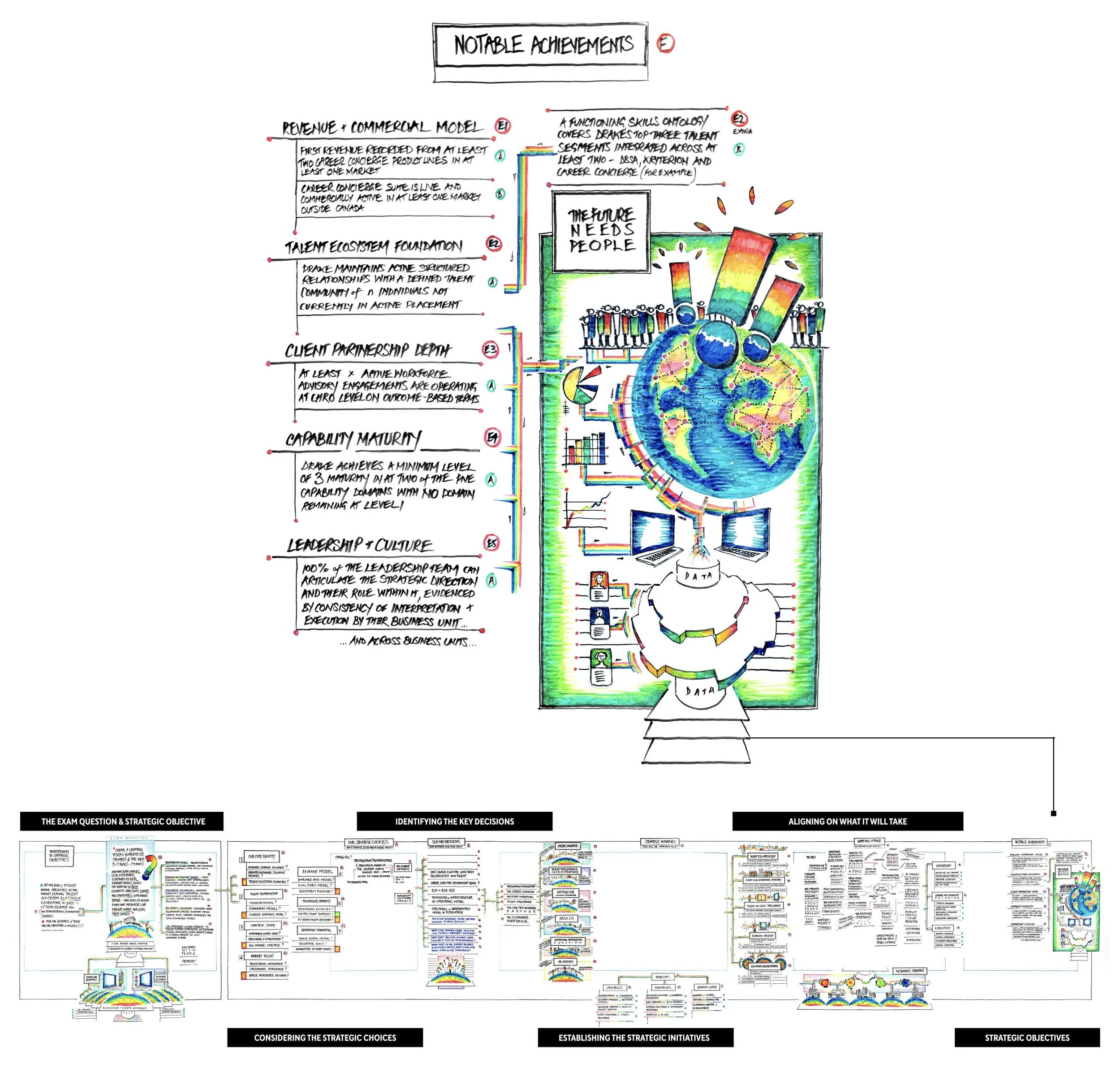
Talent Ecosystem Foundation. Drake maintains active, structured relationships with a defined talent community of n individuals not currently in active placement. The number is to be set. The principle — that Drake holds relationships with people outside the transactional placement moment — is the most important differentiator in the model and the condition against which the ecosystem claim can be tested.
Client Partnership Depth. At least x active workforce advisory engagements operating at the CHRO level on outcome-based terms. The shift from transactional account management to strategic workforce partnership — measured at the most senior buyer level and on the basis of outcomes rather than hours or placements.
Capability Maturity. Drake achieves a minimum maturity level of 3 in at least two of the five capability domains, with no domain remaining at level 1. The five domains are talent relationship, client and workforce advisory, talent and skills intelligence, platform and product, and ecosystem orchestration. Across the spectrum, it runs from basic and transactional to predictive and orchestrating. No domain can remain at its starting point.
Leadership and Culture. 100% of the leadership team can articulate the strategic direction and their role within it, as evidenced by consistency in interpretation and execution across their business unit and across business units. This is the culture measure. The strategy fails if it lives only in the room where it was made. The test is whether every leader who carries it outward is carrying the same thing.
MODULE ZERO:
The Integrational Mindset
In one sense, this module sits before the strategic framework, because the framework only makes sense if the reader arrives with the right mental model. Without it, the choices look like options. With it, they look like a system.
Why mindset comes first
Before the exam question. Before the strategic choices. Before the objective, the initiatives, or the trade-offs. The room spent time on this deliberately, and it is worth understanding why.
The model being built, a marketplace platform that holds a lifelong relationship with people across the arc of their working lives, cannot be designed, governed, or operated from inside a traditional organisational mindset. Business units, hierarchies, siloed P&Ls, territorial ownership of clients and candidates — these structures are not just unhelpful in this context. They are structurally incompatible with the platform's requirements.
The point was made plainly in the room: don't ship the org structure. The person using the platform does not care whose job it is. They want the value. The moment the organisation starts deciding which business unit owns the customer, it has already failed the platform test.
What replaces that mindset is integrational thinking. Every part of the organisation contributes to the platform by one mechanism or another. The whole is the product. The components are the inputs.
The marketplace and what it contains
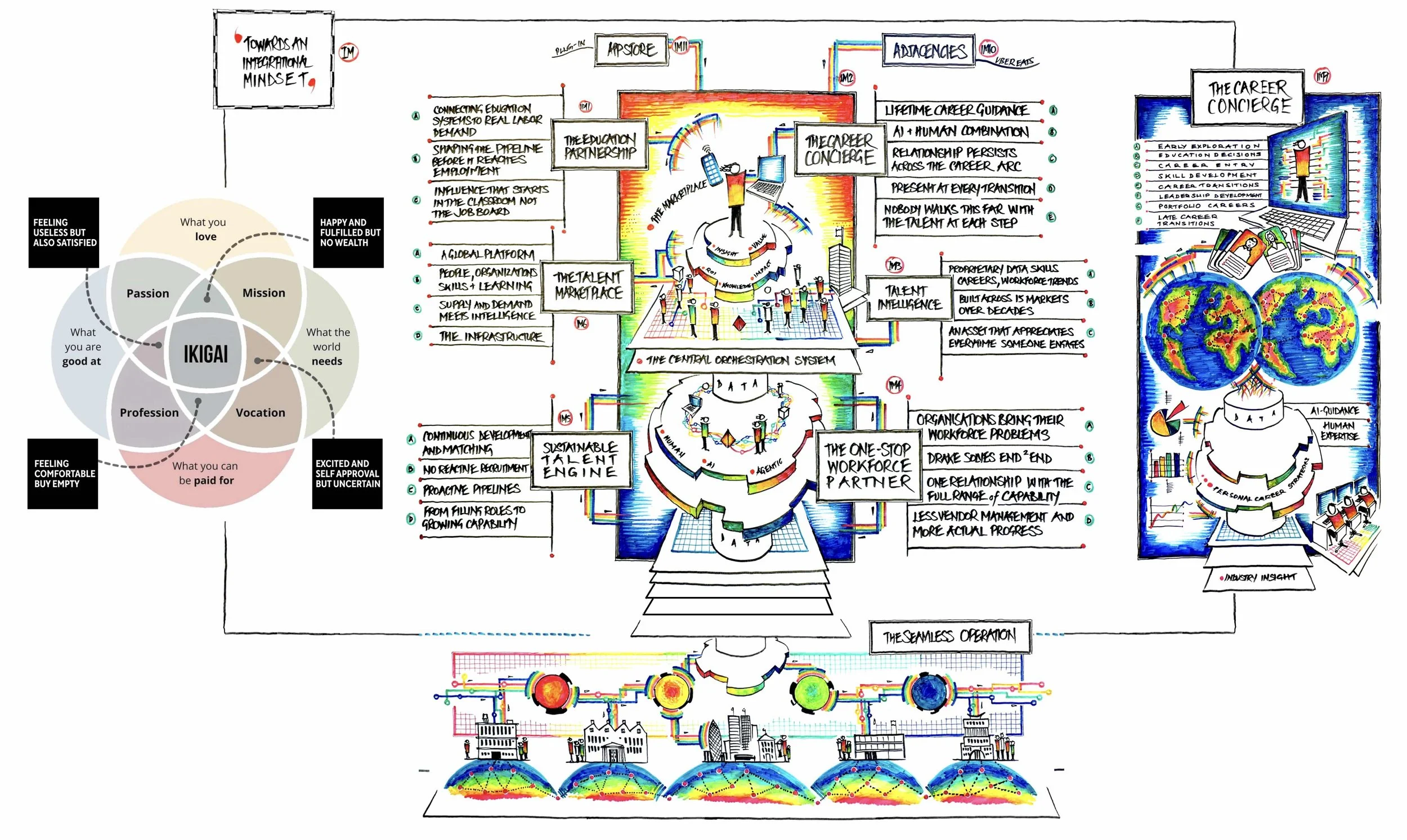
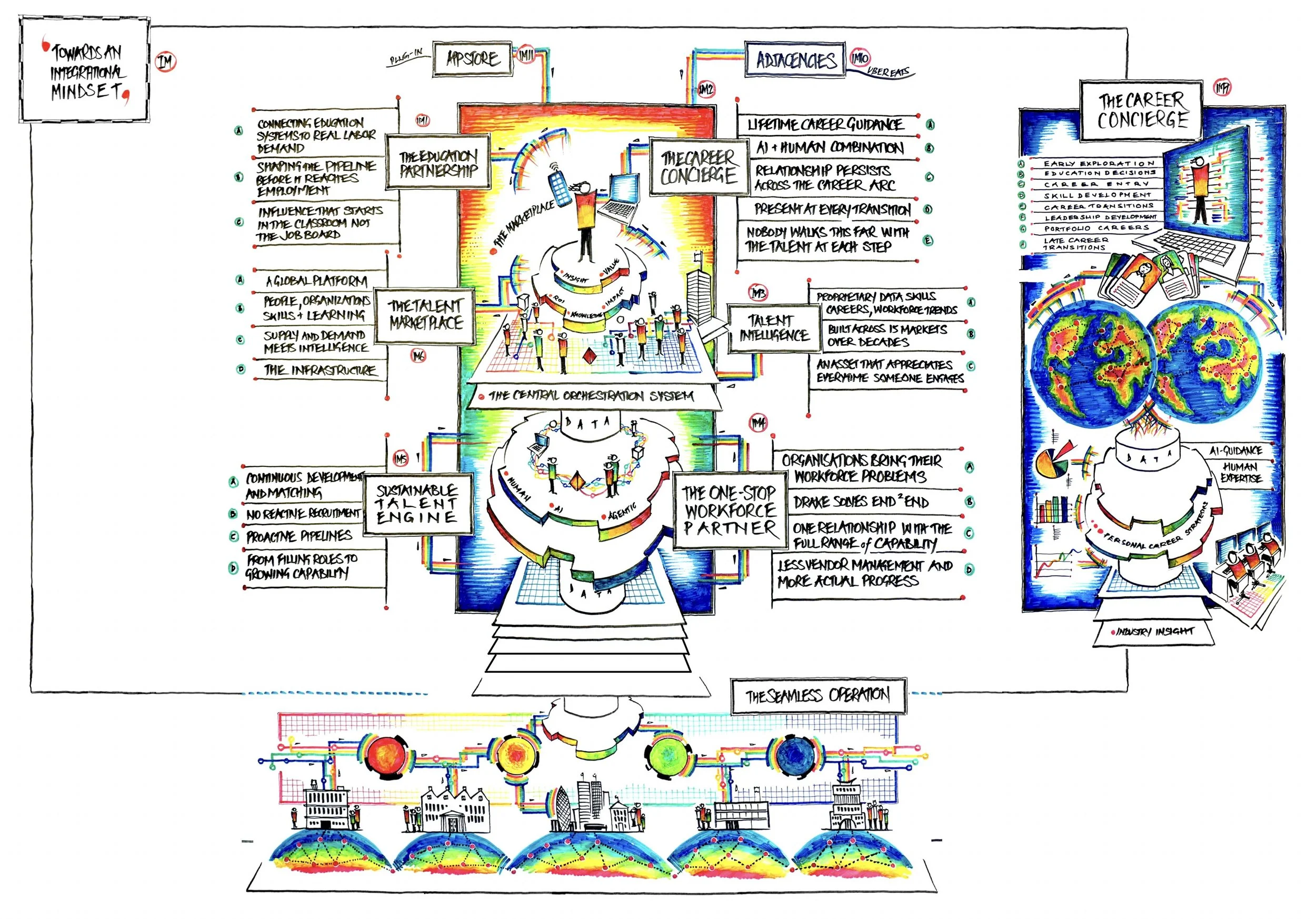
The platform is built as a marketplace with an app store architecture. Drake provides the central orchestration system, the intelligence, the data, the trust layer, the relationships. On top of that infrastructure, six interconnected components operate. They are not separate businesses. They are applications in the same store, each drawing on the same underlying asset and each adding to it.
The Education Partnership connects education systems to real labour market demand. It shapes the pipeline before it reaches employment. Its influence starts in the classroom, not on the job board. This is the earliest entry point into the life-stage relationship — the moment before a person becomes a candidate, when what they choose to learn will determine what they are capable of doing.
The Career Concierge provides lifetime career guidance through a combination of AI and humans. The relationship persists across the full career arc. The concierge is present at every transition, early exploration, educational decision, career entry, skill development, career transition, leadership development, portfolio career, and late-career transition. The defining characteristic: nobody else walks this far with talent at each step. Not a recruiter. Not an agency. Not a platform. The concierge does.
The Talent Marketplace is the global platform where people, organisations, skills, and learning connect. Supply and demand meet intelligence. It is the infrastructure layer — the mechanism through which the other components find each other and through which external partners plug in.
Talent Intelligence is the proprietary data asset: skills, careers, workforce trends, built across 15 markets over decades. Critically, it is an asset that appreciates every time someone engages with the platform. Every interaction adds to the intelligence. Every certification, every career move, every assessment makes the data richer and the platform more valuable to the next person who uses it.
The One-Stop Workforce Partner is the employer-facing expression of the model. Organisations bring their workforce problems. Drake solves end-to-end. One relationship, the full range of capability. Less vendor management and more actual progress. This is the shift from transactional role-filling to strategic workforce partnership — the employer equivalent of what the career concierge is to the individual.
The Sustainable Talent Engine is the operating principle beneath the whole. Continuous development and matching. No reactive recruitment. Proactive pipelines. From filling roles to growing capability. This is what the platform looks like when it is working properly — talent in constant motion toward its best use, organisations building capability rather than managing attrition.
At the centre of all of them: a central orchestration system combining human expertise, AI, and agentic capability. The data underneath everything. Personal career intelligence feeds back to the individual. Industry insight feeding forward to the employer.
The adjacencies
The marketplace is not closed. The adjacencies are real and part of the design. Uber Eats is the model: adjacent to the core, using the same infrastructure and the same trusted relationship with the user, extending the value of being on the platform beyond the primary transaction.
Drake's adjacencies are not invented. They exist where the life-stage relationship naturally extends. Financial well-being for portfolio and gig workers. Mental health and support services. Eldercare. Education partnerships. Immigration and mobility. Childcare and career re-entry. These are the things that determine whether someone can show up for work fully, not just whether they can show up at all. The platform that only addresses the career moment is missing most of the relationship.
Every adjacency earns its place by passing one test: does this help someone realise their potential in work and in life? Yes, it belongs. No, it does not.
What the integrational mindset actually requires
Holding the dual market. Running the business of today while building the business of tomorrow requires two different kinds of attention, two different performance cultures, and two different investment logics — held simultaneously by the same leadership team. Neither can be abandoned for the other. This is not a comfortable place to operate from. It is the correct one.
Leading through ambiguity. The platform will not be built to plan. The market will signal things that were not anticipated. The expected user may not be the one who arrives. The product that seemed primary may turn out to be secondary. The organisations that succeed from moments like this are the ones that built the capacity to learn fast and change direction without losing the thread of the original vision.
Making smart mistakes. Moving before everything is known. Testing before everything is proven. The minimum viable product is not the finished platform — it is the earliest version that generates real learning from real people. The ikigai front-end, the career concierge in a single market, the first certification issued under Drake's own standard, these are experiments, not commitments. The commitment is to what they teach.
Thinking in systems, not segments. The six platform components are not separate decisions. What is built in the Career Concierge affects what is possible in the Talent Marketplace. What is learned in Talent Intelligence feeds the Education Partnership. The decisions that look local are often global. Leaders who optimise their component without regard for the whole are working against the model, even when their numbers look good.
Recognising when the old model is talking. The territorial argument sounds reasonable. So does the instinct to protect an existing client relationship from a new platform offering. So does the preference for the known revenue model over the unproven one. These are the moments when the integrational mindset is most needed and most likely to be absent.
The invitation from the room was direct: call it out when you see it. In yourself and in each other.
Everything in the framework that follows this module was designed for people who think this way. The choices make sense when the reader holds the whole system in mind. The trade-offs are navigable when the reader understands why they exist. The sub-objectives are meaningful when the reader knows what they are trying to prove. The mindset is not background context. It is the operating condition for the rest of the work.
MODULE ZERO-B:
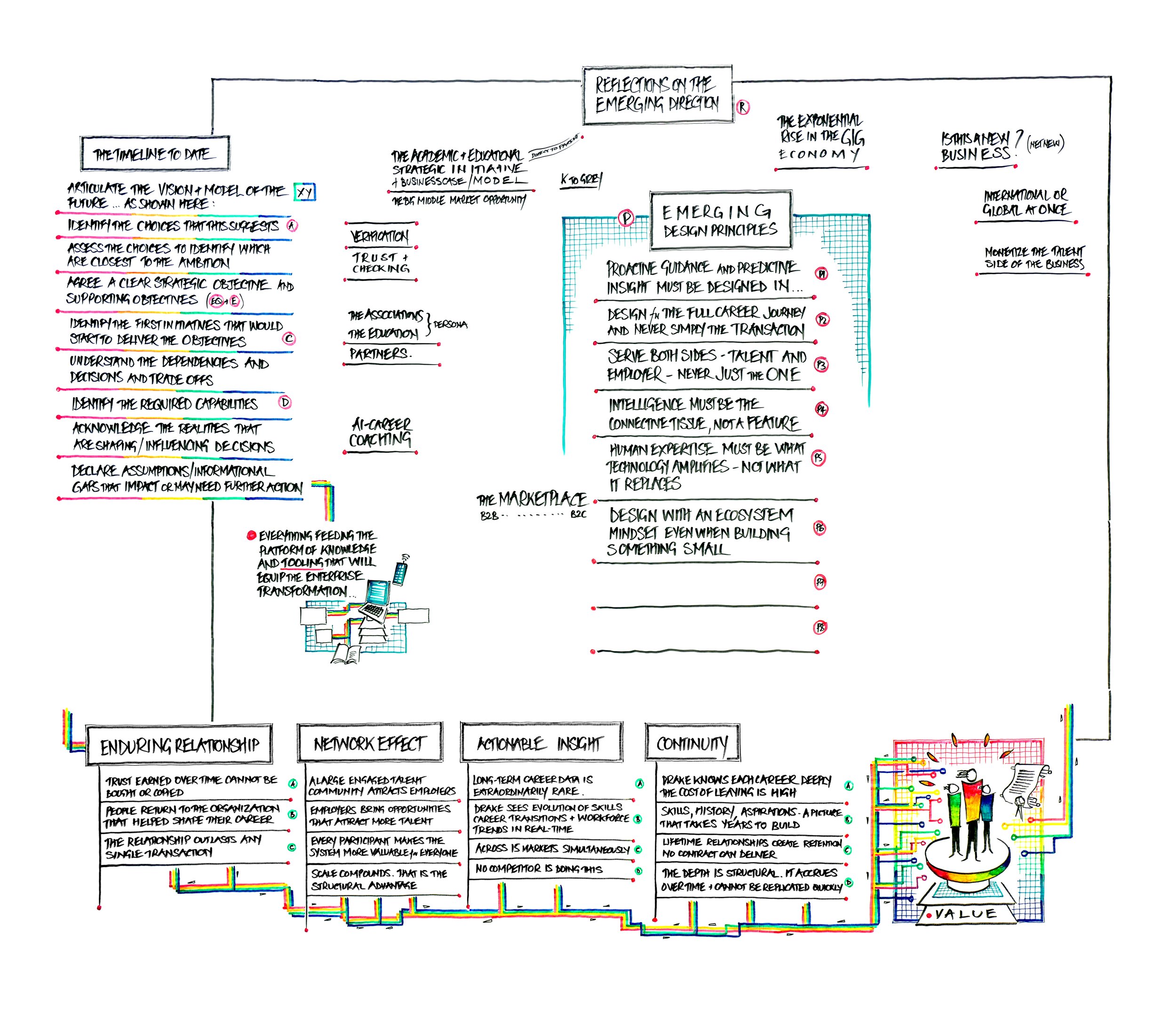
Reflections on the Emerging Direction
Before committing to a strategic objective, the room tested the direction against the evidence. This module holds that test — the design principles that emerged from it, and the structural value logic that underwrites the whole.
The process that got us here
The timeline to this point followed a deliberate sequence.
Articulate the vision and model of the future.
Identify the choices that suggest.
Assess those choices to identify which are closest to the ambition.
Agree on a clear strategic objective and supporting objectives.
Identify the first initiatives that would start to deliver the objectives.
Understand the dependencies, decisions, and trade-offs.
Identify the required capabilities.
Acknowledge the realities shaping and influencing decisions.
Declare the assumptions and informational gaps that may need further action.
Everything feeds the platform of knowledge and tooling that will equip the enterprise for transformation.
That sequence is what produced the direction now being reflected on. The question this module asks: Does the direction hold?
What the reflections surfaced
Several threads came into view:
The exponential rise of the gig economy is not a peripheral trend. It is reshaping the structure of the labour market from the ground up. Any platform designed around traditional employment relationships is already behind.
The academic and educational system represents a strategic initiative in its own right, not just a distribution channel. The K-to-grey opportunity runs from the classroom to retirement. The middle market is largely unserved. The gap between what education systems produce and what the labour market demands is structural and growing.
Verification, trust, and checking are design requirements, not features. In a world where identity and credentials can be fabricated, the platform that holds verified, longitudinal records of what people have actually done becomes the trusted infrastructure of the talent market. This is a first-mover position with a significant compounding advantage.
Associations and education partners constitute a third persona alongside the individual and the employer. They are advocating for their industries, connecting learning to employment, and are increasingly desperate for partners who understand both sides. They are a go-to-market route and a source of institutional credibility.
AI career coaching is a present reality, not a future aspiration. The marketplace runs from B2B to B2C. Managing the balance between those two sides, and the commercial model that serves both, is a live design challenge, not a future one.
The question "Is this a new business?" was asked and left deliberately open. International or global at once is a sequencing decision. Monetising the talent side of the business, not just the employer side, is the structural shift that changes everything about the commercial model.
The emerging design principles
Six principles emerged from the reflections. They are not aspirational statements. They are design constraints. Every product decision, every partnership, every market entry should be tested against them.
Proactive guidance and predictive insight must be designed in. Not bolted on. Not added as a feature once the core is built. The platform that waits to be asked is a reactive platform, which is exactly what the model is designed to replace. Anticipation is a structural requirement.
Design for the full career journey, not just the transaction. The transaction is the moment. The journey is the relationship. A platform designed around transactions will optimise for conversion. A platform designed around journeys will optimise for trust. These produce different architectures, different metrics, and different outcomes.
Serve both sides — talent and employer — and never just the one. The dual-sided marketplace is not a commercial choice. It is a design principle. A platform that serves only the employer is a staffing agency. A platform that serves only the individual has no commercial model. Serving both, simultaneously and without conflict, is the design challenge that makes this hard and the capability that makes it defensible.
Intelligence must be the connective tissue, not a feature. Data and insight are not a product add-on. They are what connects the education partnership to the career concierge to the talent marketplace to the workforce partner. Intelligence is the nervous system. Every component of the platform generates it and depends on it. Treating it as a separate business line misses the point.
Human expertise must be what technology amplifies — not what it replaces. The AI layer is not a cost reduction. It is a reach extension. Human expertise — the experienced recruiter, the career coach, the workforce adviser — is what makes the platform credible. Technology makes it accessible at a price point that changes the market. Remove the human, and the credibility goes with it.
Design with an ecosystem mindset even when building something small. The MVP is not a contained experiment. It is the first node of a network. Every early decision about data architecture, user identity, partner integration, and API design either opens or closes the ecosystem that follows. Small decisions made without ecosystem thinking become expensive constraints later.
The structural value logic
The bottom of the wall names four structural properties that explain why this model generates durable value rather than transient revenue. They are the business case in condensed form.
Enduring relationship. Trust earned over time cannot be bought or copied. People return to the organisation that helped shape their career. The relationship outlasts any single transaction. These are not soft claims. They describe the structural economics of a platform that compounds in value over time.
Network effect. A large, engaged talent community attracts employers. Employers bring opportunities that attract more talent. Every participant makes the system more valuable for everyone else. Scale compounds. That is the structural advantage. The platform becomes harder to displace not because of its features but because of its network. This is what distinguishes a marketplace from a service.
Actionable insight. Long-term career data is extraordinarily rare. Drake sees the evolution of skills, career transitions, and workforce trends in real time, across 15 markets simultaneously. No competitor is doing this. The data asset appreciates every time someone engages. The insight it produces is not a report. It is the intelligence layer that makes every other part of the platform more accurate and more valuable over time.
Continuity. Drake knows each career deeply. The cost of leaving is high — not because of lock-in, but because of the loss of a picture that took years to build. Skills, history, aspirations, verified achievements — these accumulate into something no contract can deliver. Lifetime relationships create retention that compounds structurally. The depth accrues over time and cannot be replicated quickly. That is not a competitive advantage. It is a structural moat.
These reflections are not the strategy. They are evidence that the strategy is pointing in the right direction. The design principles are the filter through which every subsequent decision should pass. The value logic is the frame through which every investment should be justified.
Together, they answer the question the room was asking: Is this real? The answer, from the data, from the analogies, and from the logic of how platforms create durable value, is yes.