
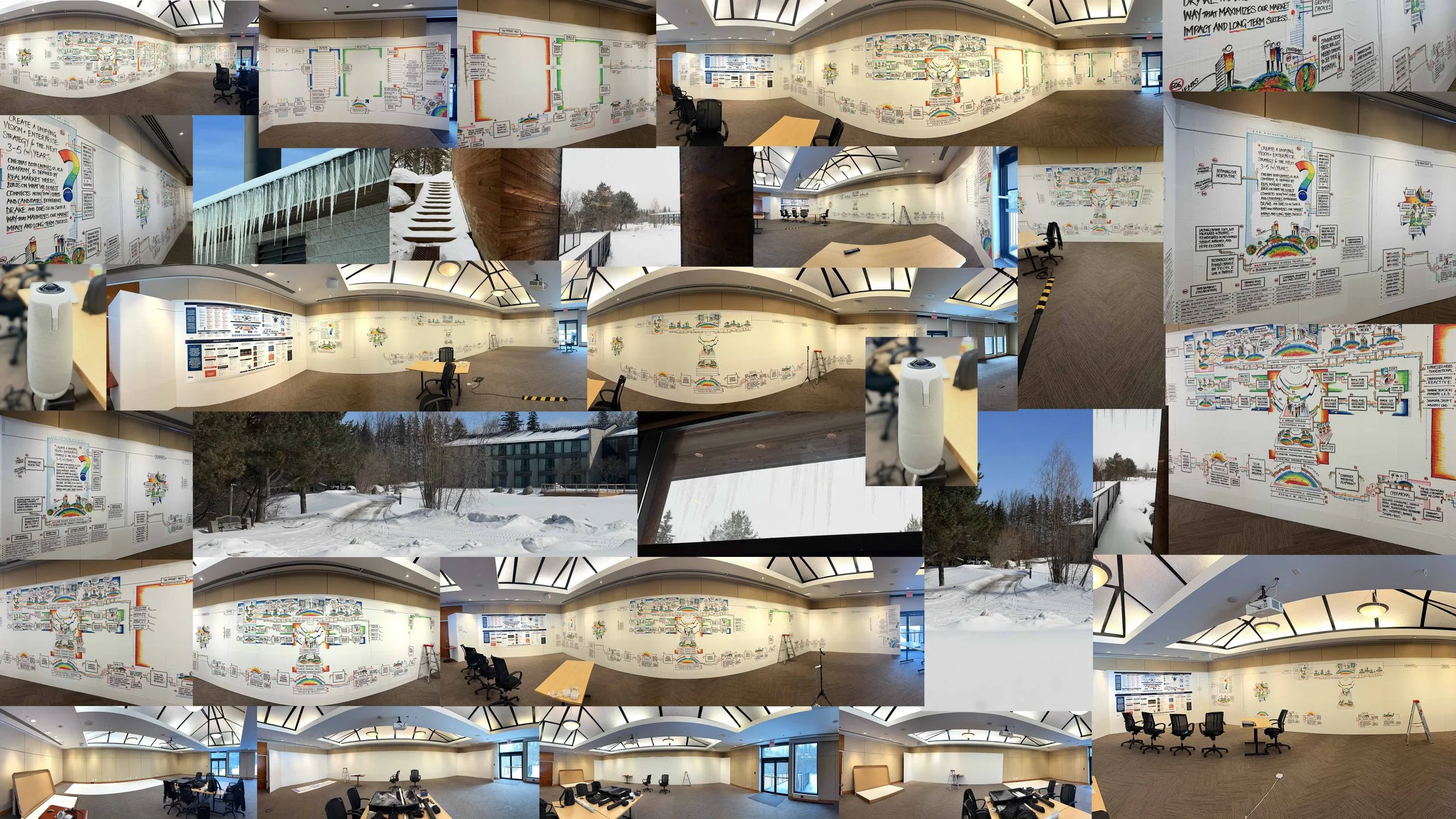
Welcome to the Drake Vision & Strategy Microsite.
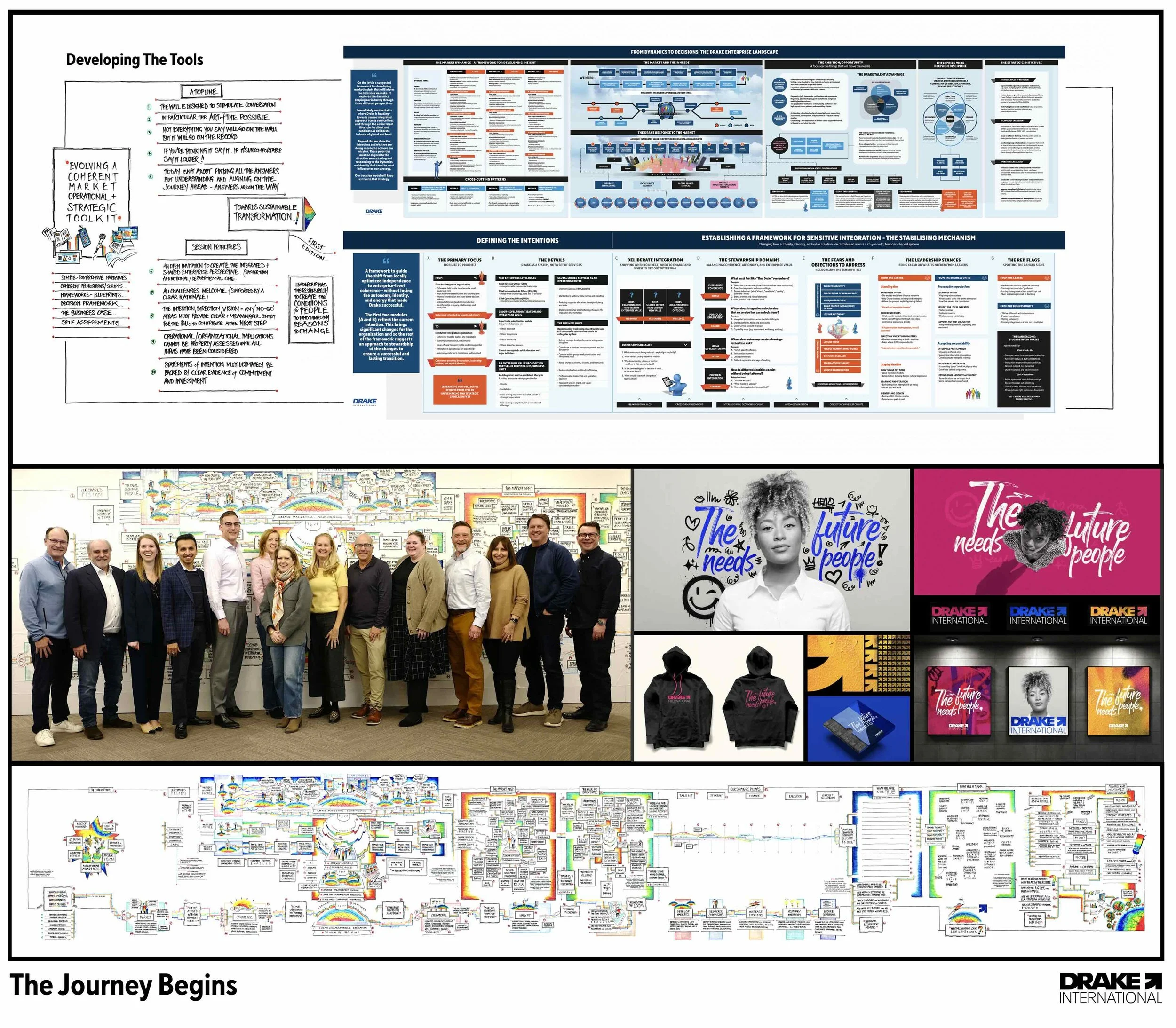
Below, you will find access to the images in both High and Low Resolution, as well as an executive summary-level narrative of the day.
This is one of many ways that the information we now have will be applied as we evolve from this important day. And we will apply it (as the conscience), ensuring we stay true to the aims.
As a result of the day and the preparation with you all, we have a considerable amount of content to arm us for the forthcoming cycles.
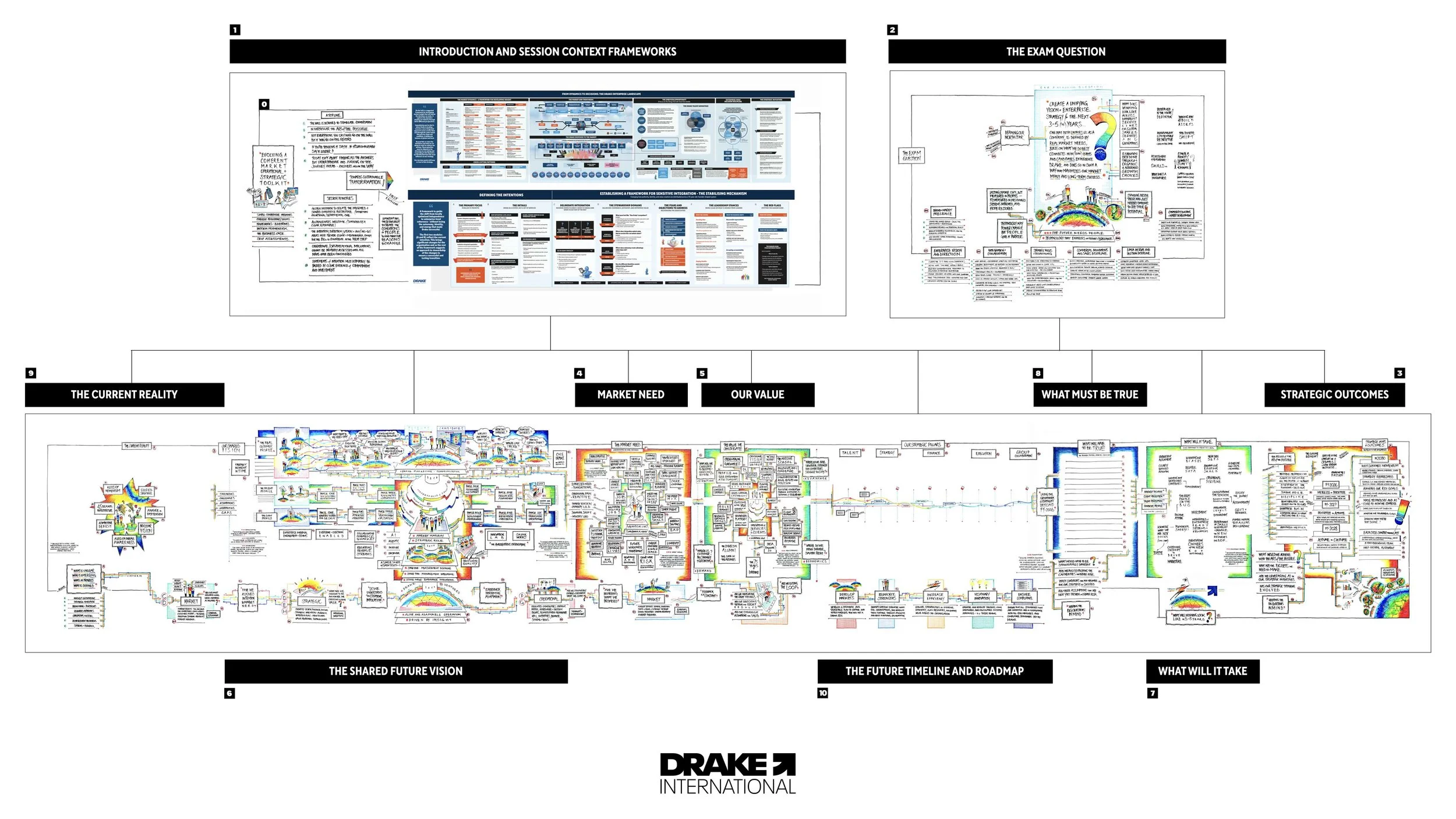
Only a portion of that is shown below.

Constantly checking for integrity
As we lead up to the BU Mini-Sessions and, following that, the next Session in April, this material will inform the more robust strategic framework we are now developing, ready for final adjustments - ahead of the internal ‘launch’ on June 4th.

Opening Statement - Karen Meredith - CEO
This is the start of the next seventy-five years.
The work that brought us here has been months in the making, with contributions from across the organization. But this day marks something else and something new. For the first time in Drake's history, a multidisciplinary leadership group has been assembled in one room to shape the strategic future.
Some of us are brand new. Some have been here for a few short weeks. Some have decades of context. That mix is deliberate. Fresh eyes on a seventy-five-year legacy.
The destination is clear.
We will leave this room with ideas and direction towards how Drake comes together as one global organisation. What will emerge will be shared narratives using common language. Scripts so that messaging lands consistently. Frameworks to collect creative thinking and then to scale it. Decision frameworks grounded in a business case.
Honest assessments of where we are and where every part of the organisation fits in the bigger picture. This is Drake's first-ever strategy kickoff as an integrated enterprise.
"Seventy-five years from now, we want to be saying the same thing we've always said: it starts with people. And we want to have proved it at scale."
The brief is to open our minds. Identify what we do best. Understand what the market needs. Define the jobs to be done and the ideal client profile. The people in this room are the main contributors to shaping the next seventy-five years, carrying the output to their business units and beyond.

The programme has shape.
Today is the first step.
Market intelligence and research will follow to validate or invalidate what we generate here. Mini-sessions in March will group people not by service line but by jobs to be done, deliberately breaking the habit of reinforcing existing silos.
We reconvene in April with a fleshed-out wall to test whether this is the strategy, the north star, the winning ambition. That prepares us for the brand launch on June 4th. But June 4th is not the end. It is the beginning of what comes after.
A complete transformation.

The safe space for blue sky thinking!
The instruction for today is simple.
Do not narrow the aperture.
Think about the art of the possible. Do not worry about missing data. That gets gathered afterwards to prove or disprove. Be present. Be open. Say the uncomfortable thing. If it is material to the case, say it louder.
Blue skies are out there. We have permission.
Karen
The Extended Narrative
The Exam Question:
“Create a unifying vision and enterprise strategy for the next 3-5 years. One that unifies us as a company, is defined by real market needs, builds on what we do best, connects how both clients and candidates experience Drake and does so in such a way that maximises our market impact and long-term success.”
The thinking that emerged around the Exam Question
Client versus candidate - which relationship matters most? The honest answer is that one doesn't exist without the other. It's not a case of choosing. But whether a market is supply-driven or demand-driven determines where we focus and where we monetise - and that shifts across cycles. In a demand-driven market, the challenge is getting the job.
"We exist because every person deserves someone in their corner — and every future depends on it."
In a supply-driven market, the challenge is finding the candidate. We need to map our markets against this lens as a foundation for strategy.
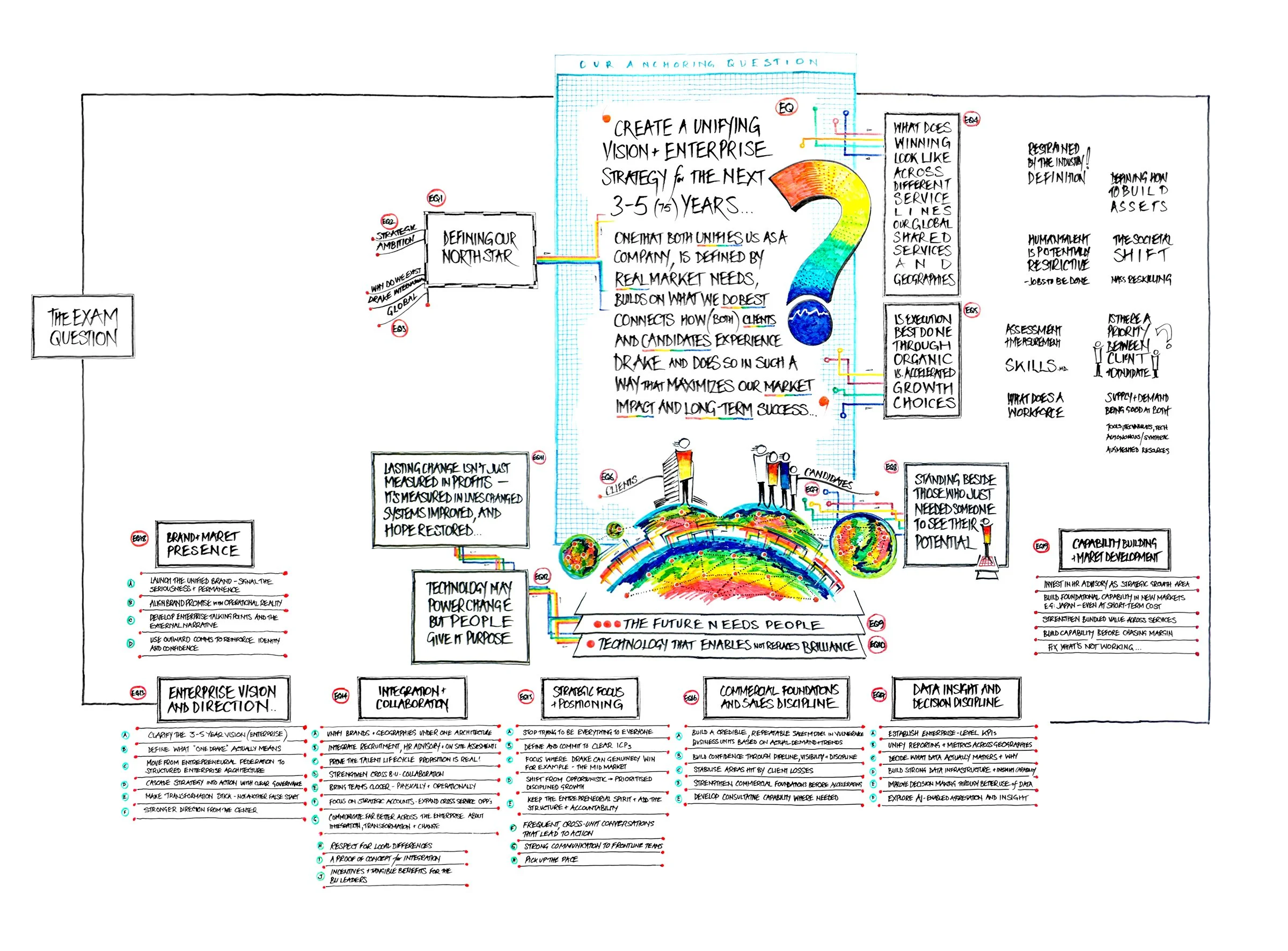
Talent is an asset we are building. Candidates represent outcomes. The jobs to be done for the client require the right talent. Currently, we may be restricted in the jobs-to-be-done arena, limited by what we can do in certain scenarios or opportunity types.
That said, we have existing setups that aren't being fully leveraged because we didn't think strategically enough at the time, entrepreneurial opportunities that held greater value but were never realised.
These are not hypothetical. They are specific, existing capabilities that could be activated now if we approached them with fresh intent. We have to be clear that we need to make choices. The exam question can't make it OK to continue trying to do everything.
AI and technology will be significant dynamics. Leaders are already asking how to become an agentic centre of excellence. There is a whole world to explore around ‘credentials for agents’ - a different form of assessment with a different business model. But skills are evolving, and humans continue to be vital, just with new jobs to be done.
“A job to be done is no longer a person in a seat. It's a mix of human skills, AI skills, agentic skills, and hybrid skills — all of which need to be developed, assessed, and managed.”
Create a new category - We must be careful how we define ourselves so that we remain relevant. This is a time to potentially own a new category. We want to move away from simply moving talent around and towards solving the talent pipeline.
There is a measurement perspective we should consider. Assessments should provide consistency as the jobs to be done evolve, creating a talent pool equipped for the future that responds to what organisations are looking for: get jobs done, and done well. But we can't ignore what the talent we represent is thinking about this and how they are adjusting to the new jobs they're being asked to do.
There is a major societal shift underway as jobs change dramatically, necessitating mass reskilling. This plays strongly to being a force for good. A big opportunity for Drake to have a credible voice.
We need to be clear on whether opportunities are global and can be applied to any geography, or are very specific to certain markets.
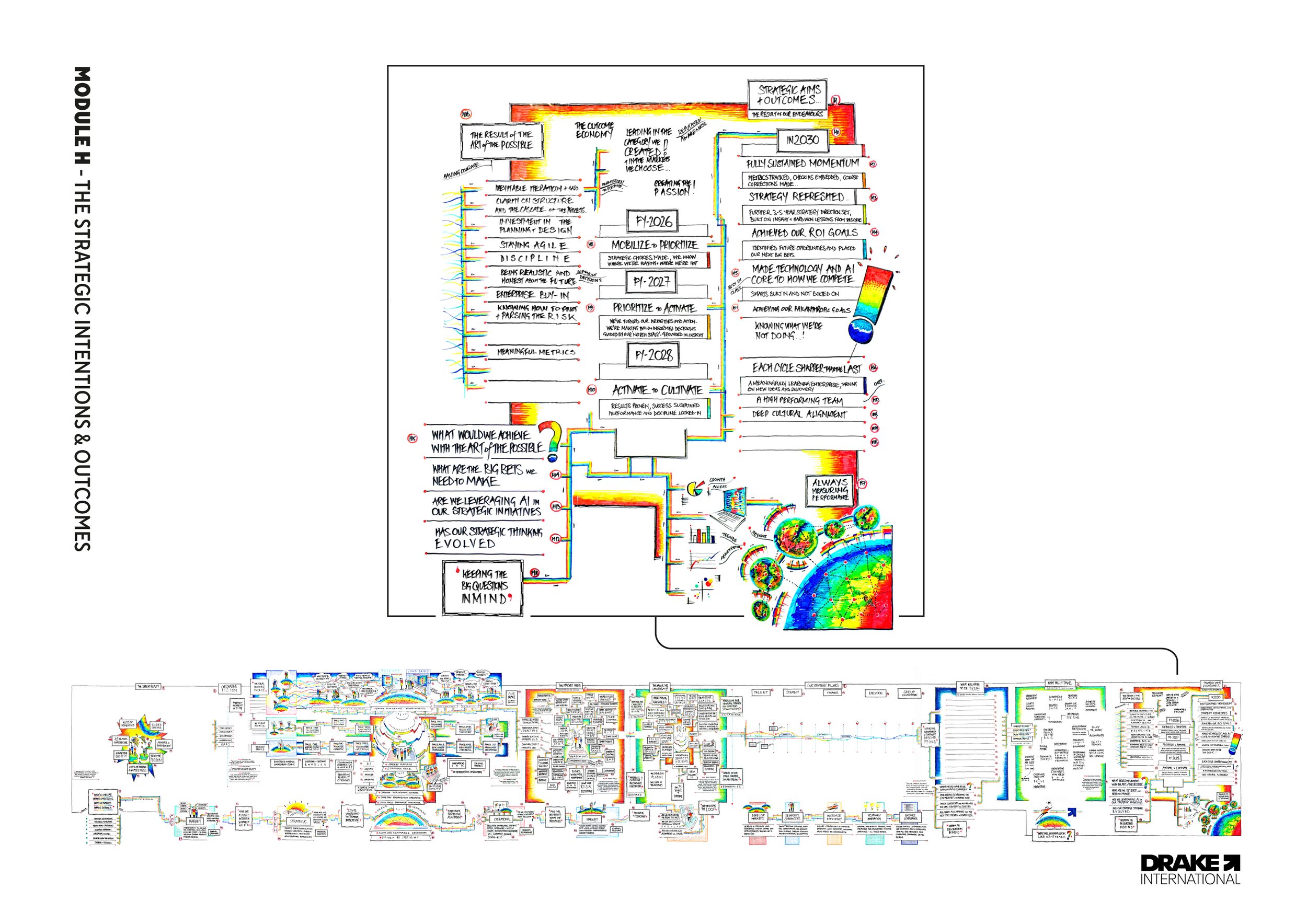
Module H - Strategic Intentions & Outcomes
The 2030 Picture
By 2030, we have established a coherent and aligned organisation to support our ambitions, backed by the right skills matrix and best-in-class technology. This includes the right mix of human talent and AI agents, with an org structure that has been properly reset rather than reactively adjusted. By 2030, we will achieve this, not declare it done.
Our recognition in the marketplace reflects our vision and aspirations. We are clearly positioned in the categories that matter to us.
Multinational rather than global. Using the word "global" risks creating expectations we cannot honour. There is a meaningful difference between where we have a workforce and where we can deliver.
Once we are digital, there are fewer constraints, but that does not make us global.
We will make deliberate choices about where we invest and be explicit about what we will not do and where we will not go. If we say "global" and can't deliver, we damage the brand we've just built. We define the negative space with the same confidence as the positive.
Leading in the categories we have created and in the markets that we choose.
The Stages
Mobilise to Prioritise (FY26): Come up with decisions on where to place our bets.
Prioritise to Activate (FY27): Start acting on those decisions — bold and informed, guided by our North Star, grounded in insight.
Activate to Cultivate (FY28): Establish the way to 2030. Results, improvements and successes are sustained, and discipline is locked in.
Through these stages, there will be a constant process of learning and iteration. This is not just a principle; it has to be designed deliberately. As we move through FY27–28, we will be learning by doing, and some things will take longer or be easier than anticipated.
The discipline is to course-correct without relitigating everything. We need a clear decision framework that defines the criteria for a pivot so we can move confidently rather than revisit from scratch each time. Making deliberate actions and acting on what we have learned, making sure we remain insight-driven.
We need to be clear about what failing fast means, give permission for people to fail, and know when and how to pivot.
High-performing teams are vital across all teams, not just centrally. Everyone contributes to realising the vision and is clear on how they contribute. Real bottom-up participation, not just buy-in. The research on large-scale transformation is clear: a small group can only drive change for so long before they burn out or stall.
We need to shift from buy-in, which means "OK, I'll do it", to genuine contribution and enthusiastic adoption. Deep cultural alignment throughout the organisation will take time; we are probably talking about the 2030 timeframe.
We want passion, inspiration and intentionality. We also need to be honest that there is a significant gap between the mindset in this room and that of much of the organisation. Bridging that gap will be one of the biggest challenges of this transformation.
Mindset is a key condition.
Do we as leaders have the right one? There is a real question about whether we are sufficiently connected to the day-to-day reality of the organisation. Do we know the brutal facts? Do we understand what is actually happening in the business?
That is the starting point. At the same time, in this room today, we have the right mindset to open the aperture, think blue-sky, set the direction, and then do the hard work of merging that aspiration with reality. These are two different tasks, and we should be clear about which one we are doing at any given moment.
What has been proven to work in transformations like this?
External pressure is the single most powerful lever for enterprise change. When the external world demands it, people move. We have an extraordinary case for change in AI, demographic pressure and market disruption.
We should use it deliberately, not as fear, but as a crystallising force. Trust in leaders. Honesty about the thinking and the uncertainties. Communication and repetition.
“The ‘Throw Up’ Principle': People are just beginning to hear it by the time you're ready to stop saying it. The message needs to be consistent, repeated, and - critically - reinforced by visible action from leaders who mean it.”
A burning platform and a case for change. Creating belief in the vision and its viability. Equipping people to get on the bus. This is a real and current gap. Many of our people are using Excel and off-the-shelf language models on their desks, not because they're resistant, but because they haven't been trained or equipped. Getting people on the bus means investing in tools, training and onboarding for the journey, not just communicating the destination.
Aligned measurement and incentives, and being clear about the difference between outcome metrics (which may not move for months or years) and leading indicators (which tell us whether the right behaviours are taking hold now). We need to tell the story of progress through leading indicators while the outcome metrics catch up.
Psychological safety. Making it impossible to ignore - real examples of the change in place. A structured cadence of regular meetings, reporting requirements and planning cycles creates reinforcement that makes the change feel real. People tend to ignore things until they can't ignore them anymore. The cadence makes it impossible to ignore.
Everything from FY26 through FY28 has to be enabled within the business. The right capabilities, viable plans with the right people involved, underpinned by the right measurement, with the right disciplines in place.
The investment in planning and process infrastructure is a genuine enabling outcome in its own right, not an overhead. A global planning cadence, cascaded goal architecture, and regular resource allocation reviews are not bureaucracy — they are the mechanisms by which priorities are set and sustained. The cost of not building this is far greater than the cost of building it.
We will also need to be clear about how much risk we are willing to take and how much change the organisation can absorb.
Module C - The Market Need
We considered market need across a range of types:
Expressed Need - "We need recruiters." Operational Pain - "We cannot fill roles fast enough." Strategic Tension - "We don't know what skills we'll need in 3 years." Structural Shift - AI, regulation, demographic pressure.
Market need must be examined from both the client and talent sides. This is a structural principle, not a secondary consideration. The industry has historically only monetised the client side, and that has created a blind spot.
Reskilling and upskilling are a clear need, even if not yet a specific want. There is a dynamic related to ageing where succession planning is becoming the reality that organizations have tried to avoid for too long.
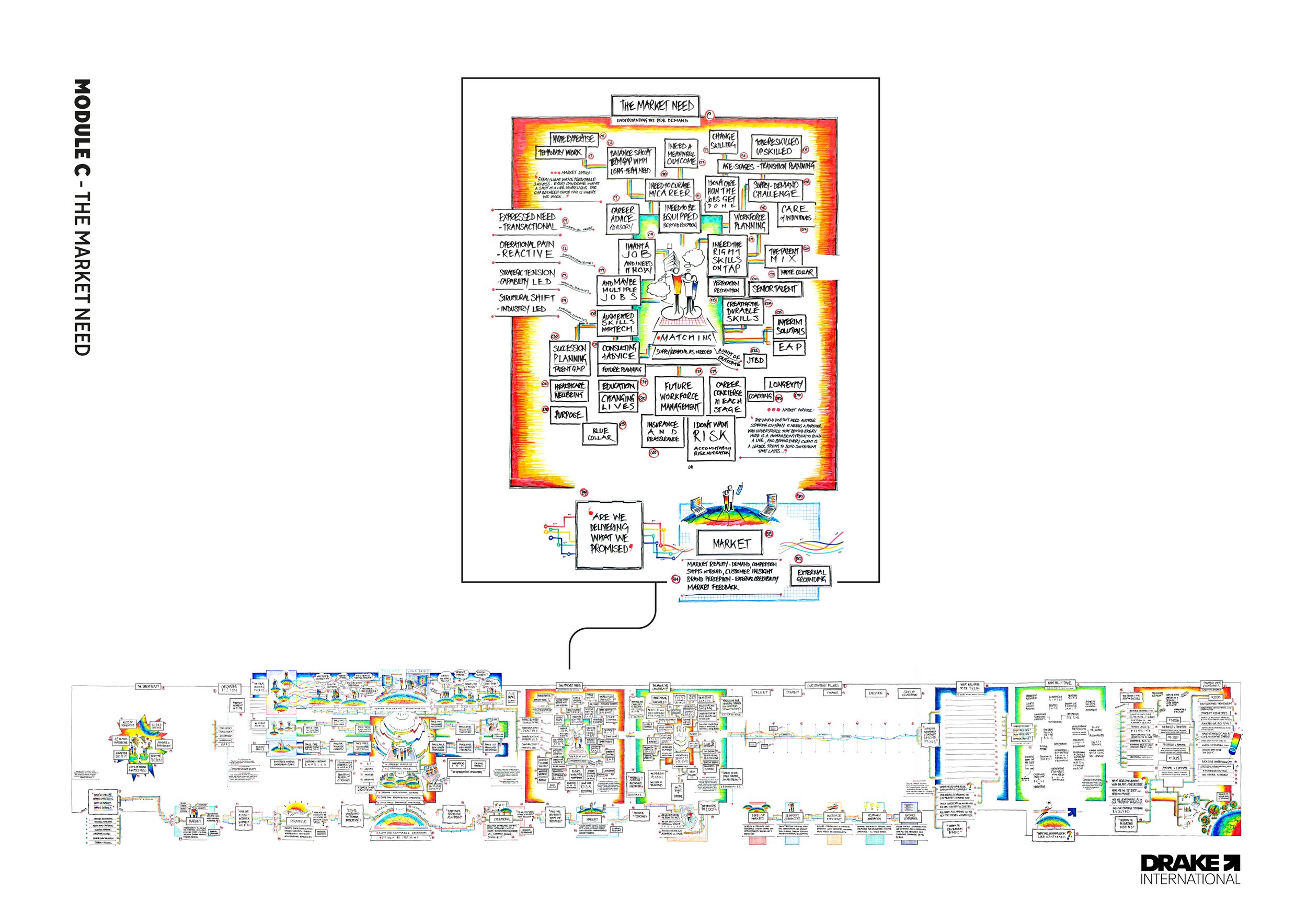
Senior, highly experienced people are about to leave, and the layers in succession aren't ready- potentially exposing 30-year talent gaps. In some organizations the gap is not one level but a structural hole, where a founder or long-tenured leader held on to key people and suddenly those people are gone together. That is not a skills gap; it is a succession catastrophe. We can plan for it.
Big investments in certain industries (healthcare being the clearest example) will generate spikes in demand that we can anticipate. These spikes create supply/demand imbalances that cannot be solved domestically; organizations end up sourcing talent internationally from countries that have been through a similar cycle.
“We need to see the dynamics across geographies and spot the patterns before the spike arrives, not after.”
There are precedents for companies that track every stage of people's lives and have solutions for every transition. Recruit in Japan is the clearest example. They own ‘Indeed’, hold approximately 40% of the human solutions market in Japan, and describe themselves as a data company, not an HR company.
Their entry point is temporary work for high school students. They are the number one provider for new graduate recruitment. They have businesses for weddings, honeymoons and every life transition through to executive search. That is the cradle-to-grave model in practice, and it is built on data.
There is a segment of organisations in a rationalising state, having chased the shiny object and now needing to embed what came out of that. These pursued AI and technology without fully understanding the value capture. They are very different from value-driven clients, making deliberate investments. We need to identify which camp a client is in and service both differently.
Traditional change management no longer works (if it ever did). The specific challenge with AI is that change is now continuous — not a single change curve but many simultaneously, some evolving while still in progress. The opportunity for Drake is to be the voice of stability in the client's internal change — people who understand how to navigate continuous change, not just a single transformation programme.
How Do We Define The Markets
Tiers:
Mom and Pop, SME (250 and under)
Mid Market (250–5,000), Enterprise (over 5,000)
Government is a separate market with sub-segments including education, health and not-for-profit.
Definitions may vary across governments, corporates and associations, and thresholds differ by geography and industry.
Industries:
The lower the margin and the more commoditised the business, the less valuable it is for us. We also need a view on competitive intensity; high margins in a market mean nothing if barriers to entry are too high and we are a new entrant. We need to define where we have a genuine right to win, not just where the returns look attractive.
Some functions are industry-agnostic, so we also need to consider whether functional specialism is more attractive. Finance and accounting have been a durable and consistent market, not because someone decided it was the best market, but because certain organisations developed depth of expertise and built confidence in it.
“We can and should identify our equivalent areas of subject matter depth, the jobs to be done where we genuinely know more than anyone else.”
There is a lot of work underway to define the markets and analyse the opportunities. Really understanding the markets and how they work is critical to success. Can we start with our sweet spot? Is it more helpful to align on jobs to be done where we have subject-matter expertise?
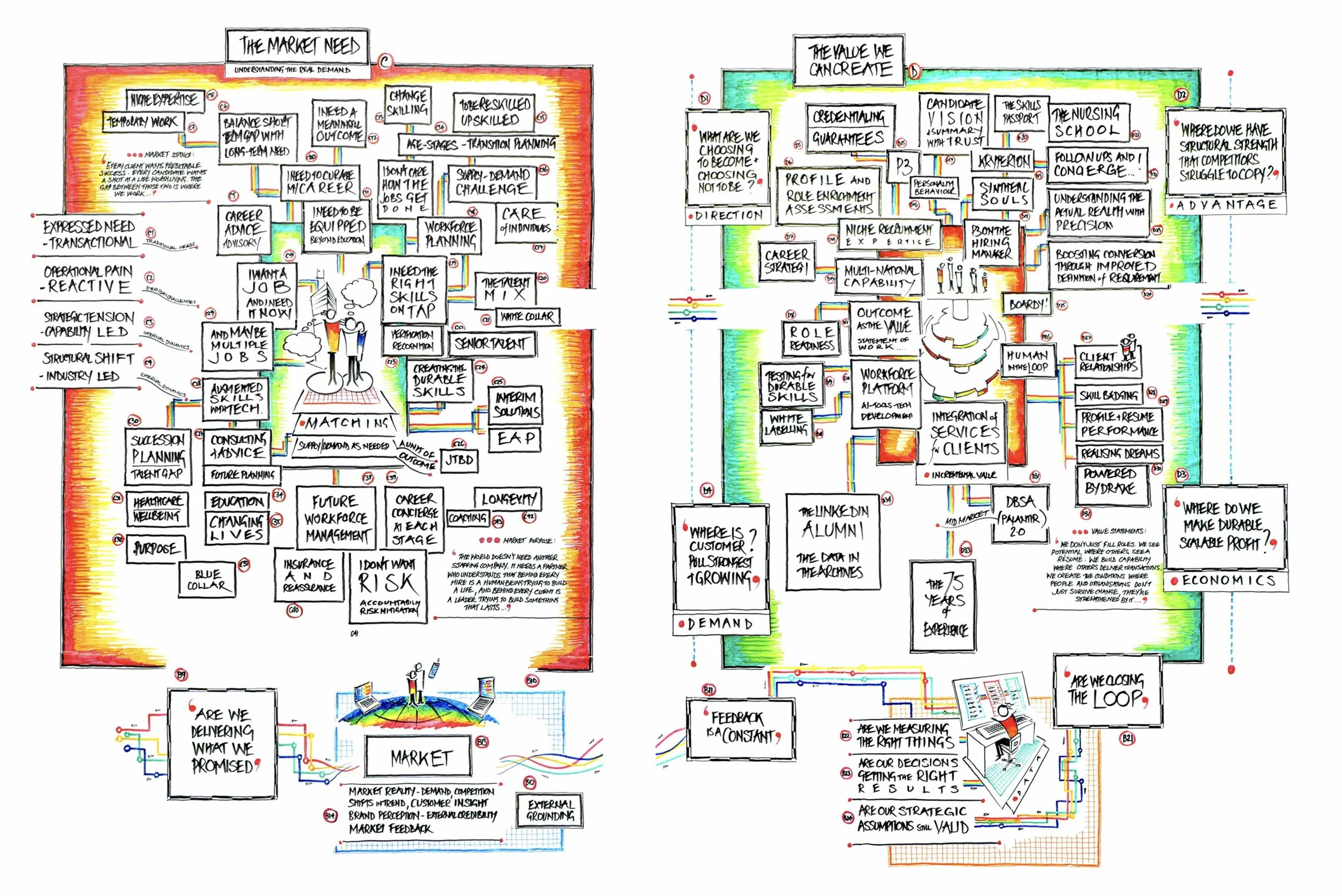
There is also a market need on the talent side. We need to look at the need from both perspectives. A lifetime relationship with candidates has been considered but never made to work, partly because companies couldn't sacrifice short-term placement revenue to build it, partly because the patience was never there.
But we have two things they didn't: AI that makes systematic curation possible at scale, and a 75-year horizon. This is still an opportunity. We have to be clear where we have a right to win.
We are committed to helping talent find jobs despite monetisation challenges. HR advisory is an opportunity on the client side, not widely available, and it would get us further inside the client organisation. Both Deloitte and PwC have launched their own recruitment businesses in Japan, specifically in the interim and contractor supply.
This creates friction within their own organisations because it sits awkwardly alongside their core consulting model, but it signals clearly that advisory firms see an opportunity in our traditional space and are moving into it. The competitive window is not permanent.
As the work environment evolves, it is increasingly moving towards delivering outcomes rather than simply supplying skills. Skills are less of an issue for clients; they are expectations that come with the outcomes needed.
Companies don't actually know what they need for the future. They need guidance, not simply the skills, but the structures. People need to understand the actual jobs to be done.
There is a tension among leadership, HR, and the business, each trying to understand what is needed or what they are being asked to provide. Everyone needs to think differently about their needs.
We can be the ones to guide them, backed by opinion pieces that raise our profile and establish our credibility as advisors, not just suppliers. We are not strong on advisory right now, but we can be.
The need described:
Client: Find the right fit now, when needed, adjusted or gone when not needed. Meet a need with minimum risk. Think Uber.
Talent: I want a job now, with different motivations (earn money, develop skills) — and to build experience. The job-for-life model is no longer a good fit. There is room for a more liberal, experimental approach to career development.
Think of it as the charm bracelet model — a liberal arts approach to career building where people try short stints across different sectors and functions to discover what they're good at and what they love. Three weeks here, three months there.
A diverse portfolio of experience that builds a genuine playbook. Parents are already trying to curate this for their children through personal networks, but there is no systematic, scalable version of this anywhere in the world.
“A technology platform offering subscription-based career guidance and concierge support — for parents, students and early-career individuals, at say $30 a month is a viable, recurring model. And it could equally become a corporate benefit.”
We are a talent matching platform. We can see where there is demand and availability and facilitate the movement of talent to where it's needed.
Identifying durable skills may be high on our list. There is a range of skills (like needs) that may be ranked by importance.
At some point, we go from matching people to jobs to matching a combination of people and technology to meet needs. We have to be able to take the client on a journey — one they can navigate at their own pace. The readiness of the client matters. We cannot push faster than they can absorb.
“If we look at the end stage of work and the needs of older generations, there is ongoing support required through that transition, too.”
What we are talking about is defining the future of the workforce.
Future Workforce Management(FWM) (For example) becomes a potential category. Acting as a proactive career concierge, not old-fashioned career coaching but systematised, connected guidance from cradle to grave.
Do you have the right person, and are they following a path that is also good for them? Are we making good matches? This is a mutual benefit test; the match has to work for both sides. All based on a clear understanding of the outcomes required and what it will take to achieve them.
There is also work to be done advising businesses in certain industries on how to make themselves more attractive.
Social impact can still be very superficial in many companies, not life-changing. But education is a huge enabler of change, and this is an opportunity for us to help people's lives. Clients may not buy this initially, but it could be a part of what we are doing.
The structural shift is likely to be where the biggest challenges will lie for clients most affected by a changing world.
Risk is something we need to respond to — we already play a role in removing some risk for the client. If we take the Airbnb analogy, we want to create clients who are super hosts and candidates who are super guests. We can be the company that supplies the best candidates because they come with a rating.
This model exists at the blue-collar level. It hasn't been replicated for the higher-quality job market. Doing this digitally for blue collar is table stakes — the tech already exists. That is not real innovation. The white-collar equivalent would be a game-changer.
Module D - The Value We Can Create
Matching problems and outcomes to guarantees.
Being willing to make the guarantee before we have perfect confidence, because the guarantee itself accelerates learning. At 60–70% confidence, offering a guarantee and absorbing some early risk will close the gap to 90% faster than waiting.
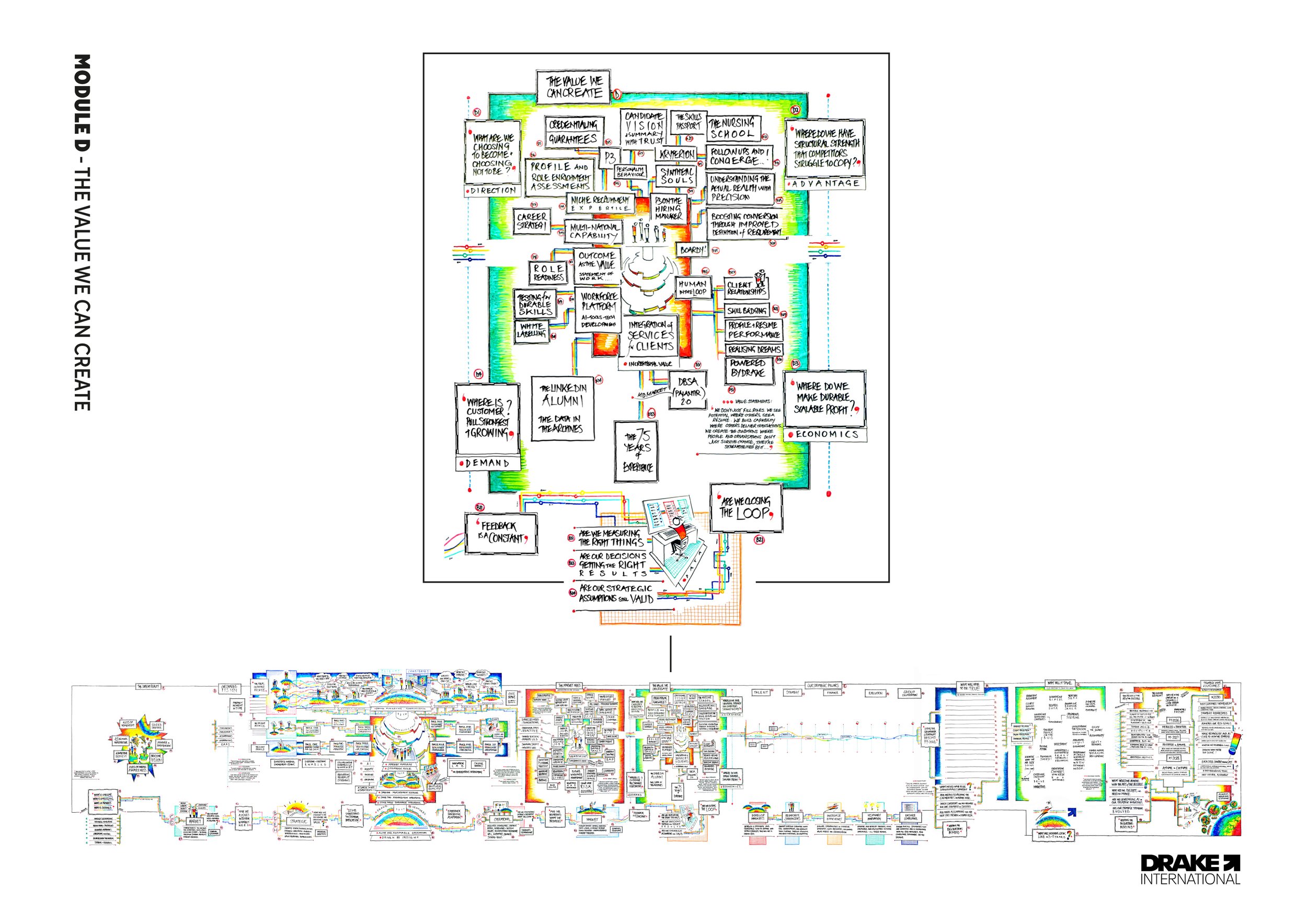
We don't always need to be covert about this; in some cases, we can be transparent with clients that we are building this capability in real conditions. The ‘Drake Concierge’ follows up to ensure things are going well, a part of the service placement that helps ensure the placement was a good one.
"We increase the capability of people and organisations to achieve outcomes that matter. That's the simple version. The complex version is that every connection we make creates a ripple — through families, communities and economies."
Connecting on the moments of truth that matter to a candidate or client. A rich profile-based assessment to determine full fit, not just tangible skills. Greater integration of our services in an industry that has been historically fragmented.
The marketplace platform. Elevating the definition of skills (durable skills) and CVs, enhanced by AI, without losing the authenticity of what is being said. Not AI on AI.
Our Advantages:
The depth of expertise and volume we can leverage from Kryterion.
P3, our behavioural assessment tool, is based on science.
Measuring people's qualities and giving them a profile. With corporate-facing elements that allow clients to define what they need, then run a match to identify hits and development requirements.
We could extend this to creating a synthetic digital twin. The value of P3 is not as a standalone product; it is P3 combined with other solutions to make a holistic proposition.
Opportunities for advanced metadata. The integration of Kryterion with the rest of our capabilities is where the competitive advantage lives.
The Opportunity
A true global ecosystem, which doesn't exist right now. The ability to match across countries, backed by a transferable skills passport that recognises the different dynamics between regions (like credentialling). The equivalent of the digital wallet.
Unlike platforms like LinkedIn, we potentially have rich metadata around placements that gives us IP. We should also consider our dependence on LinkedIn, a platform that, by some estimates, accounts for the majority of our placements. That is a strategic vulnerability.
“Whether or not we build a competitive alternative, reducing that dependency has to be a deliberate decision.”
How can we leverage our 75-year legacy to codify what we have learned? Or have we lost the enterprise memory? Either way, we need to organise ourselves to build this IP. We haven't lost everything. And the ability to harvest insight from unstructured data now makes this easier. A critical underpinning for the career concierge.
Insight-driven matchmaking. Bringing supply and demand together in the right context, and knowing which clients and industries have which specific needs. Durable matches are made possible by a blend of human and digital skills that know which questions to ask and which nuances to factor in. Matches based on having profiles on both the client and candidate sides.
The ultimate value we can create is outcomes for our clients. We can own that outcome and charge for delivering it. The business case is based on the value we can create for a function, the job to be done.
A concrete example: a university Career Centre running 16 staff to manage hundreds of co-op placements could be delivered by three people and AI, with Drake committing to the outcome and charging for it. The proposition elevates to a higher skill level. Synthetic data (structured and unstructured) would allow us to project likely value through predictive models in the absence of real data.
We already have outsource functions (DBSA) that automate and can explore the next generation that takes them to a new level, creating a ‘Palantir 2.0’ that leverages the DBSA concept, focused on outcomes. DBSA's current functions, automation, offshore services, and administrative outsourcing are at high risk of disintermediation.
But DBSA has exceptional clients, which makes it a real springboard. The next generation of this capability, uplevelled with AI and focused on higher-skill outcomes, is the equivalent of a mid-market Palantir, helping companies automate the front end of their funnels, build AI-enabled business development functions, and leave technology behind. Every company in the world is looking for this, and almost none have the in-house skills to do it.
“Several of these opportunities enable us to generate recurring revenue streams - a model we are committed to. This extends beyond subscription to licensing - the ability to create models, frameworks and tools (including Kryterion-based assessment approaches) that can be licensed to others and replicated through a franchise-type mechanism.”
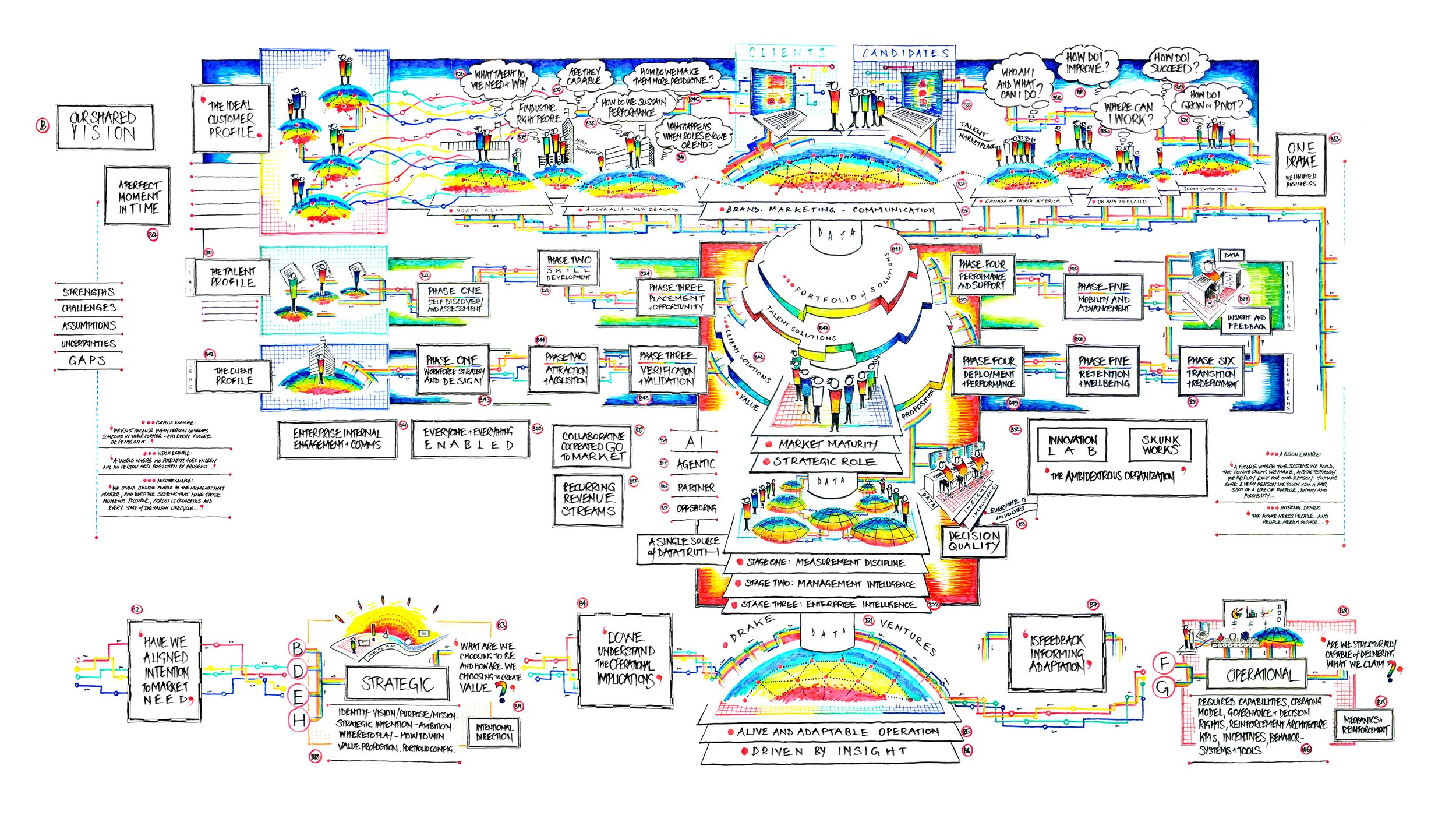
Module B - Our Shared Vision
An aspirational story that describes our North Star
We see a world where:
We are one Drake providing services across the value chain. We are operating as a talent marketplace. We are disrupting the market and driving its direction. We are one business with a portfolio of solutions across geographies, solving the needs of each region. We are committing to the markets where we can create the most value.
"We connect people, technology and insight to possibility — across every stage of the talent lifecycle, in 15 countries, through care, innovation and human brilliance."
AI and offshore are constant considerations when we make choices. For every action, we pause and ask: can this be done offshore, or automated with AI? This is not an afterthought - it is the lens through which all decisions are made.
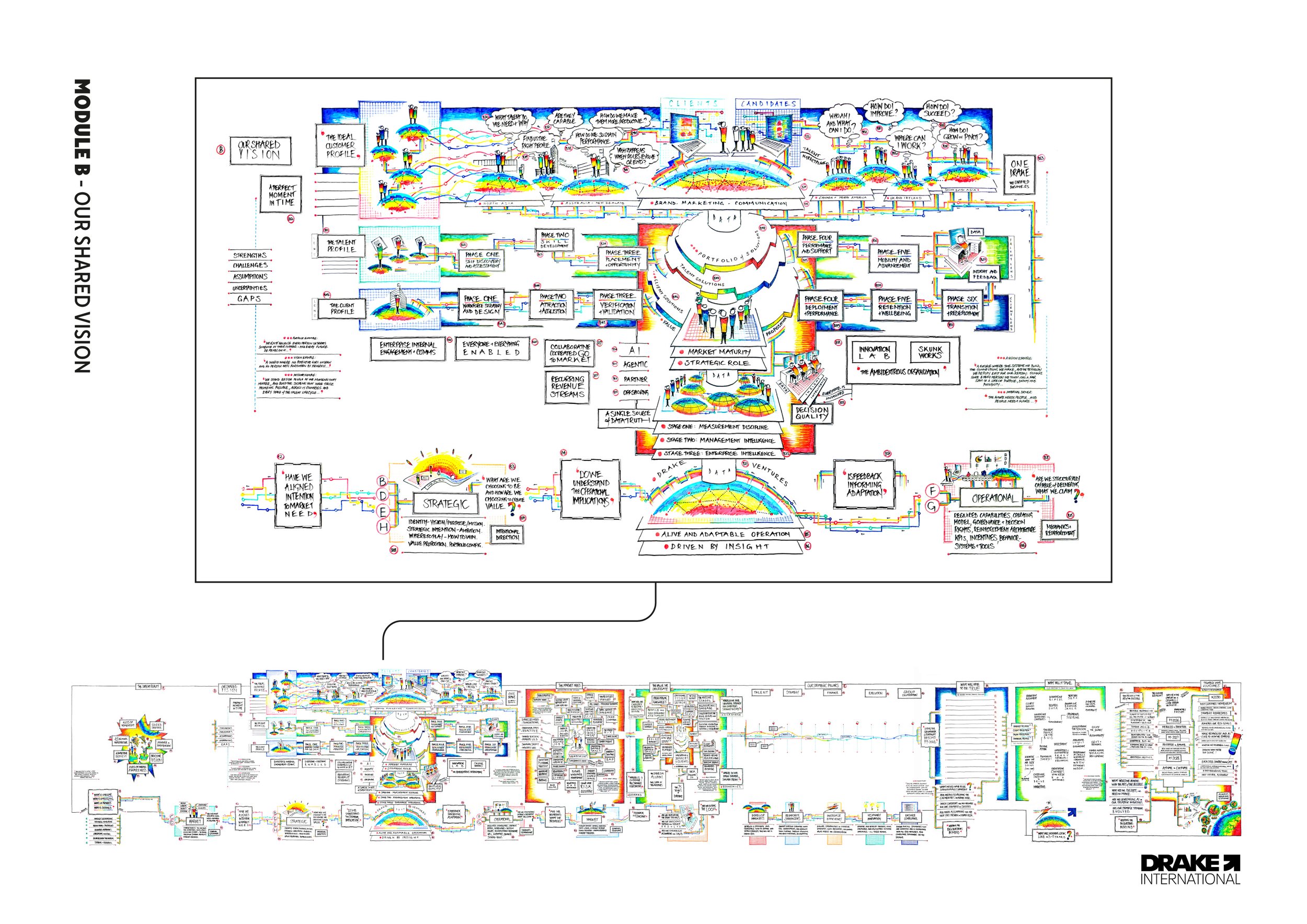
We are always looking for ways to elevate outcomes and our own efficiency as we navigate and adopt new technologies - showing we practise what we preach.
We are co-creating with partners who are equally invested in this vision - moving from transactional to strategic relationships. This means identifying our most innovation-ready clients, going to them at the highest level, and proposing to genuinely co-create and co-invest in new solutions. Not a briefing and a deck - a partnership with skin in the game on both sides.
We are a critical friend and partner to both client and talent. We have one source of truth in our data. We are making the most of a stable recurring revenue model with good margins.
We will build the business of tomorrow outside of the business of today, protecting what happens today while building the future - elegantly and swiftly, without upsetting today's business or creating unwanted confusion.
The people working in the current business need to understand that what they are doing today ladders up to the future strategy. It is not a dead end - it is foundational. Our language has to reflect this. "Their business" becomes "our business." Silo-based loyalty gives way to Drake-wide identity.
"A world where no potential goes unseen, and no person gets left behind by progress."
This is a profound transformation coming at a perfect time for an industry we have served for 75 years. It deserves the right messaging.
Our innovation lab is already a reality, and this will increase the positive energy already there. But we should be thoughtful about the risk of an Innovation Lab becoming a place where innovation is contained rather than proliferated.
The aspiration is an ambidextrous organisation where innovation capability is spread throughout - a Centre of Excellence that enables and proliferates, not one that inadvertently becomes the place where everyone else assumes innovation happens instead of them.
"We stand beside people at the moments that matter, the first job, the career change, the credential earned, the second chance, and we build the systems, technology and partnerships that make those moments possible at scale."
We are talking about a spectrum - from improvements to existing businesses all the way through to net new businesses disrupting the industry. Whatever choice we make at each point on this spectrum is aligned with our vision.
"A future powered by human brilliance, where technology doesn't replace people but changes what they're capable of."
The Drake Data Maturity Model
From Measurement → Management → Intelligence
Stage 1 — Measurement Discipline: "We track performance." KPIs defined (often inconsistently across countries), dashboards emerging, financial reporting cadence strengthened, manual tracking still common, multiple versions of the truth. The focus is on operational visibility and accountability.
The questions being asked: What are our numbers? Did we hit the target? Who is underperforming? Where are we losing margin?
Stage 2 — Management Intelligence: "We use data to allocate resources and shape decisions." This is where most companies stall. Enterprise-wide KPI definitions, comparable productivity metrics across geographies, clear portfolio segmentation, investment decisions linked to performance evidence, and consistent performance triggers. Focus is decision discipline and capital allocation.
The questions: Which service lines genuinely create economic advantage? Where do we double down versus reposition? Which ICPs generate repeat value? What signals justify investment or exit?
Stage 3 — Enterprise Intelligence: "Data shapes our hypotheses, not just our reporting." This is where a portfolio like Drake becomes differentiated. Shared data architecture across service lines, cross-sell visibility, client lifetime value measured across services, predictive models (AI-assisted where relevant), evidence-based experimentation and scenario modelling before investment. Focus is a strategic advantage and a key to learning speed.
The questions: What does the talent lifecycle look like across our portfolio? Which services reinforce each other? Where are we structurally disintermediated? What early signals predict client churn? What capability gaps will matter in 3 years?
Module F and G - What Will Have To be True/What will It Take
Leadership team alignment is a minimum, taking a consistent message out with visible commitment.
Ongoing alignment that shows up regularly. Leadership has to hold each other to account with real consequences for speaking with different voices. The test is not what is said here — it is what happens in the branches and on client calls next month.
Clarity on what we mean by "One Drake" will be critical.
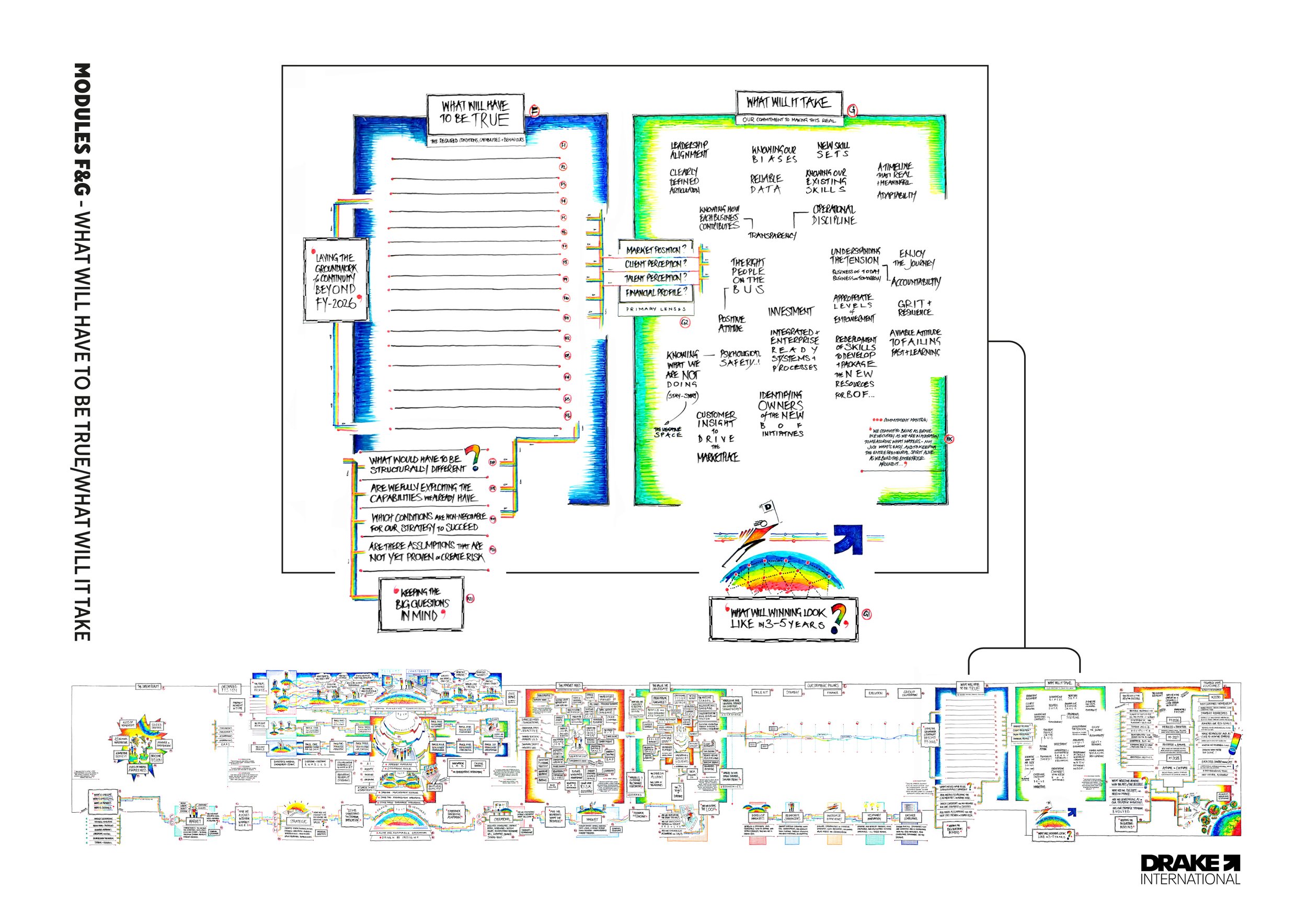
The right people are on the bus with the necessary skill sets. Filling gaps in core skills that exist today. We don't want to simply bring in new talent; there will be diamonds within the business. But we have to be honest: not everyone will make the journey, and the energy cost of carrying people who are not aligned is too high. Identifying early who is genuinely on the bus, who needs help getting there, and who needs to exit — and acting on that quickly- is part of the leadership discipline.
A timeline that we all understand and keep assessing to make sure it's realistic. Clarity on what we will stop doing or continue doing, but stop investing in.
Understanding what each business contributes and identifying the negative space.
Flexibility. There will need to be iteration and a bold learn-and-respond approach with suitable (earned) empowerment in the right people, which may not start with a great deal of empowerment.
We need a fail-fast mentality and a culture of psychological safety that encourages innovation where appropriate, balanced by accountability so that failure is not even a concern. We need the right incentives and models that enable the behaviours we are talking about.
We need to appreciate that we may be asking some of our people to sell solutions that could ultimately replace their current jobs. That is a profound ask. It requires extraordinary psychological safety to do it well. This point deserves to be said plainly and repeated — it is one of the hardest human challenges in this transformation, and it cannot be glossed over.
Transparency. People can see each other's business and how well each is performing at the appropriate level of data sharing. The degree of transparency needs to be established.
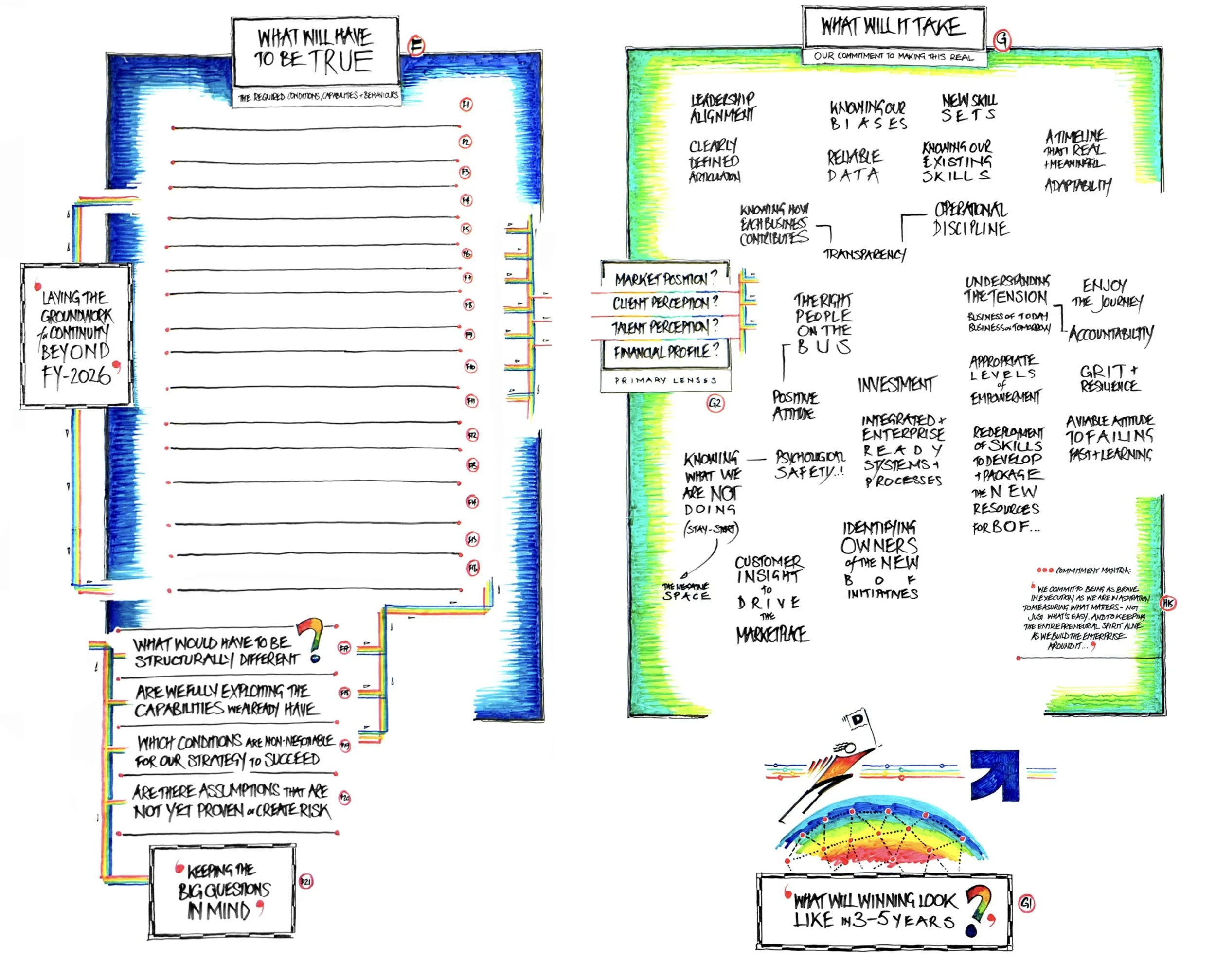
The enabling ways of working that support One Drake -shared planning, visible KPIs across teams, leaders sitting in each other's operating reviews- are not operational hygiene. They are an early and tangible demonstration of the vision.
The gold standard is a BU leader proactively recommending that the investment be directed to another part of the business because that is where the ROI is better. That is an ownership mindset. That is what One Drake looks like in practice.
Grit and resilience. A positive attitude and the feeling that we are enjoying the journey. Things will get worse before they get better during the transformation.
We need courage to carry on through the difficult period, belief in the mission to sustain us, and the ability to show progress through leading indicators while outcome metrics catch up.
Reliable data and operational discipline to keep gathering it. That discipline extends to other activities - focus on goals, validating that we are doing the right things and getting the right results. We may have to stop doing things we do today to stay on course. This, in turn, will require reliable systems to support us. The data that we need - with appropriate governance.
Embedding more innovative practices to facilitate fresh thinking - however, we can make that work with the people we most need to encourage to think differently and try new things. Some things may come through the Innovation Lab, others might suggest forming Centres of Excellence.
First, we need conversations with the right people, and then we need to understand why they do things the way they do - even when it's not what we want, but they think it is. Exposing a smaller group (sales teams, for example) to different types of conversations will hopefully light a spark that spreads.
We need to find the right ways to tell this story to clients and candidates. They have to be meaningful to each.
We have to learn how to partner. There is a definite appetite, but this is not an industry that is strong on partnerships - it will take time. There is a strong desire to do the right thing for the client.
We have to do justice to our new brand work. Anyone in a role facing the market has to represent that brand and do nothing to detract from it.
We need the right capabilities to support launch and then carry this forward. We know we don't have them now, so this will not be in place for June 4th. And we only get one chance.
We have to be operationally ready when the brand lands, because an undelivered promise is more damaging than no promise at all. The lesson from other organisations that have attempted brand-led transformation is that the language changes quickly, but the processes and culture take far longer. We cannot let that gap open up.
Demonstration of intent - putting some new practices into play so they can be experienced and acted on.
Connect the dots back to Bill's vision. In many ways, he was ahead of his time. We need to show where and how we are honouring that thinking - back to the future with recognition of the changes in the industry and markets since. Carrying his legacy forward will help those who have been long-term Drake to feel inspired.
The tech platform that will be fundamental to the marketplace — the version that allows us to go beyond what exists in the market today. So much of what we've defined in our vision rests on having this designed and being implemented. We need to work out what we really mean by "marketplace."
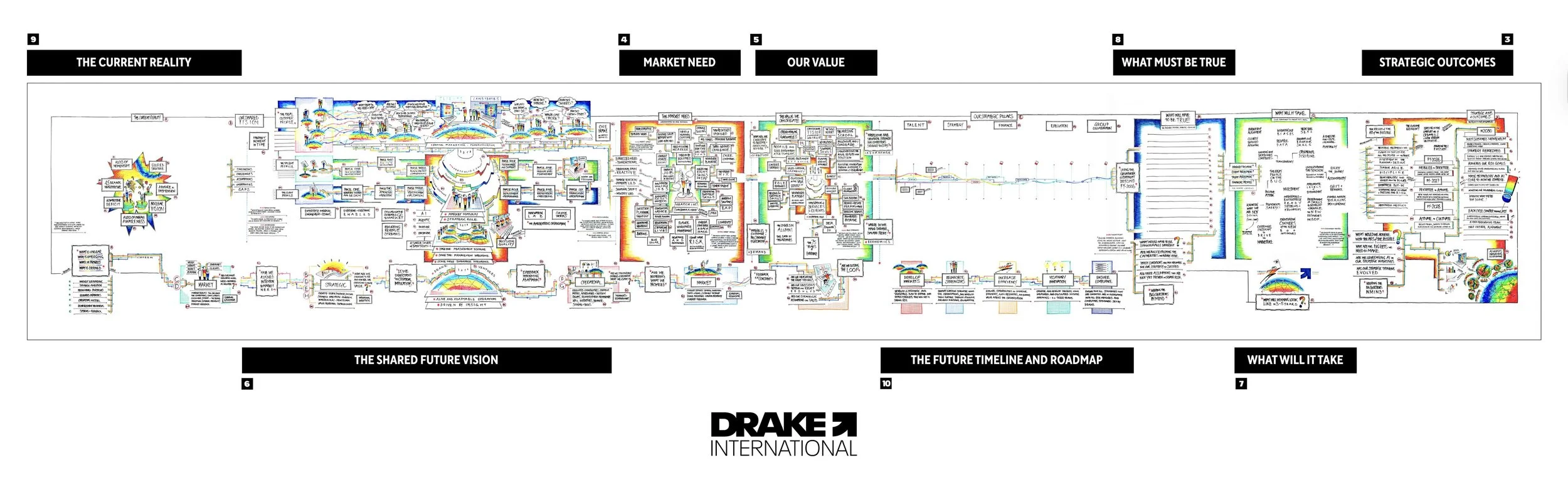
In Closing
This is our 75th anniversary year, and that is not just a milestone; it is a gift.
We are at a moment where the market does not yet have what we are building. AI arrived when it did, and we are here to use it as our accelerant.
The legacy of 75 years gives us a narrative that is both authentic and forward-facing: we are not reinventing Drake, we are fulfilling it.
Connecting the future back to what the company has always stood for - and showing how far we have already come from where we were - is a powerful and honest story.
It is a rallying cry for those who have been here longest and an exciting signal to everyone who joined more recently.
We should use it with intention.