


Part I
An agency under
heavy criticism.
The Rural Payments Agency pays England’s farmers more than £2 billion a year. Payment delays and weak controls had brought it years of criticism, and £680 million in unforeseen costs and fines.
Established in 2001, the Rural Payments Agency encourages a thriving farming and food sector and helps ensure strong rural economies. An executive agency of the Department for Environment, Food and Rural Affairs (Defra), it is the accredited paying agency for all Common Agricultural Policy schemes in England, paying farmers and traders over £2 billion each year.The Common Agricultural Policy is the European Union’s largest common policy: 40% of its €1,034 billion budget for 2007 to 2013. It also runs cattle tracing across the whole of Great Britain.
To meet EU requirements, it manages more than 40 schemes. That means holding information on more than two million land parcels and 120,000 customers, recording thirteen million cattle movements every year and carrying out over 23,000 inspections.All figures in this story are as RPA and Group Partners published them in May 2013.
From its inception, RPA faced years of social and political criticism for delays in paying UK farmers under one of its schemes. Critics in the media, in government and in farming organisations called on the agency to close considerable gaps in its controls and financial processes, and to rebuild or significantly strengthen its IT.
Sustained criticism of its leadership led the agency to be seen as a risk to Defra. Multiple reviews of its operations and third party audits followed.
£680m
paid by RPA in unforeseen operating costs and European Union fines.
RPA recognised that it needed change across the whole agency, in its systems and in its processes, to improve performance and restore its reputation.
Part II
Every part linked
to every other.
The new chief executive found an agency working in silos. With Group Partners, its leaders drew one framework of the whole organisation and agreed what had to change.
When Chief Executive Mark Grimshaw arrived, the agency was short of senior leaders and lacked both an organisational structure and a way to process change well. Its departments sat far apart, and the distance encouraged an unhelpful intellectual separation. With each department run as an independent business, there was no way to reach the operational excellence Grimshaw wanted.
The problems of RPA couldn’t be isolated to one area of the organisation. It wasn’t just an IT infrastructure problem or departmental people issue, it was Agency wide. I knew I had to address the entire organisational structure.
To create the right structure for excellence, the new chief executive approached Group Partners. Using Structured Visual Thinking, a process Grimshaw had used in earlier government work, RPA’s senior management and Group Partners built a framework and a roadmap for change. Working together over time, they shaped a vision and the way the agency would work, and made sure the transformation they were designing could be achieved and sustained.
Grimshaw believed the frameworks could show the foundation of future success and give a complete picture of where the agency stood. That mattered for the RPA Arc, an organisational structure in which every part, from departments and roles to end goals, is tightly linked to the others. No area would succeed by itself. Every area had to succeed, building on how each depended on the rest.
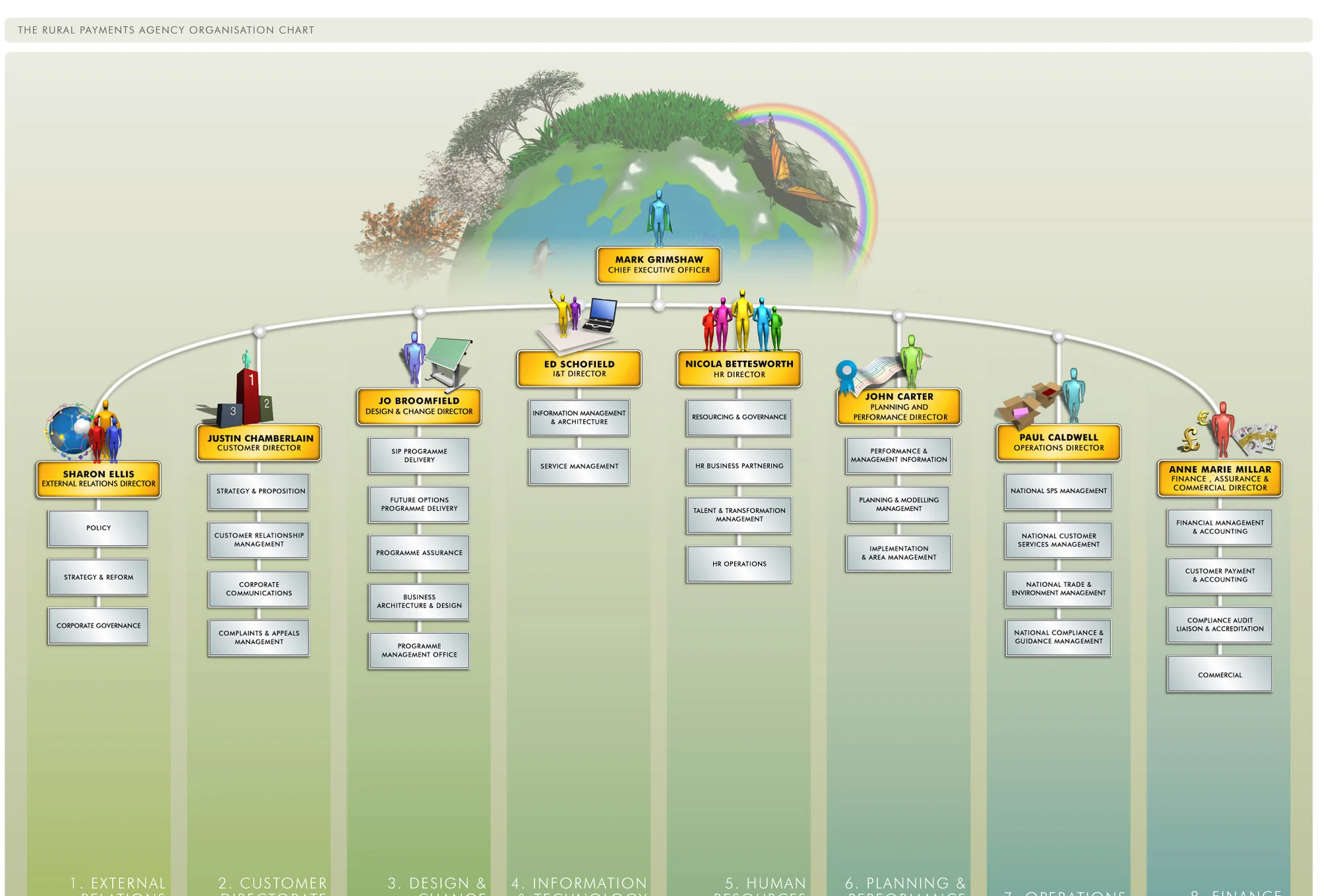
In order to understand the full scope of the problem and take into account its context, I felt that Group Partners’ Structured Visual Thinking approach was the only way to showcase the entire picture and get to our desired outcome in a frictionless way.
The work began with one keystone question, asked together by RPA and Group Partners.Group Partners now calls this the exam question: the one question the whole piece of work has to answer.
What is the strategic framework for positioning RPA for operational excellence, increased performance and achieving its goals in the next 3, 5 and 10 years?
Over three days, the agency’s leadership team shared their insights and their view of its future. Everything about how the agency worked, its mechanisms and processes, its dynamics, its causes and their effects, was debated and drawn into the map. The current reality was put into context, and from it a blueprint for change emerged.
The plan we were putting together called into order the required architecture to tackle the challenge. In working as a group, our collective thinking and strategising was helping us solve these problems. I knew what we were creating in the session would quickly have a large impact on what we were working to achieve.
By the end of this stage the team was aligned around shared goals and understood its strengths and weaknesses. It could move quickly to deeper thinking and to the detail of its long-term strategy. The framework was broken into separate modules, which became the tools for the next steps.
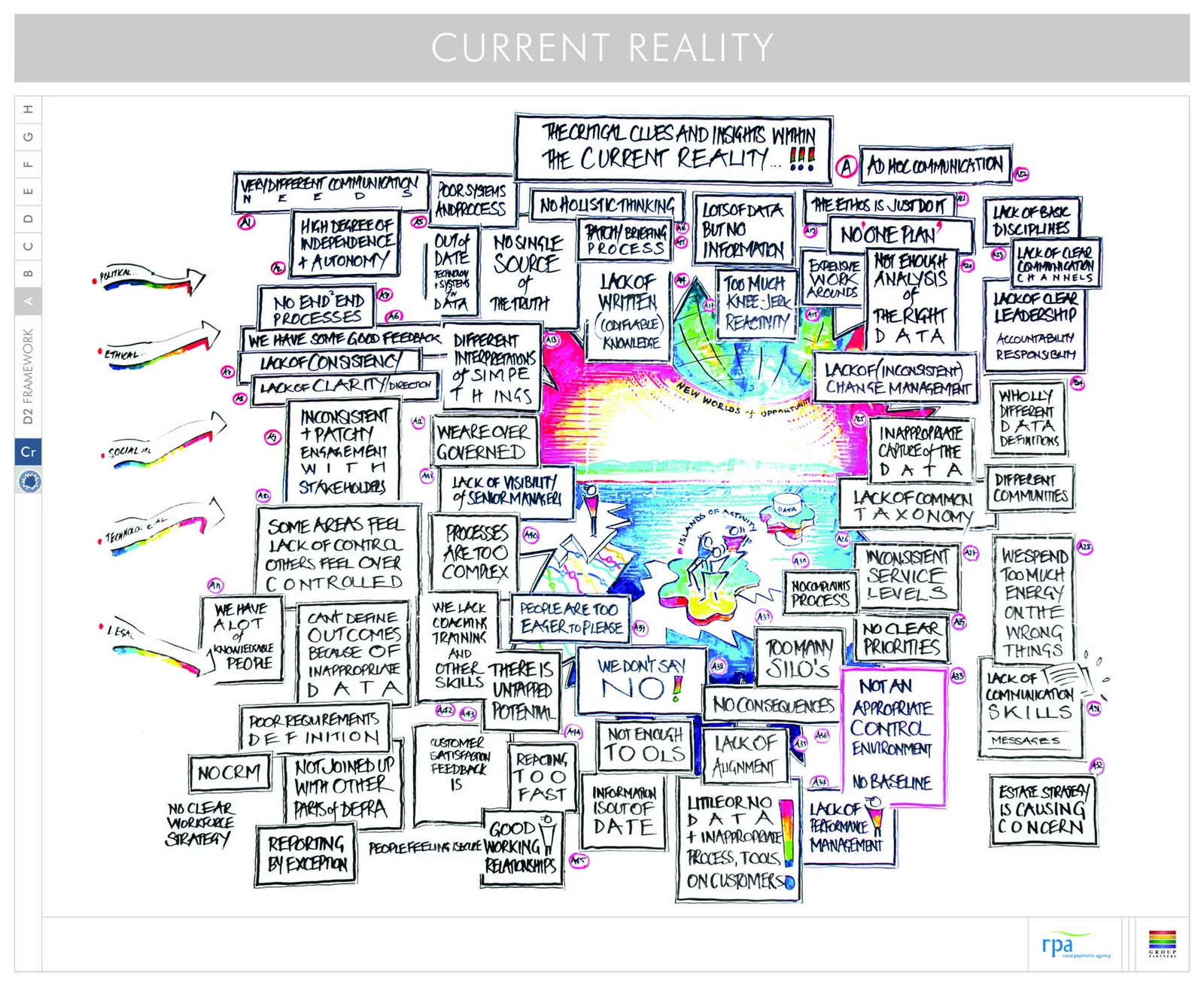
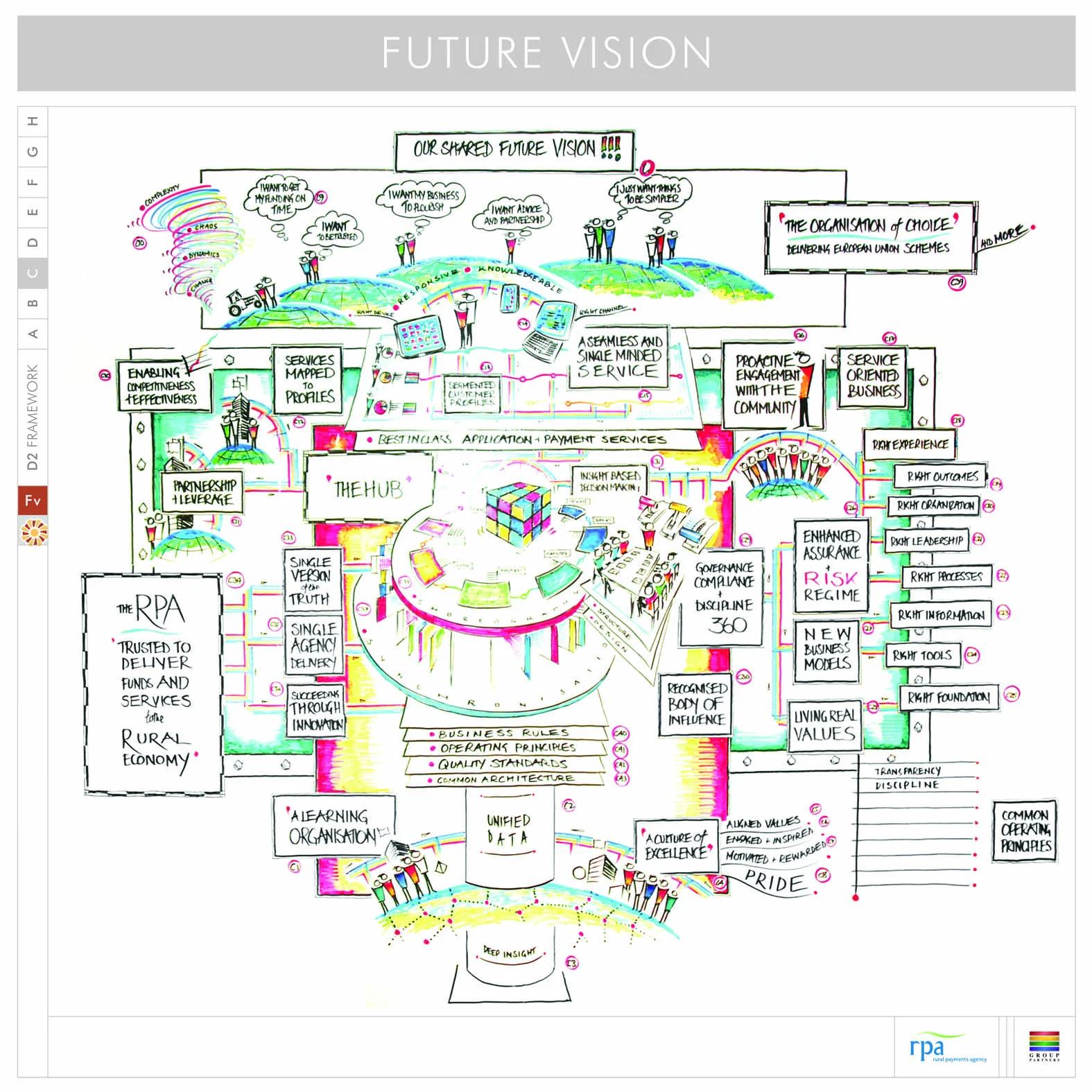
The framework also exposed the state of the agency’s relationships with its customers.
The lack of focus on our customers was one of the biggest pain points identified within the framework. I started to understand what I had inherited, what I had to work with, and how I could develop better activities for efficiency and connection. I realised we had to put customers at the heart of everything we do so they would see us as a partner and not just a transactional entity.
By the end of the session, RPA had identified 70 initiatives in the framework that it would need to address to change the organisation. The executive team voted together to reclassify 25 of them under larger initiatives, and then to consolidate them into six themes.
Sequencing across other people’s areas showed us how our operations could not be isolated. The process helped bring down silos in a structured, obtainable way.
Part III
The right people,
then the plan.
It took nearly four months to put the people, roles and structures in place. Then a five-year plan had to be paid for, and its first 100 days had to show it could work.
It took nearly four months to lay the foundation for the people, and for the roles, processes and structures they would follow to deliver the agency’s future success.
The right people with the right skills was critical.
As soon as the team’s capability to tackle large-scale change was in place, and roles were clearly defined in the agency’s Strategic Improvement Plan, it was time to carry out the vision.
The Arc and Leadership Model underpinned by strict governance is absolutely the right model for the organisation. It needed to be put back on its feet and have projects land right the first time, results that can be seen in programme successes.
The genesis of the five-year plan came from the foundation laid with Group Partners and the six core principles found within it.
Carrying out the five-year plan was no small effort. Within its first 100 days, RPA realised that the Strategic Improvement Plan, 45 separate projects of which 21 were public commitments, would need £30 million of funding beyond what had already been allocated.The Strategic Improvement Plan: 45 projects, the 21 filled squares are public commitments.
The executive team built the business case for the extra investment, showing how the work would tackle the legacy issues that were driving inefficiency and costing large sums in EU penalties. It held itself to a credible, understandable case, and worked widely with colleagues at Defra so they understood why the funding was needed and what it would deliver.
The fact that we achieved what we set out to in the first 100 days inspired the team, built faith internally and also gave us massive credibility.
Sometimes going against the grain and radical thinking is required for large-scale change.
Part IV
What changed,
in the numbers.
Once the framework, the roadmap and the five-year plan were in place, RPA paid more farmers sooner, with a smaller permanent staff. Customer satisfaction rose to 8.7 out of 10.
Since creating the framework and roadmap, and starting its five-year transformation plan, including how programme activity is run, RPA has seen a number of concrete successes.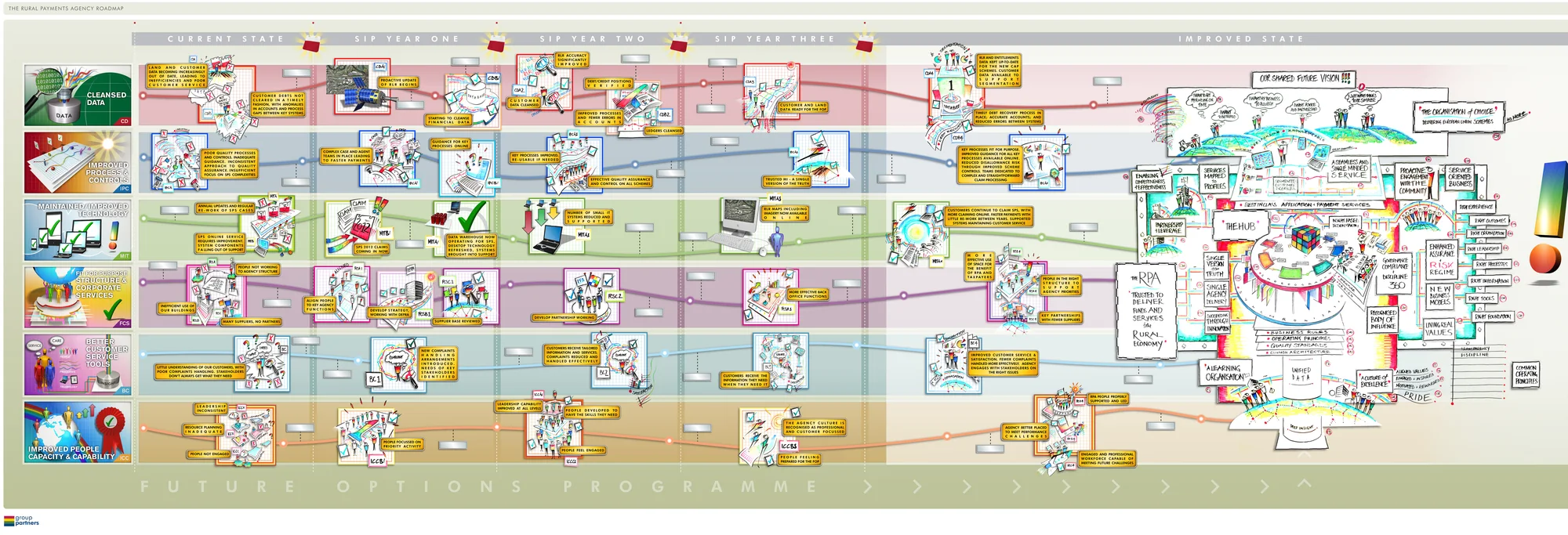 The RPA roadmap, from the original case study.
Timely payment under the Single Payment Scheme is judged twice, in December and in March. For each month there are targets for the percentage of customers paid and for the percentage of the total fund paid, in pounds.
Before 2011, RPA worked first on the smaller, less complex claims to meet its December targets. The new approach gave the more complex claims to senior caseworkers, and those higher value claims were paid earlier.
The share of customers paid in December rose. By the end of December 2011, 88% had been paid, against 86% in each of the two previous years, and in December 2012 it reached 93%. The improvement carried through to March, with 99% of claims paid by the end of March 2013 against 95% in 2010.
The focus on complex claims did even more for the share of the fund paid. In December 2009, 78% of the fund was paid out, falling to 74% in 2010. It rose to 82% in 2011 and to 88% in December 2012. That meant £224 million more reached the farming sector in one month than would have done without the shift in focus.By the end of March 2013, 99% of the fund’s value had been paid, up from 94% in 2010.
In April 2010 RPA had 2,813 permanent employees. Better systems and processes, and higher personal performance across the agency, mean it now serves its customers better with 2,075. Reliance on contingent workers has also fallen significantly, and where they are used it is as part of a flexible workforce, with structured knowledge transfer into the agency.
A new and comprehensive debt strategy, introduced in 2011/12, cut the amount owed to RPA through overpayments to customers from £38 million to £11 million.
Customers’ view of the agency improved year on year. On a scale of 10, satisfaction was 7.1 in 2011, 7.5 in 2012 and 8.7 in 2013. In the UK, a rating of 8.7 puts RPA on a level with many of the best performing companies in the private sector.
RPA has also become a high performing agency in the eyes of both the EU and Defra. Since 2010, 21 public commitments and eight projects in the five-year plan have been delivered on time and on or below budget. The remaining projects were on track to finish in the 2013 to 2014 financial year.
Starting new work is now simpler. There are only two ways to begin change in the agency: new requirements pass through an external relations gate, and services through an internal delivery gate. By watching what needs to start to keep the improvement programme on track, the executive team can plan, monitor performance and analyse new programmes so that they succeed.
Design governance has been critical to consistent reporting and documentation of processes and programmes, all held centrally in the agency’s own SharePoint. New information sharing tools keep processes and guidance captured consistently, in one place.
Part V
What the executive
team learned.
Grimshaw found targets that rewarded the easiest work. Changing them, and holding to the change, taught the executive team five lessons.
In all things there are easier and harder pieces of work. Doing all the easy work hits certain targets but means that others fall short. Easier work usually equates to less value in the eyes of others within an organisation.
On taking over, Grimshaw saw that the agency’s key targets were flawed. They led to perverse behaviour, with teams competing to do the easiest work. He asked RPA’s people to change how they saw complexity and to solve short and long-term problems alike: the right ones, really well.
Everything any team did had equal value, and volume of work gave way to quality of outcomes. Along the way, the executive team learned five lessons.
Every organisation needs professional working standards and rigorous customer service standards, upheld by its people. There must be minimum levels of acceptable performance. Codes of dress and conduct are a necessary part of an efficient, high performing workplace.
Published customer service standards set out what employees and customers can expect. They drive the pursuit of greatness and define how an organisation treats the people it serves. Customers must be at the heart of everything a public sector organisation does.
Collective consciousness is a positive organisational trait. In RPA, every department head knows what everyone else is doing. They may not answer for each other’s outcomes, yet they support one another and contribute to each other’s initiatives for the good of the wider agency. Headline knowledge of all the agency’s operations lets senior leaders work smarter and keep meeting their targets.
Don’t forget where you came from. Once organisations begin to achieve and sustain change, they tend to forget where they began and the painful work that brought them to where they stand. It is important to keep telling, and retelling, the story of the agency’s evolution.
Being accountable means being open about performance evaluation and statistics. To benchmark success you must track your progress, and data and systems for statistical and analytical information are essential. In 2013 RPA said it would publish its full performance statistics on its website.
First published by Group Partners in May 2013 as The Rural Payments Agency: Case Study. Names, titles and figures are as they stood then.