


Part I
A milestone
in Cape Town.
The African Governance Architecture carries the African Union’s commitment to democracy and human rights. In February 2016, with its strategy running only to that year, its members met in Cape Town to ask what came next.
Unpacking a topic as profound as this is a daunting task. It is also a privilege, and a chance to gain real insight into the dynamics that shape the outcome of any initiative designed to deliver positive impact. It demands respect and single minded focus.
Group Partners designed the framework for the strategy retreat known as Cape Town 2, held from 15 to 19 February 2016. Its purpose was to capture the perspectives and insights that would further the African Union’s strategic intentions for AGA, a programme still in its infancy and facing all the usual challenges of an initiative this complex.AGA connects the African Union’s instruments on democracy, justice, governance, human rights and constitutional law. Its institutional mechanism is the African Governance Platform, the AGP.
The programme had reached a key milestone. Its strategy covered the period to 2016, so an important question for everyone present was how that strategy needed to evolve, and what that meant for each of them and for the future direction of AGA.
AGA has now moved on from the four original platform members. There is more awareness and more involvement, with a secretariat and a platform. Two clusters are constituted. The foundations are here, and initiatives are being planned and implemented. For a governance programme this is a tremendous success.
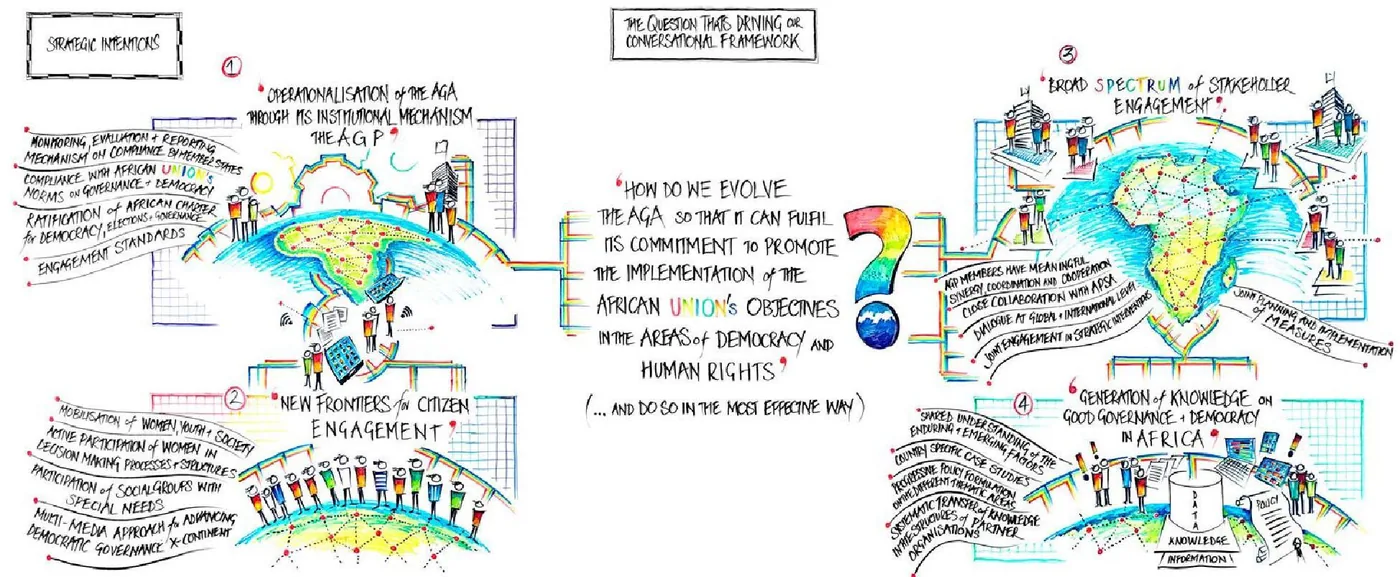
Any framework designed for conversation needs to help those taking part focus on a common aim. Group Partners calls this the exam question, and chose one suited to the needs of this retreat.
How do we evolve the AGA so that it can fulfil its commitment to promote the implementation of the African Union’s objectives in the areas of democracy and human rights? (…and do so in the most effective way.)
Cape Town 1 anchored AGA. There are important links to Agenda 2063 that remind us of the AGA purpose and inspire us as we grow AGA. This is about representing the African people. We have to ensure citizens themselves feel the difference, and that we are changing their lives in a positive way.
Part II
An architecture
nobody could see.
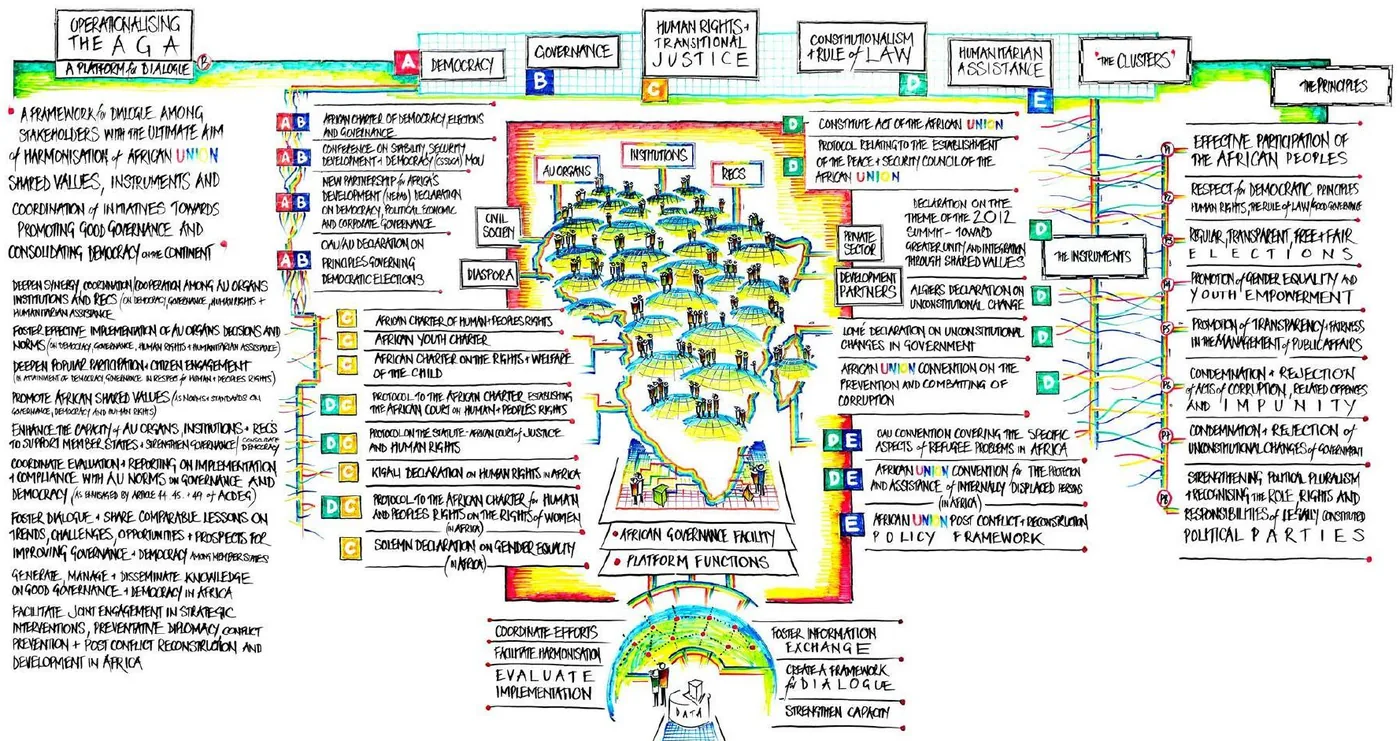
AGA was hard to grasp because no one had drawn it. Many instruments, each with its own mandate, have to be interpreted by 54 Member States in harmony with one charter.
To prepare for the two days it would support the discussions, Group Partners needed a good appreciation of AGA and its role within the African Union. The significance of the programme was easy to see. Deconstructing it was quite a challenge.
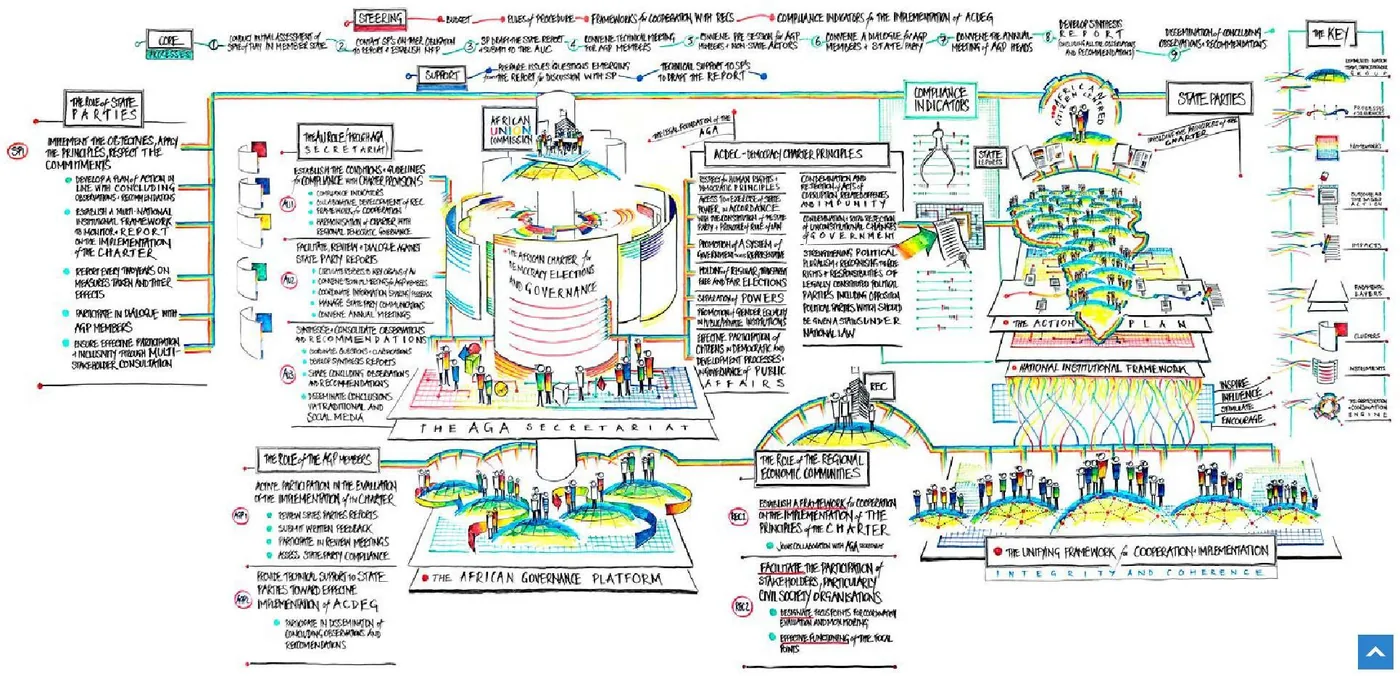
It is a complex topic, made much harder by the absence of any visual representation of what AGA was and how it worked. Group Partners felt compelled to bring it to life, and made the architecture the centrepiece of the framework.
The conversations in Cape Town reinforced that view. There was regular reference to confusion around meaning, structure, intention and operation. That is hardly surprising for an initiative of this scale, but it needed quality discussion and serious focus.
In an ideal world there would be no need for something like AGA. Everything would connect seamlessly, and everyone would share a common understanding of the commitment being made to peace and democracy.
The reality is that many frameworks, or instruments, have been created over time that relate in some way to democracy, justice, governance, human rights and constitutional law. They are international agreements, and each has a mandate that has to be fulfilled. That is not going to change.
The challenge comes when 54 Member States have to interpret them, and act on them, in harmony with the primary framework: the African Charter on Democracy, Elections and Governance.
The number of Member States that have ratified the charter is increasing. There are still questions as to whether these ratifications are driving the changes and outcomes implicit in it. That is debatable, and also not surprising: there was never going to be an instant and profound change across the continent.
As more organisations and institutions become involved with AGA, coherence and compliance matter more. New processes need a solid foundation, by which Group Partners means a shared understanding of definitions, meaning, intention, structure and process.
Most important are the member states. AGA is their prime responsibility, and we can give them the processes and structures to implement, but this will only be successful if they participate and own the process. A union is only as good as its member states.
We still have a long way ahead. Despite the successes we need the architecture to work fully, and there are many things that we need to complete. The state reporting process can now start: we have the enablers in place.
Part III
What the room
kept saying.
The same themes returned through the week. Each part of AGA’s network wanted something different from it, while its largest donors were planning to give less.
A brief immersion in the discussion is no basis for claiming a full understanding. But as independent observers and translators, and with the help of the framework that developed over the two days, Group Partners saw repeating themes. They give vital clues to the development of AGA, as both a mechanism and a platform for dialogue.
Confusion around structures and responsibilities. Platform members need to be very clear on the role of the secretariat, from planning through to implementation, so that everyone works consistently in the same direction. The clusters were not really thought through at Cape Town 1. They have grown since, and need to consider their enhanced role in steering and driving content.
The need to create capacity. This featured in several ways: doing more with less, and becoming less dependent on external investment by sharing better the knowledge and expertise that exist across the membership.
The question of relevance and impact. No one in the room doubted the relevance of AGA to good governance. But it was still ‘a well kept secret’ to many people not directly involved who need to play a part in its success.
The intentions stated ahead of the retreat stood the test of the week. It was not necessary to add more. The critical factor was to clarify what already existed: important intentions and principles that a broad and diverse audience needs to understand.
The ultimate outcome is better implementation of AGA, regardless of who is responsible. AGA lets its members reach more people and appreciate each other’s mandates and activities. It helps them take more collective responsibility, guided by the same understanding. For that, they need to understand the network that is now so vital to success.
To funders, AGA was still not very clear. It looked more like a process than a rich mechanism supported by a programme and a roadmap. They need to see what they are supporting, and to know that AGA delivers value to the Union and is effective in the Member States.
For parliaments in Member States, AGA can be a source of valuable knowledge. Parliamentarians are often not well informed. Ratification of charters and protocols matters to them, because without it democracy and good governance will not grow. Involving national parties in the dialogues will help align their decisions with the norms and standards.
Governments and the institutions around them asked for guidance and support to implement the shared values, and for the resources to do it. The confusion came up here as well.
Civil society wanted a platform for meaningful participation. It wants to be taken seriously in dialogue, and to know that what it passes to AGA will be considered and acted upon. It wants to be represented by effective networks that are connected meaningfully to AGA and seen as credible representatives of the citizen.
The donors were frank. GIZ said the parameters would shift over the next few years. Germany would continue to support AGA, and the political commitment would continue, but there would be new funding dynamics. For AGA over the next three years it would mean less funds, maybe 40 to 50%.
This is one of the most expensive governance programmes, and that level of investment could not continue. The conversations suggested it was not as bad as it sounded. It meant being more focused and more targeted, moving away from big, costly events and coordinating through a joint roadmap.
The European Union said the joint Africa and EU roadmap agreed at the last summit, for 2014 to 2017, still stood. Governance and human rights in Africa are at the heart of the root causes of conflict and insecurity. But the EU could not afford to keep investing at the same level. Its own member states see a lot of money, but not the level of results it promises. Ratification is no guarantee of results. They want to see outcomes against benchmarks, and they are looking for exit plans.The EU was then implementing its pan-African programme, supporting AGA, civil society and elections among others.
That raised a question. Are there really no results, or are they not being articulated in a way that provides the evidence? Is there a clear definition of the results being requested, and of how they will be measured?
Everyone’s capacity becomes our capacity.
There is a lot of opportunity to improve AGA’s effectiveness, and to deliver at far less cost with greater impact.
Part IV
Three frameworks
on one wall.
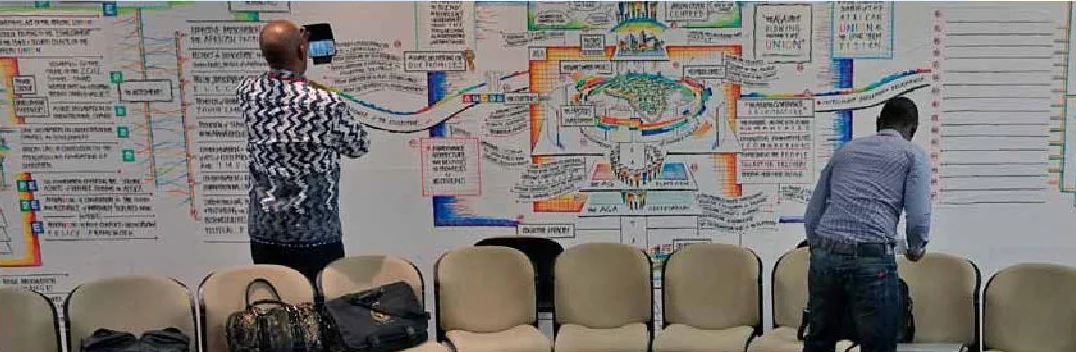
Group Partners arrived with a wall of logic already drawn. Two frameworks carried the week’s conversation. A third, for reporting, was introduced on the final day.
Frameworks have the ability to provoke. They highlight gaps and enable important calculations. For this team, the hope was that they would bring real clarity to the way forward.
The world is awash with information, much of it valuable but most of it out of context. Other people’s information is often ignored, because it was written for different audiences and different purposes.
Group Partners had prepared well in advance, distilling as much as possible without being blinded by the wealth of material. As the team arrived, a wall of logic was ready: a conversational framework that honoured the incredible work already done, with space for the agenda the team needed to work through.
Imagine it. More than 50 nation states across a whole continent, the clusters that offer insight and expertise, the actors and organs involved in bringing anything about, the instruments that must be applied and the processes and policies within them. Now imagine it applied uniquely in each national instance and every context. Everyone demands simplicity, but the world just isn’t simple. The story had better be.
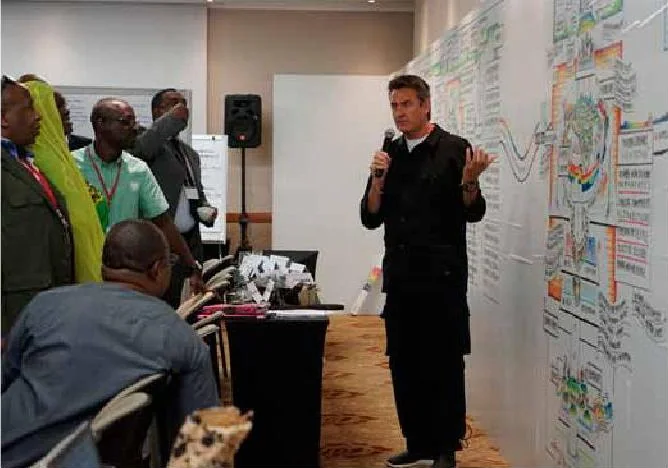
Two primary tools were in the room. The Context Framework explained the driving question, surrounded by four quadrants that set out AGA’s strategic intentions. The Conversational Framework honoured what had already been achieved, and let the week’s conversations be reflected in a logical way.
By the end of the week there was a third, the Reporting Mechanism, introduced on the final day as a next step in formalising this vital dimension. It set out a workable model for everyone to play their part, and to connect activity all the way back to the primary instrument, the Democracy Charter.
On the far left of the wall, the framework set a baseline of where things stood, the barriers and challenges set against real achievements. A lot of progress had happened since Cape Town 1 in 2014.
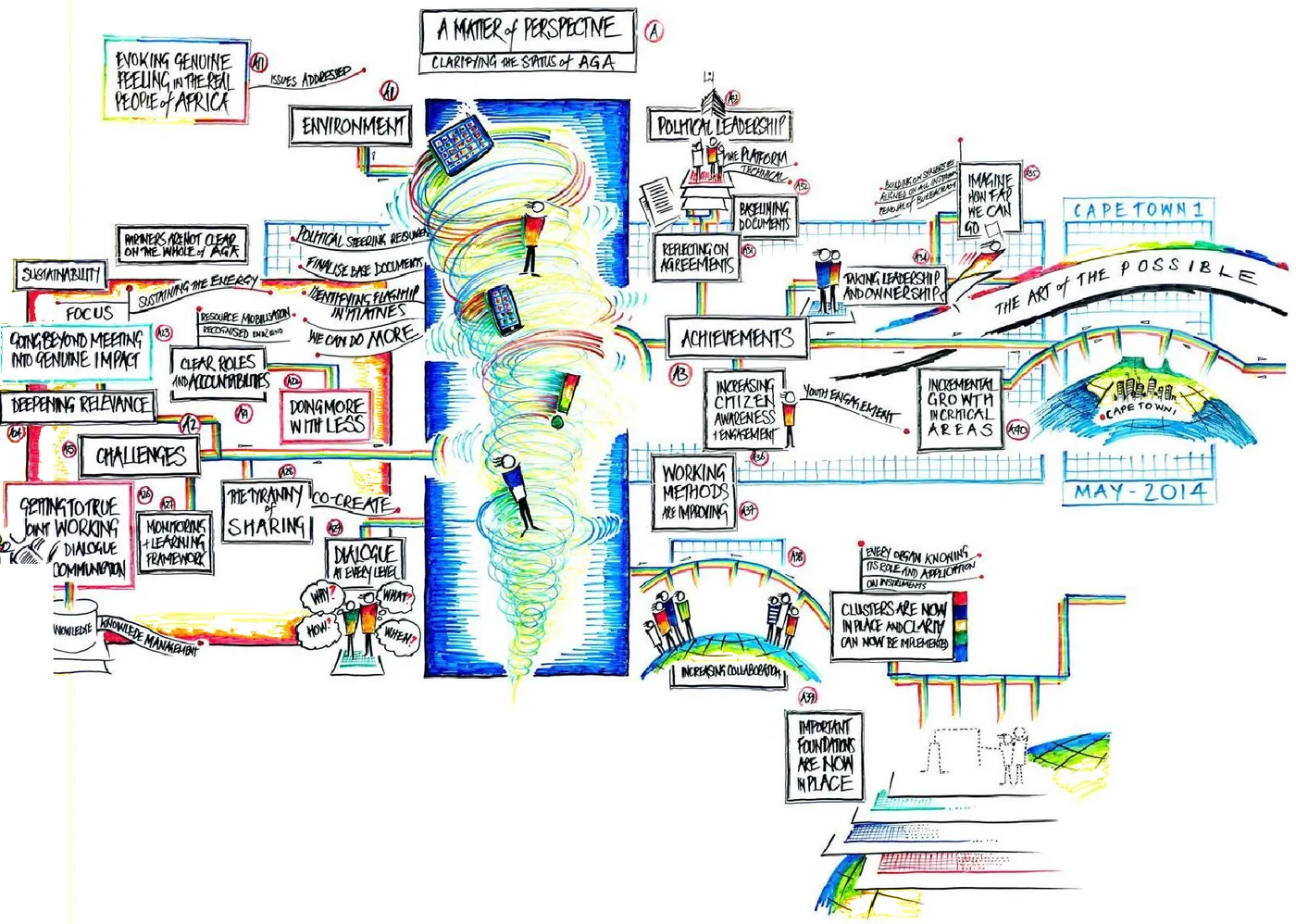
Conversations take many forms. The frameworks are designed knowing that important dimensions will arise and clues will emerge, a mixture of important fact and genuine insight. Anything repetitive or superficial is resisted, to arrive at the most valuable and unified reflection of each topic.
Part V
A vision, new goals
and a roadmap.
At the heart of the vision are the African people. The team turned AGA’s strategic intentions into new goals, and the goals into a roadmap running to 2020 and beyond.
A core aim for the week was a unified AGA vision: something that would bind all the members around a common view and help articulate the machinery of it all. It would also clarify everyone’s main role in implementing it.
At the heart of the vision are the African people. It is a citizen centred system for the benefit of Africans, people who simply want to get on with improving their livelihoods. Everything else is in pursuit of that outcome.
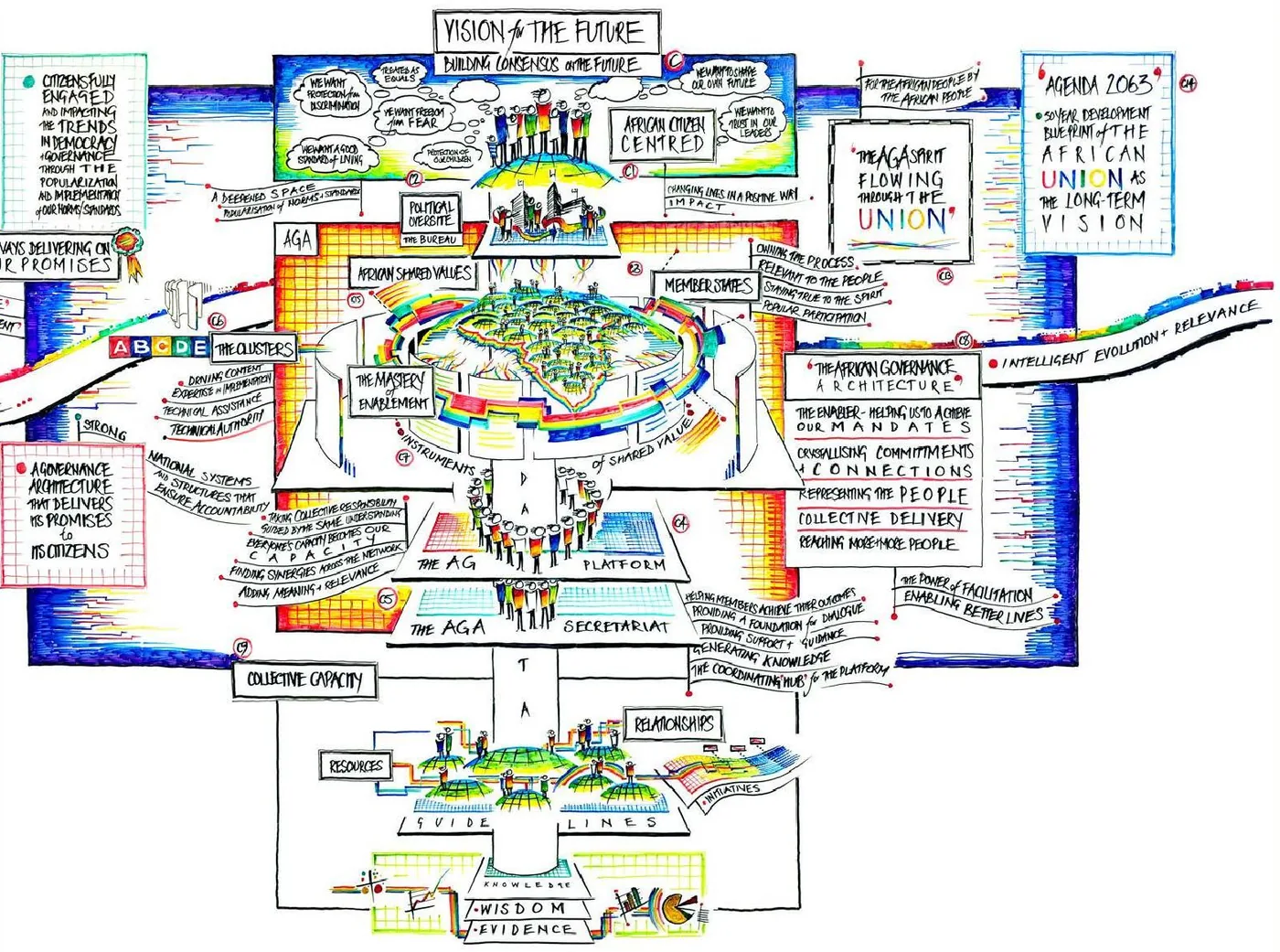
The new goals began with a reminder. AGA already has a set of powerful strategic intentions, and the job is to make them work. The team split into groups, and their reports were collated into repeated themes. These guided the outcomes, and the actions that emerged in the roadmap.
A roadmap is a set of initiatives and actions over time. This one runs to 2020 and beyond. Each outcome demands certain actions, and each action is likely to be preceded by activities that make it possible. Some outcomes must be complete before others can be reached. Every action needs a clear plan, budget, owner and deadline.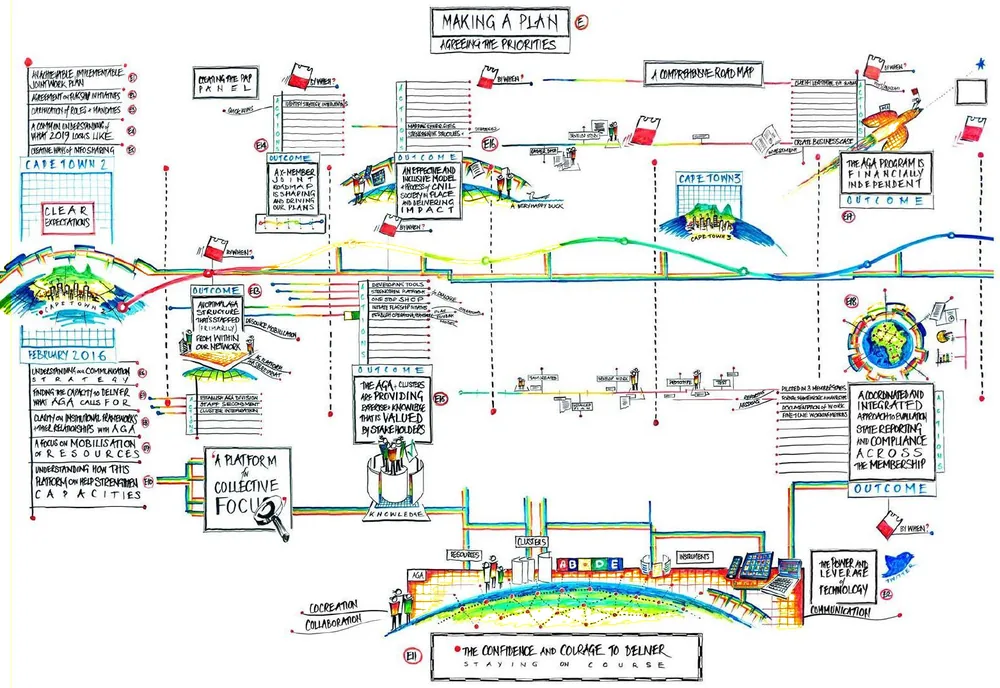 The roadmap, from Cape Town 2 in February 2016 onwards. Source: the original report, pp. 33 to 34.
As we leave Cape Town 2 we need to be mindful of the much larger and diverse network that we can draw from. There are synergies that we are finding even without asking for them, because of the broader network and their connections. We need to think more broadly about the contributions and value that we can bring as a collective.
The ambition of the programme is very high. How far it is achieved will depend directly on how well it is implemented and communicated.
Frameworks are living tools. They are a visual reflection of the systems and dynamics involved at a point in time, and so always a work in progress. Some elements are merely a snapshot. Others provide vital definition and anchor intention.
First published by Group Partners in 2016 as The African Governance Architecture, a report on the Cape Town 2 strategy retreat, 15 to 19 February 2016. Quotations are from participants, as the report recorded them, without names.