

Part I
A city
in decline.
Ibadan was the intellectual centre of modern Nigeria. Since the 1980s it has been losing its middle classes and its young people to Lagos.
Nigerians are an amazingly talented, culturally rich and passionate people. In common with much of the continent, they also face huge challenges: poverty amid oil riches, widespread corruption, tribal and ethnic intolerance, a lack of strong or even working systems, and meddling by generations of outsiders. It is a rich mix, and we have found it in differing proportions in all the work we have done in Africa.
Ibadan is the capital of Oyo State. It has an impressive heritage as the intellectual centre of modern Nigeria. Most of the country’s elite were educated there, and it was home to Nigeria’s first university and its first television station.
Since the Structural Adjustment Programme of the 1980s, Ibadan has been a city in decline. Many of its middle classes and younger people have left, and are still leaving, for Lagos, the booming commercial capital.Lagos is less than 100km from Ibadan.

Its problems are compounded by its being an urban sprawl in a largely rural state. The city is divided between 11 local governments, and the strategic oversight and interdependence it needs are sorely lacking. Pressure on the Nigerian Government’s limited revenues means it is unlikely to fund the investment regeneration needs.
Yet there is much to celebrate: a population of intelligence, charm, boldness and inventiveness and, most important of all, a deep commitment to change.
Our challenge is to harness our authentic tradition to renew our city as a beacon of 21st Century excellence.
Part II
One question
for the whole city.
Concerned citizens led by the Omoluwabi Collective asked Group Partners to help shape a 30-year plan for Ibadan, owned by its people.
Group Partners was invited by a group of concerned Ibadan stakeholders led by the Omoluwabi Collective. Our host and sponsor, Ade Adjewali, already knew our work. His vision for the city and his commitment to its regeneration were what drove and inspired the initiative.
The same people were behind Mesiogo ’09, a civic renewal project fully in keeping with Ibadan’s courage and originality. Our role was to facilitate a critical stakeholder event, and it was a first for us in more ways than one.
30 years
the span of Mesiogo ’09, a strategic framework for the civic renewal of Ibadan.
Mesiogo ’09 is a conceptual and strategic plan for the renewal of the city. It pictures what Ibadan can become in the 21st century. Owned by the people, it sets the direction and priorities for Ibadanland and lays a foundation for turning development into transformation. It also gives a context for an infrastructure plan, and for the projects that social and governmental organisations will deliver over the years.
Most importantly, it sets the measures for holding government objectively to account, whatever its political background. It gives citizens a platform to contribute, and so builds a partnership for the progress of Ibadanland.
The work turned on one exam question.The exam question is the one question the whole piece of work has to answer.
What is our vision, direction and strategic framework for Ibadan? One that embraces the perspectives and encourages the contributions of residents and indigenes, and creates a place to live, play and raise future generations?
Part III
Months of
preparation.
A survey of more than a thousand people and small workshops with local leaders gave the event its starting point: a vision drawn from what people wanted and what stood in their way.
We started preparing for the main event months ahead, with a strong mix of old and new tools and techniques. They draw on the latest global thinking about transformational change in complex environments, and at their heart are the age-old traditions of conversation, storytelling and visualisation.
1,000+
people of all ages and from all walks of life answered the survey.
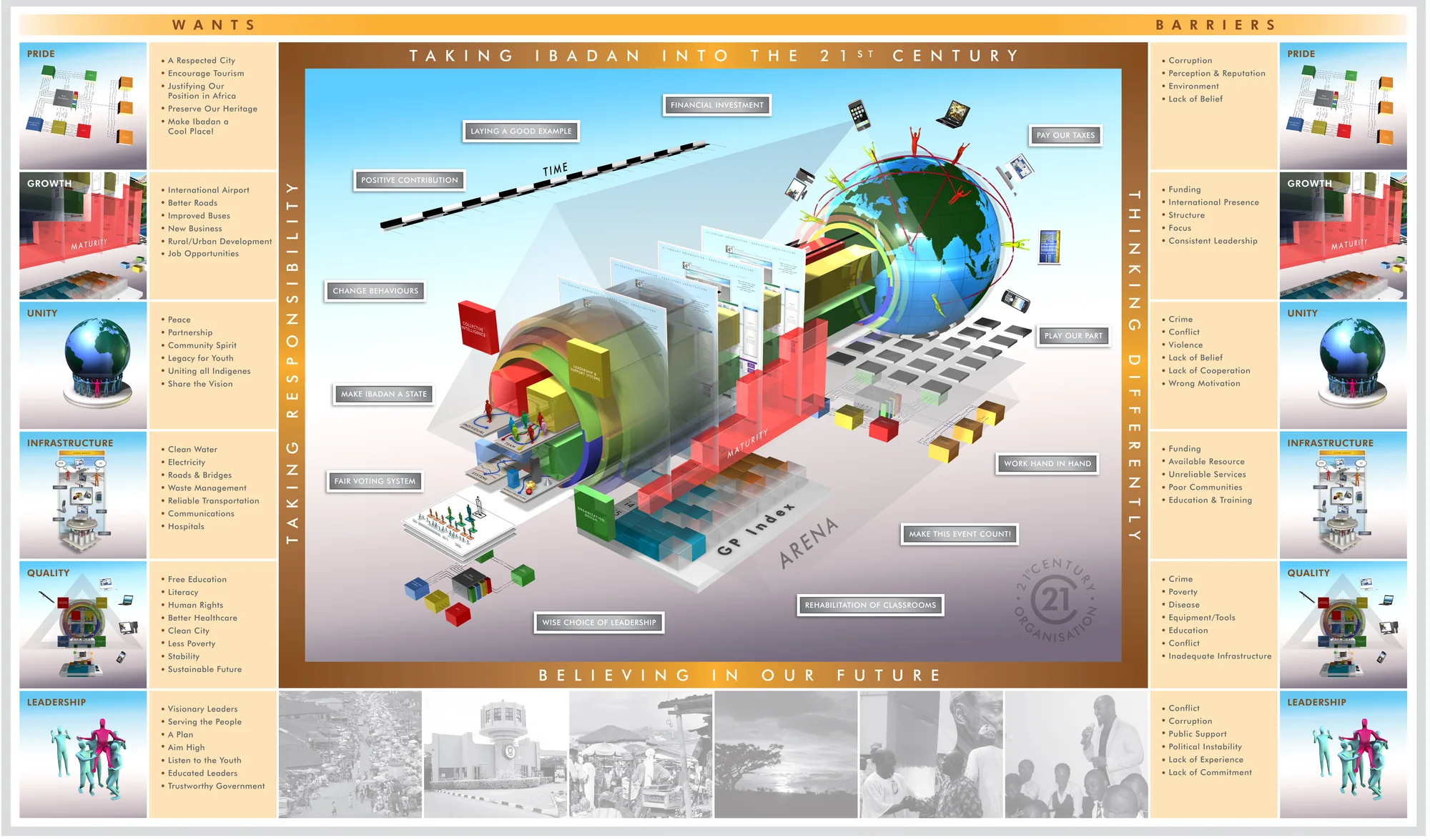
A broad survey gave us invaluable context and data, and so did small interactive workshops with influential indigenes and residents. Some messages came across loud and clear. The infrastructure was in serious need of improvement. Current laws were being ignored, or were simply inappropriate for the country and its culture. And people were forgetting the city’s heritage and traditional culture, the very things that once made Ibadan great, and so were losing their authenticity.
From the wants and barriers the survey identified, we drew a vision for bringing the city into the 21st century. It showed a clear way forward, based on taking responsibility, thinking differently and believing in a positive future.
Part IV
Two hundred
in the room.
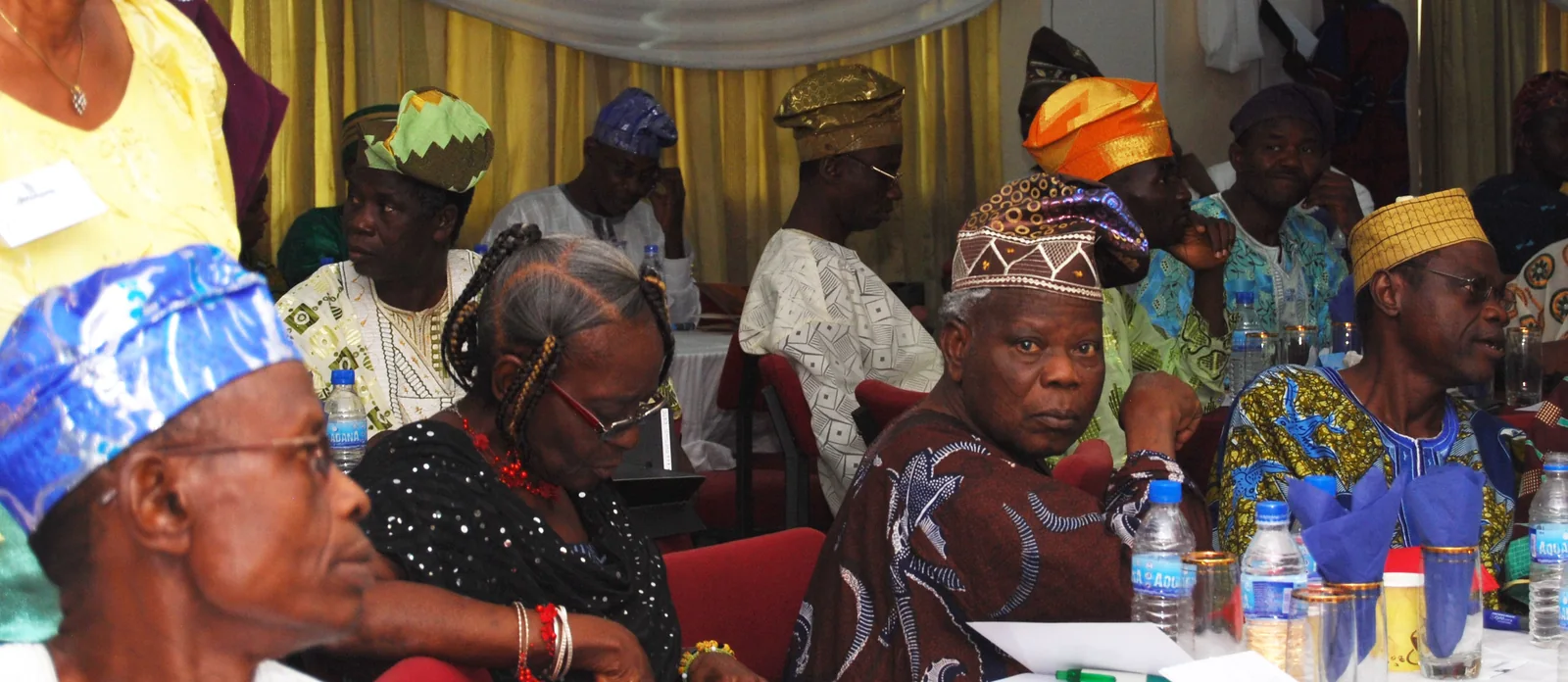
Up to 75 people were expected. More than 200 came, three kings and 30 chiefs among them, and the day held together.
As always, we arrived at the venue well ahead of time to set up and get to know the space. To our delight we found an enormous 120ft wall. On it we displayed the vision we had brought with us, and visualised the frameworks as they evolved during the discussions.
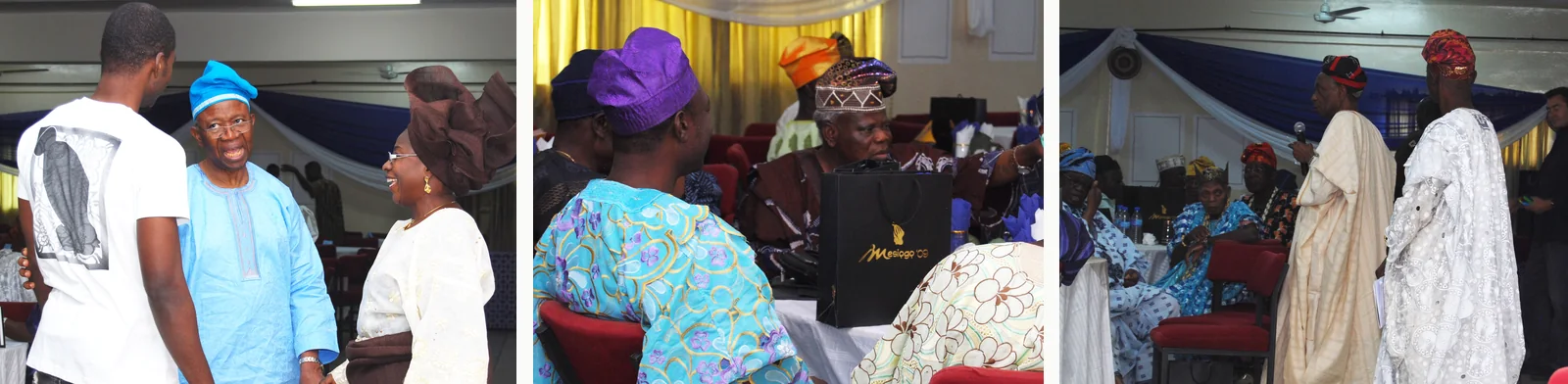
And what discussions they were. Where we were expecting up to 75 people, over 200 turned up, including three kings and 30 chiefs in full regalia. It was hot, 35 degrees, and diesel generators powered the air conditioning. There was loud and constant noise from singing, chanting and praying, and of course from mobile phones.
Instead of what might have been chaos, we had an insightful day of inspirational guest speakers, and of hard work and open discussion with a varied group of stakeholders.
In the normal course of events, we are more likely to work with a group of between 10 and 20 leaders and senior managers. They may or may not be used to working as a team, but they will have been told what to expect, and asked to keep calls and emails to the breaks.
It is testimony to the flexibility of the approach, and to Structured Visual Thinking, that it can cope with very different situations and come through them with flying colours.
Part V
A blueprint built
on the market.
Three schools of thought had to be heard. The framework found its foundation in something every resident knows: the art of trade.
In the course of discussions, three distinct schools of thought made themselves heard.
Conservative, advocating an orthodox, cautious approach.
Transformationalist, ambitious and courageous, and committed to changing the current realities.
Incrementalist, committed to practical, step by step change.
Their needs and views had to be taken fully into account if the framework was to last. In any case, it was clear that different approaches and mindsets would be needed at different stages of the journey.
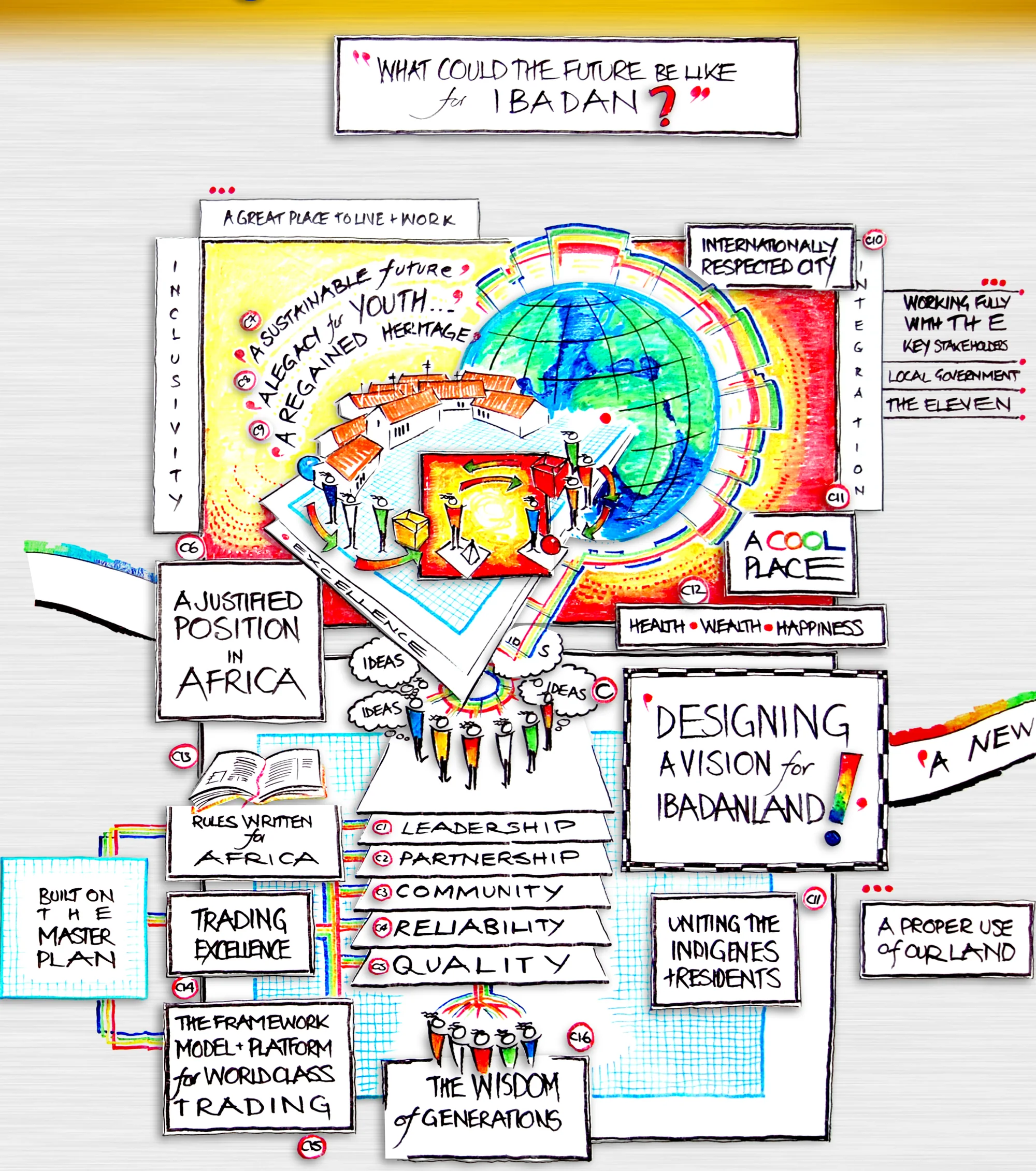
Marketplaces are a rich part of Nigerian life, and Ibadan is no different. The city thrives on its markets, which at their best are places to socialise and to trade. Their strength can be equated with the vitality of the city itself: as one has deteriorated, so has the other. We wanted to use the ingenuity and tenacity of the market trader to rejuvenate the city, and at the same time overcome the obstacles that residents and indigenes reported so widely.
So the marketplace became part of the framework’s foundations. The art of trade can be followed in all walks of life, drawing on the people’s own wisdom and skill and applying it to the regeneration of their city. An everyday transactional model became a transformational one. It can keep evolving and adapting. It is not so rigid that it demands inappropriate structure or process, yet it is structured enough to bring a welcome and necessary level of organisation.
The vision crystallised the ambition for the city, with something for everyone, whether cautious, practical or ambitious. It offers a blueprint for a planned, functionally secure and socially reliable city in a stable political environment: Ibadan as a beautiful place to live and work, through the active participation of everyone with a legitimate stake in it.
It draws on the experience and practice of other cultures but is not a slave to them. It considers them from an African perspective, organised around laws and structures that flourish in the region. And it will be carried out in ways that combine the wisdom of the elders with the insights of youth.
Part VI
A framework
for Ibadanland.
The outcome was a strategic framework for the city and its region, drawn as a visual plan designed to evolve. It was the start of the story.
There is hope in dreams, imagination, and in the courage of those who wish to make those dreams a reality.
The outcome was a multifaceted strategic framework. It sets the direction and priorities for Ibadanland, and details how residents and indigenes see the city and the surrounding area as a place to live, work, play and raise generations to come.
This was just the start of the story of Ibadan’s regeneration. The framework that came out of our time there is ultimately about raising the quality of life for the man in the street and for people throughout Ibadanland. It is about helping people think like metropolitans again, and realising development in health, education, the environment and poverty, in the governance of the city, and in growth and economic opportunity.
Its three strands are critical.
Community: greater unity and collaboration, and personal sacrifices to improve the environment in which people live and work.
Prosperity: more opportunity for the region. Better infrastructure and conditions draw more interest in the city, from people who want to do business with Ibadan, to live there or to visit.
Citizenship: better conditions and a better environment improve the quality of life, and healthcare and education reduce poverty by creating opportunity.
Back in London, we worked with the studio team to develop the framework as a 4D visual plan. For the first time in Sub-Saharan Africa, it captured the vision for a city through its stakeholders in graphic, easily understood visuals. The model is designed to evolve and adapt, while giving enough structure for the organisation the city needs. It is a platform for action, and it highlights the areas that need attention.
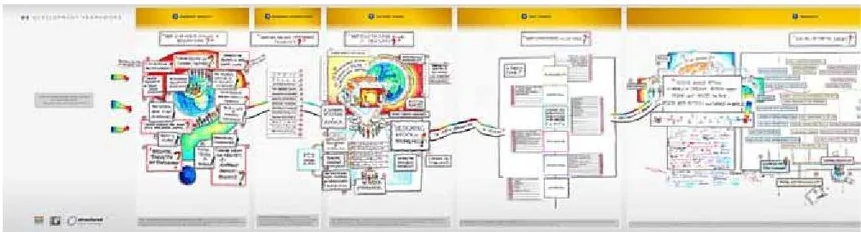
Other outputs followed. A series of documents, including a detailed workbook, captured all the papers and ideas from the two days. A film was made for a leading Nigerian television talk show. And a multimedia website connected the thinking, the process and the outcomes with the diaspora of Ibadan descent.

A regenerated Ibadan will stand as a beacon of excellence for the region, comparable with other international cities, attractive, authentic and well organised. It will be a city where everyone takes responsibility for its development and upkeep: a city for the people, by the people.
First published by Group Partners in December 2012 as A Group Partners Case Study into the Regeneration of Ibadan. Names and figures are as they stood then.