


Part I
A network across
the Horn of Africa.
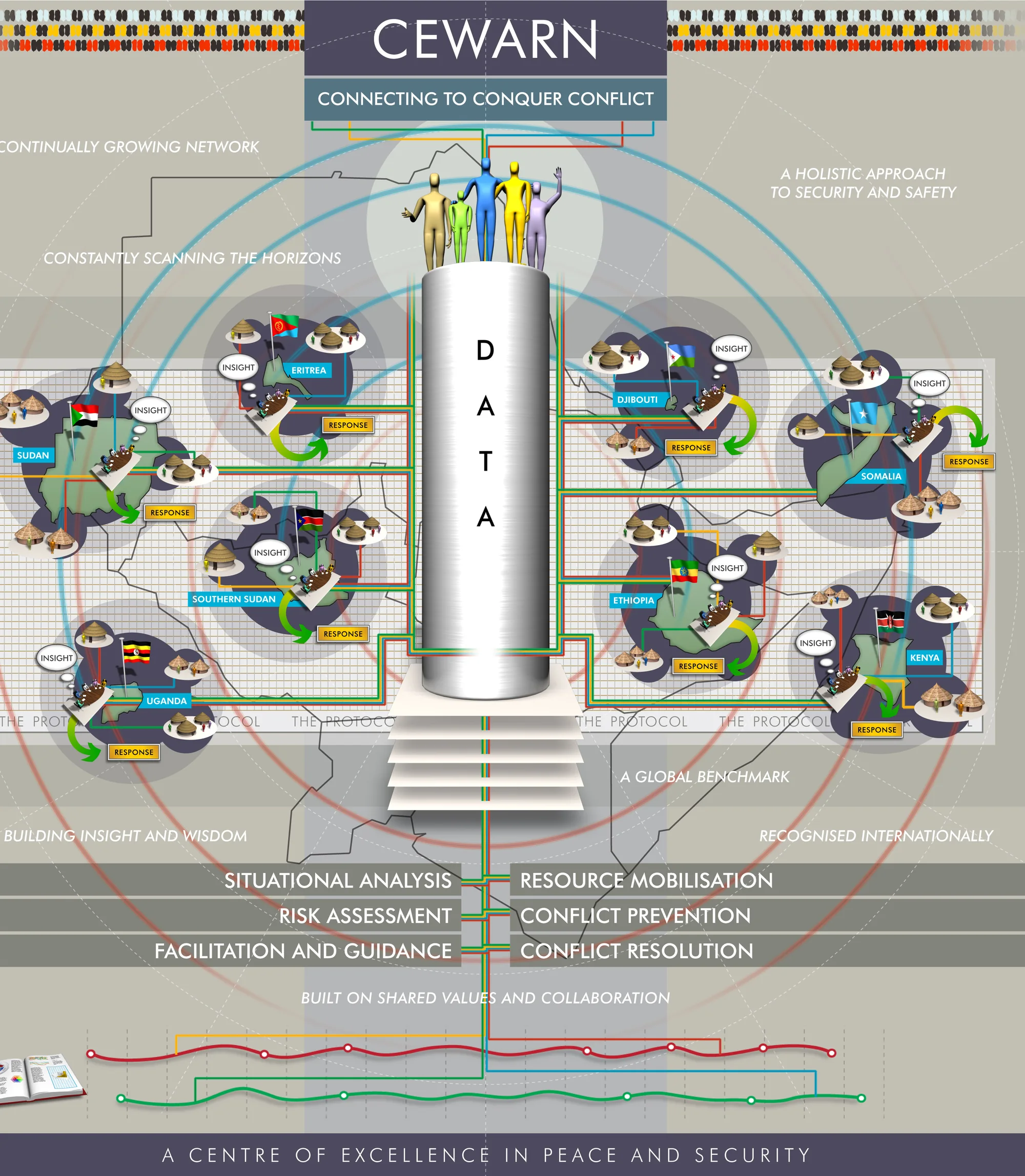
CEWARN is the conflict early warning network of the IGAD member states. Since 2002 it has watched for violence in the border lands where herders and their livestock cross from one country into the next.
The Conflict Early Warning and Response Mechanism, CEWARN, is a collaborative effort of the seven member states of the Intergovernmental Authority on Development: Djibouti, Eritrea, Ethiopia, Kenya, Somalia, Sudan and Uganda.South Sudan also appears on CEWARN’s own map of the region. It is one of IGAD’s programmes for preventing violent conflict in the region. The member states set it up by Protocol at the 9th IGAD Summit, in Khartoum in 2002, and since then it has worked with a particular focus on cross-border pastoralist conflict.
Its mandate is to receive and share information about potentially violent conflicts and about their outbreak and escalation. It analyses that information, develops case scenarios, formulates options for response and carries out studies of particular kinds and areas of conflict. In each member state a Conflict Early Warning and Response Unit, or CEWERU, joins governmental and non-governmental stakeholders, with National Research Institutes and Field Monitors working alongside.
For most of its first decade, CEWARN worked in three clusters, pilot areas that each straddle a border.
By 2011 its legal basis was firmly established and the mechanism was working well enough to be seen as a continental benchmark.
Even so, it was hard to describe. CEWARN’s Director, Dr Martin Kimani, was concerned about what a word like “Mechanism” suggests. It is accurate, but it loses the living nature of CEWARN and the part played by so many people in its network. It suggests something owned and managed by a team in Addis Ababa, rather than a network that spans the whole Horn of Africa.
The conflicts it watches are close and personal. Two elders described them like this.
All our livestock have been taken by the Toposa and this fellow is still talking peace. Where is the livestock he purports to protect? He keeps irritating us by coming back to us; do I shoot him to keep him off forever?
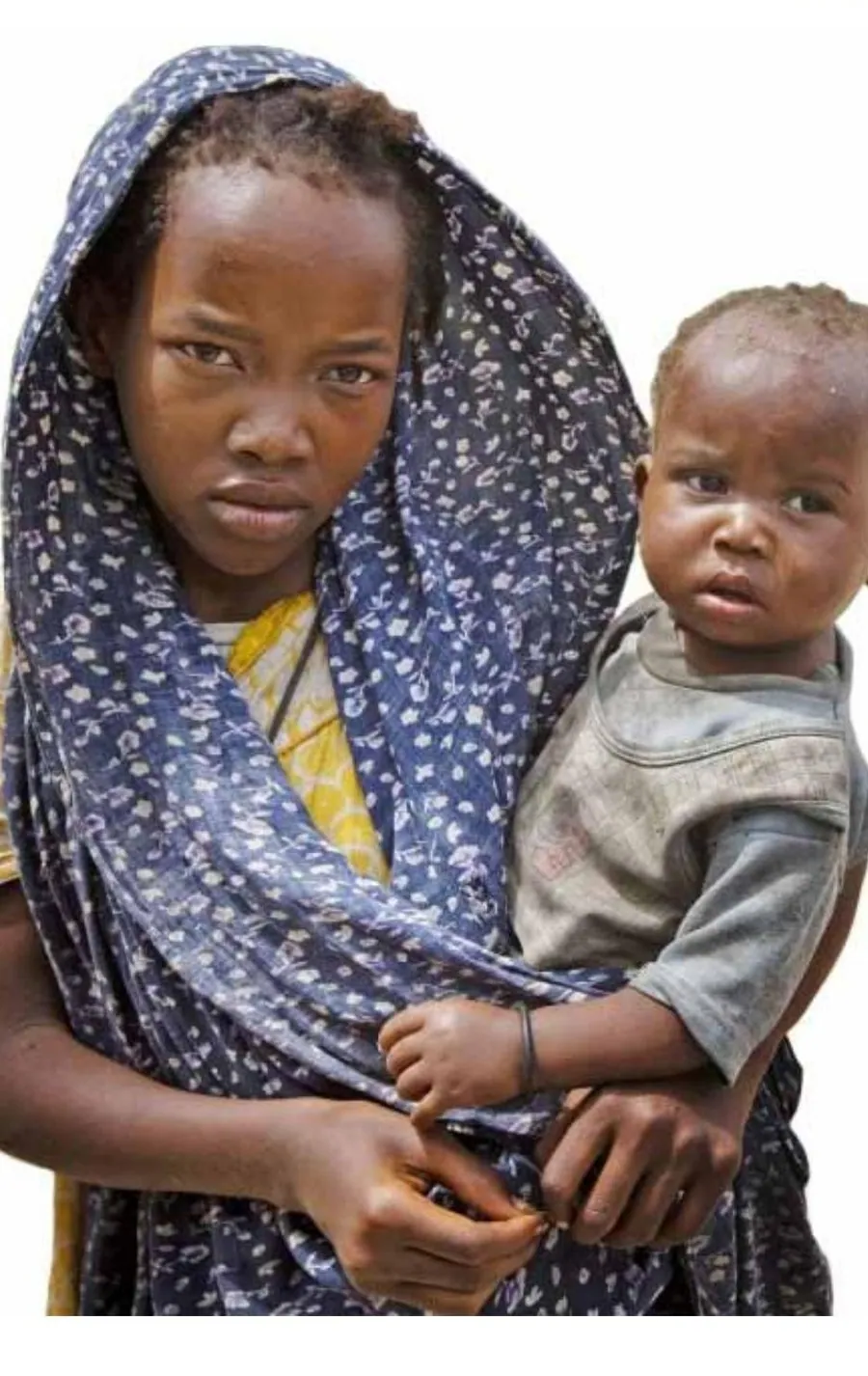
We no longer collect wild fruits or undertake wild hunting because of insecurity in our ancestral land. This concentrated camp has transformed us into women. The future is bleak.
Part II
A strategy built
from the bottom up.
In May 2011 the member states asked CEWARN for a new strategy. At a retreat that August its team decided to build it from the views of the people it serves. Group Partners joined the work that November.
In May 2011, the 10th Committee of Permanent Secretaries, representing the member states, asked CEWARN to develop a new strategy. It was to widen the network’s thematic and geographic coverage and strengthen its institutions, while extending its partnerships and its coordinating role.
The new strategy would run from 2012 to 2019. The goal of the previous one, for 2007 to 2011, had been to build structures for conflict early warning and response. The goal of the next was to use those structures more effectively on broader challenges in peace and security.
Group Partners came to the work through Adewale Ajadi, a long-standing partner best described as a transformation entrepreneur, who facilitated the CEWARN team throughout.Group Partners and Adewale Ajadi had earlier worked together on a framework for the regeneration of the city of Ibadan, in Nigeria. In August 2011 he facilitated a retreat for the team. There, the decision was made to engage with the people and to develop the strategy from the bottom up.
It was an attempt to realise more deeply a century of Pan-African aspiration, which holds that true progress is rooted in the living customs and priorities of African peoples.
The temptation when working at the regional level is to conference and make bold statements. But the CEWARN mechanism is driven by a bottom-up approach, that is solutions are often local even if the problems are national or international.
For Group Partners it was a dream project. The approach was courageous and had never been tried on such a scale. The problem was genuinely important, and wicked: a social or cultural problem bedevilled by multiplicity, with requirements that keep changing. It was a chance to put Group Partners’ beliefs and techniques to one of the toughest tests ever. And the team it would work with was committed.
The programme had to evolve naturally, with enough structure to give reasonable certainty that a coherent strategy would emerge. The views of the many at the local level had to stay relevant in the more rarefied reaches of national and regional policymaking. What was needed was simplicity without losing complexity.
Some principles held throughout. Insight and contribution were built from the bottom up, through a number of consolidation points, until everything combined to inform the strategy. Underneath sat CEWARN’s theory of change.
That high quality, credible information and analysis on emerging threats to peace and security, delivered in timely fashion to the right individuals and institutions, will lead to decisions that increase peace and security in the IGAD region.
Part III
Eight weeks
in the field.
At the start of 2012, CEWARN staff and local experts talked with almost five thousand civilians and local officials in five countries. Group Partners spent weeks drawing what they heard into a common structure.
The team began with a small set of primary questions for the people it would meet. They had to be generic enough for extremely diverse interviewees, and still repay the effort with real detail.
The divide between “field” and headquarters is an idealisation. The field, in other words, is life. However long the trips and conversations, they would only ever be a drop in the ocean against the population and size of the region.
After a workshop with experienced local facilitators, led by Adewale, Group Partners helped shape the way the material from the local conversations would be collated and synthesised.
Over eight weeks at the start of 2012, CEWARN staff went with local experts and, using a common guide, met civilians and local officials in Djibouti, Ethiopia, Kenya, South Sudan and Uganda.The teams did not travel to local areas in the Republic of Sudan, where there were no existing areas of focus at the time, or to Somalia, because of security risks.
5,000
Almost five thousand civilians and local officials, heard in eight weeks.
They talked to elders and women, to market traders, youth and officials: anyone who could offer insight into the conflicts that can turn violent, and clues to their causes. They also asked people for their solutions, and for what an ideal future would look like.
The teams talked to many people and tried to talk to traders, youth and women. Enormous amounts of material were gathered and CEWARN tried to create a simple way to visualise the information that was received or encountered.
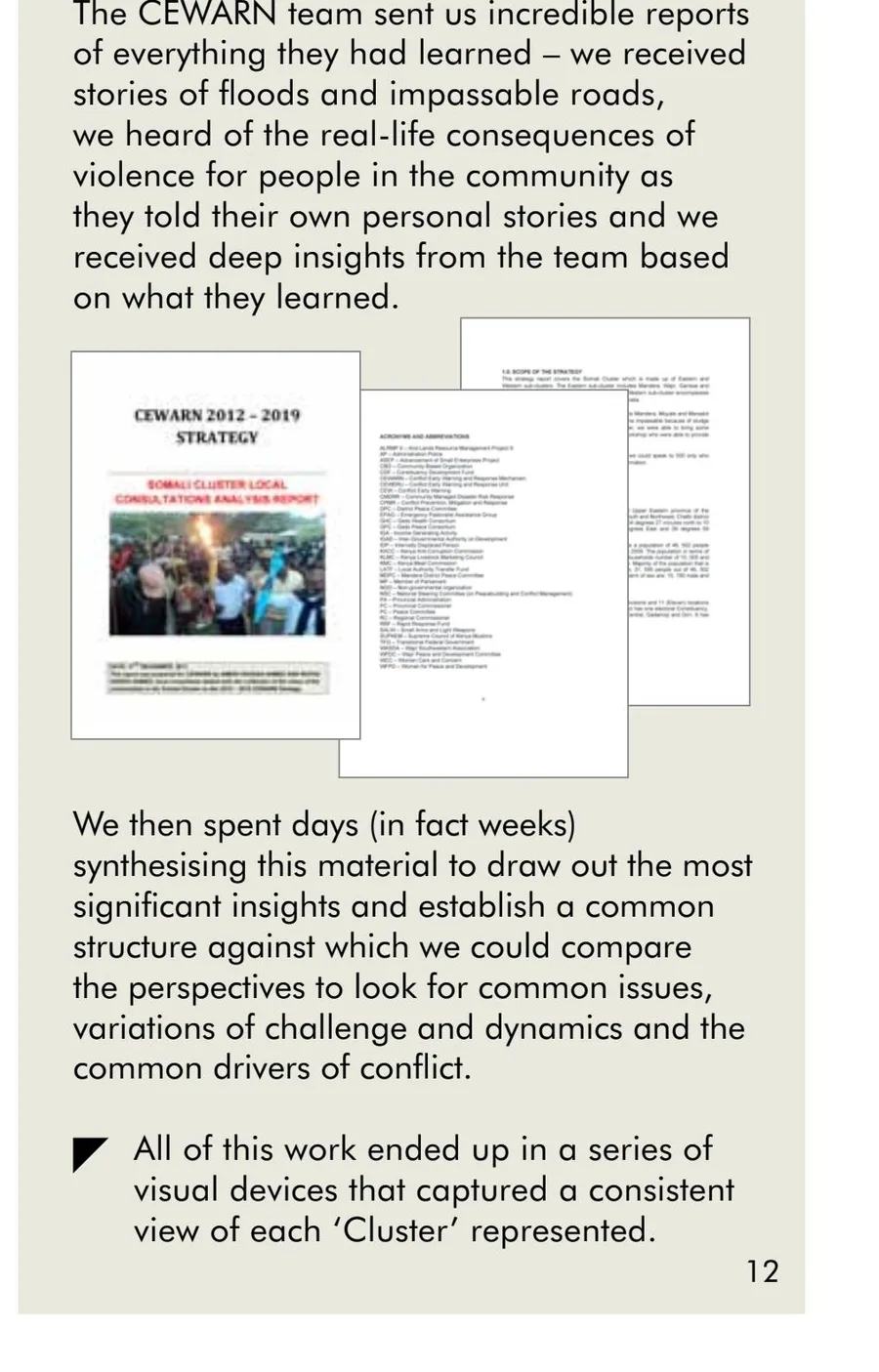
The reports that came back were remarkable. There were stories of floods and impassable roads, and people told of the real consequences of violence in their own lives.
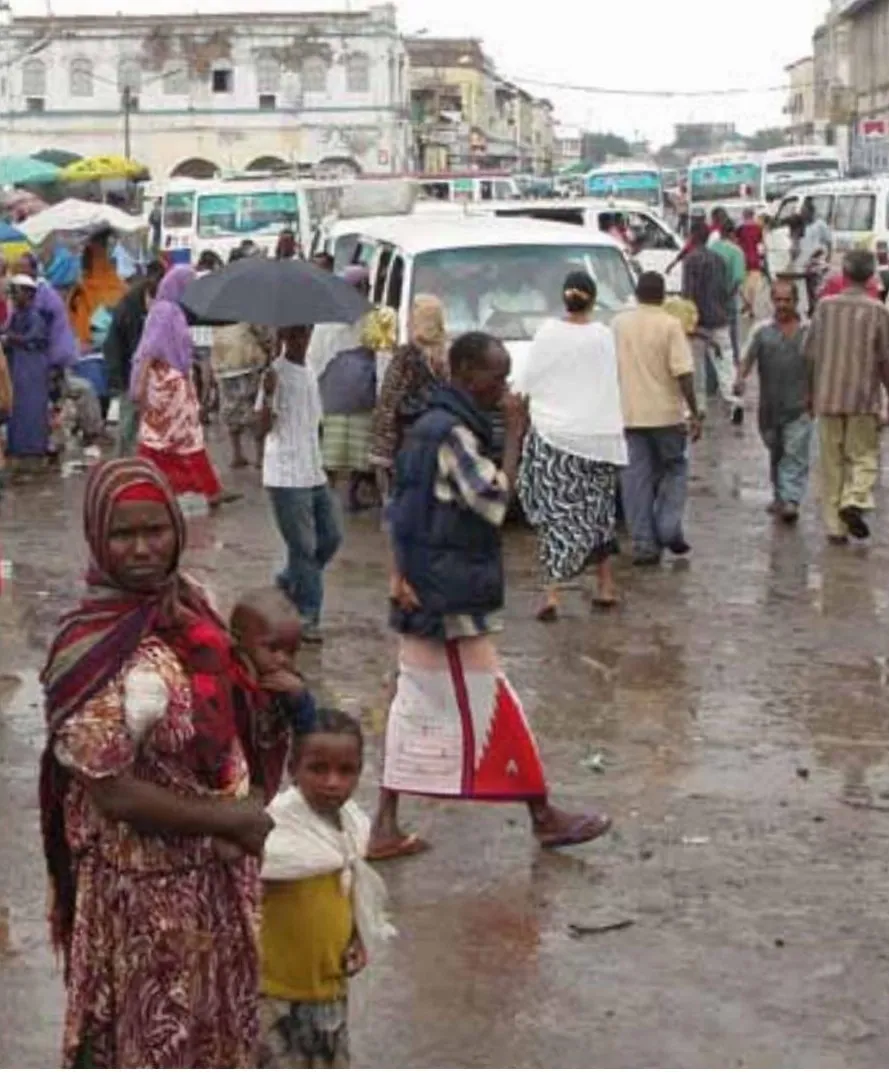
People spoke plainly about peace. “Without peace there will be no future and development,” said one. Another noted that women were now involved in peace meetings and had a voice. “We have realised education is power and light,” said a third. Others asked for pasture to be shared fairly, to avoid the overgrazing that leads to friction.
They also described what had been lost. The Turkana and the Dassanech once shared one elders’ tree, and the youth obeyed what the elders agreed. The Pokot and the Turkana once lived in harmony. Raiding turned to killing and retaliation, and once guns came in, trust between the communities was gone.
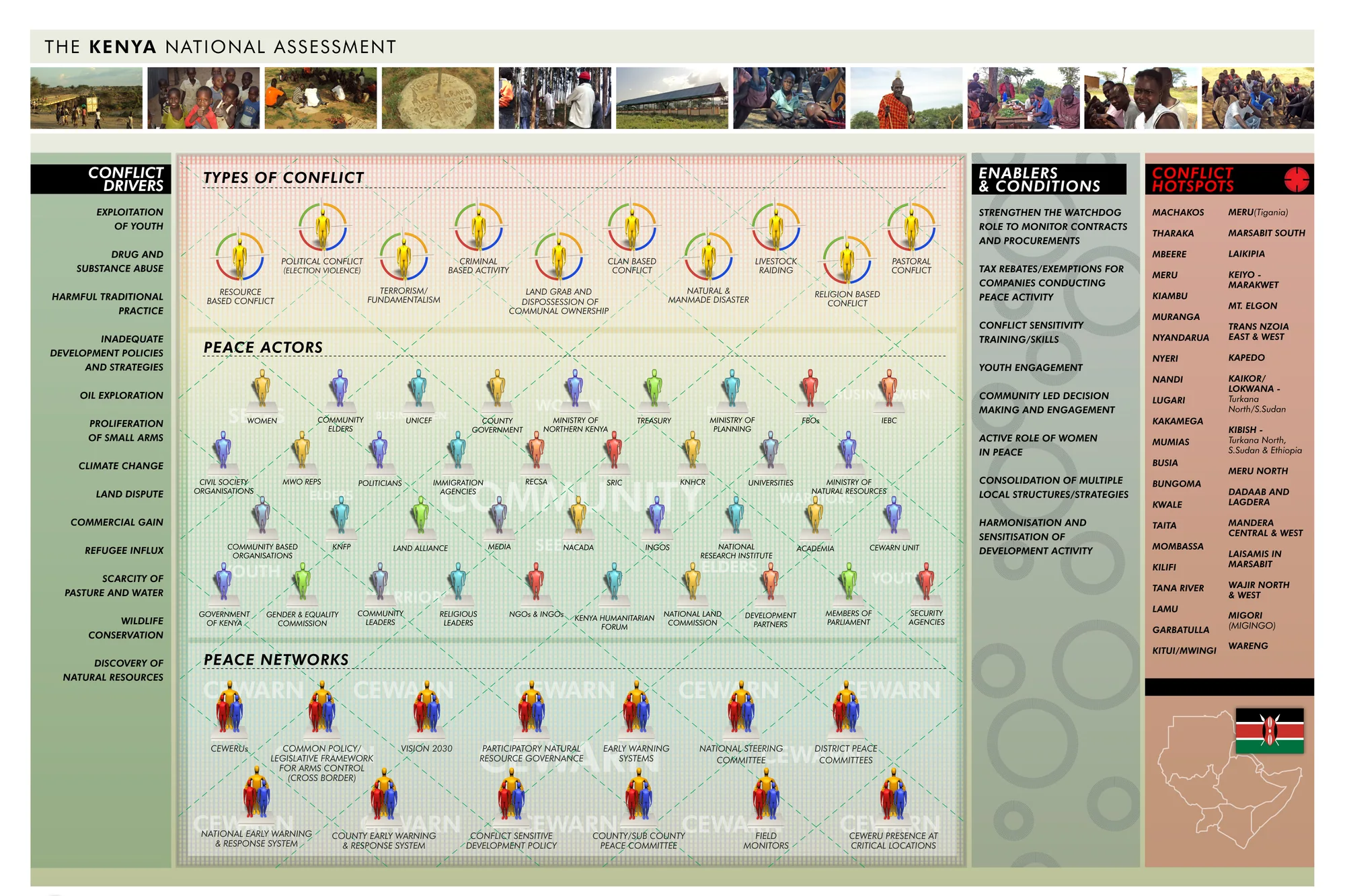
Group Partners spent weeks synthesising the material. It built a common structure for comparing perspectives, to find the issues they shared and the common drivers of conflict. The work became a series of visuals, each giving a consistent view of one cluster.
Part IV
From the nations
to one room.
National officials worked with the local visuals and gave each country its own. Then nearly sixty people met in Addis Ababa and built the framework for the strategy live, over two to three days.
Senior officials from government and from non-governmental organisations were asked to work with the visuals that represented the views of the people. Most had never seen visual tools used in this way. Engaging with structured views from below was already a win, given how rarely such views reach national processes.
They identified the top national threats to peace and security, and debated their causes and solutions. The questions had a fractal quality, having been asked at the local level too.
At a time when most strategy was still made from the top down, national players praised the CEWARN team for taking a different approach. The visuals and the structured data sparked strong debate, and strengthened ownership of the mechanism across the member states.
From each meeting came a detailed report, and from those a new visual for each country, reflecting the national voice.
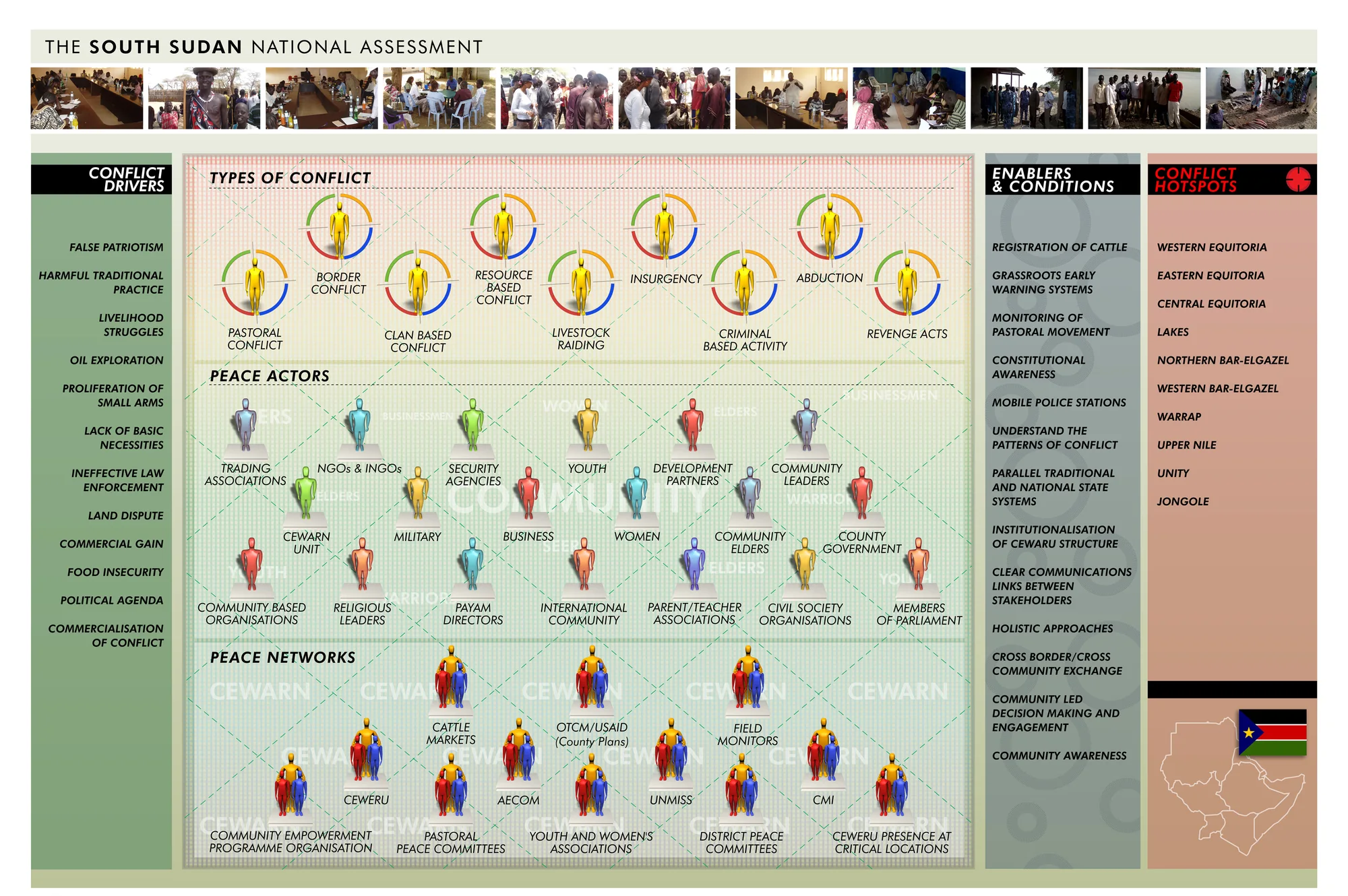
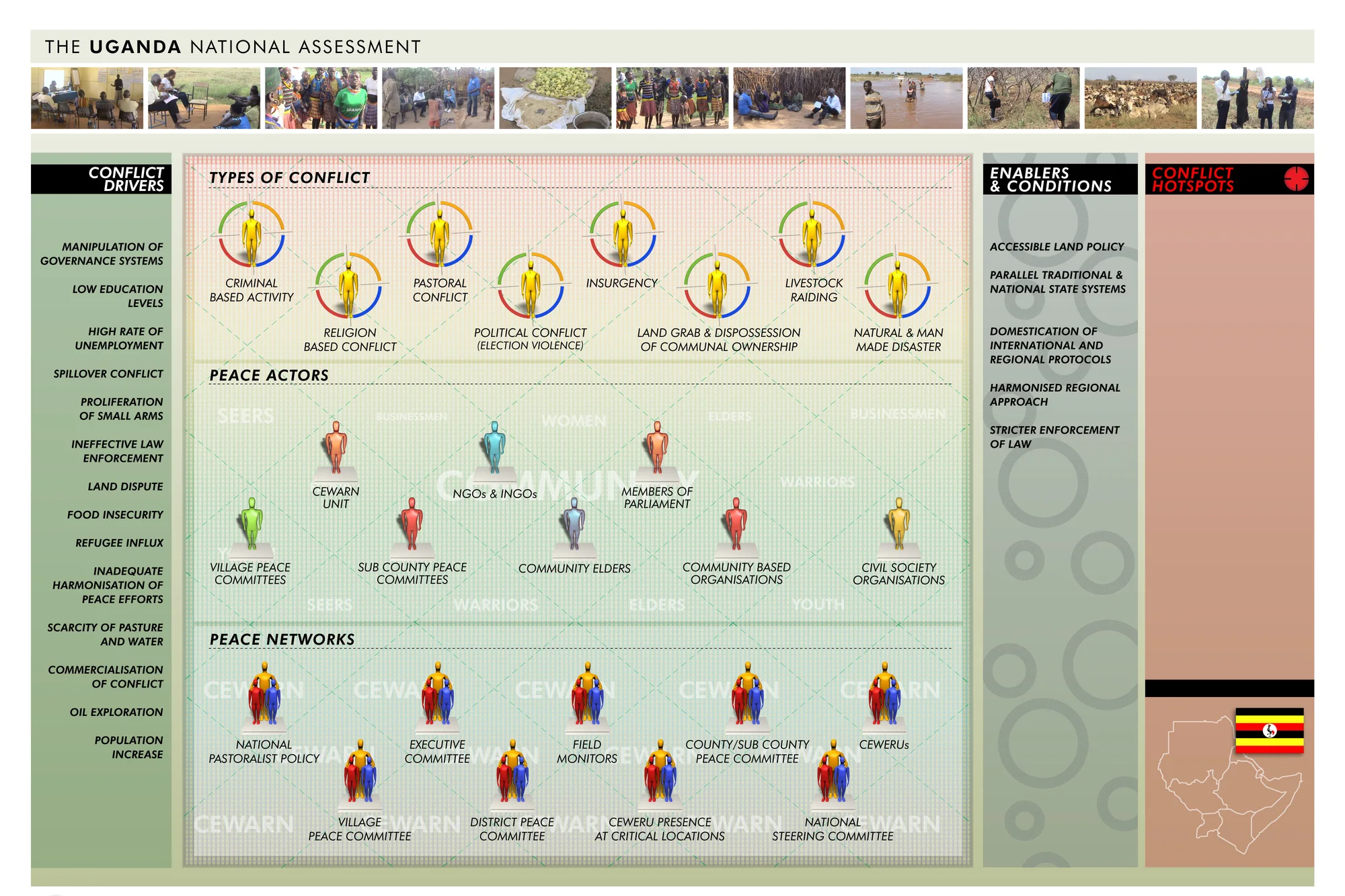
The situation demands a comprehensive and holistic approach that addresses the big picture from a regional perspective. In this respect, CEWARN needs to expand and transform itself into a Regional Peace Hub that prevents conflict and builds peace in the IGAD region.
The process then moved to the regional level, in Addis Ababa. The CEWARN Unit and the heads of the CEWERUs came, with UN and diplomatic officials and senior people from NGOs and donors. Nearly sixty people spent two to three days in one room to shape the final piece of the puzzle.
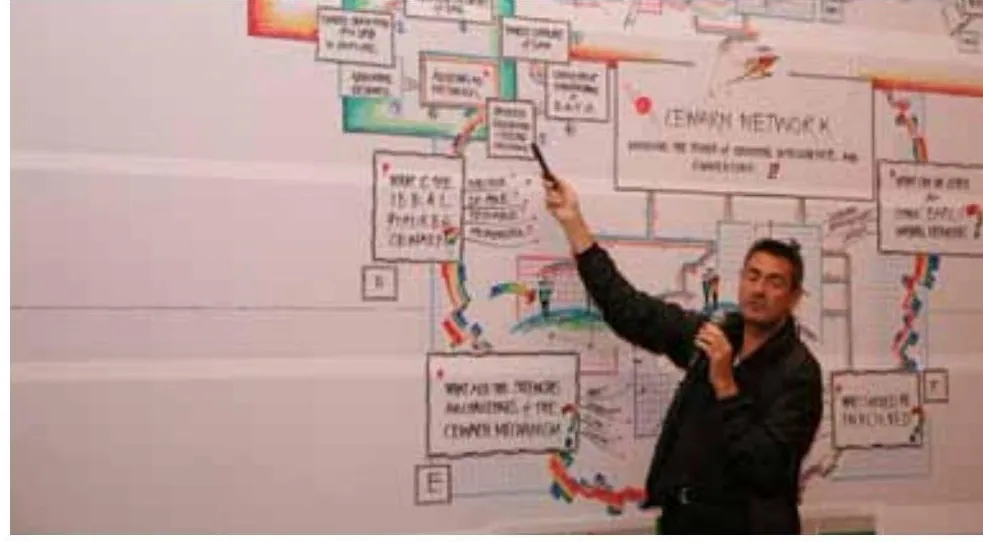
A gathering of that size needed its own design. Facilitated discussion and group work made sure every stakeholder’s view was represented in a framework built live over those days. Group Partners designed a bespoke structure with enough logic to produce input that could inform the strategy, without trying to write the strategy in the room.
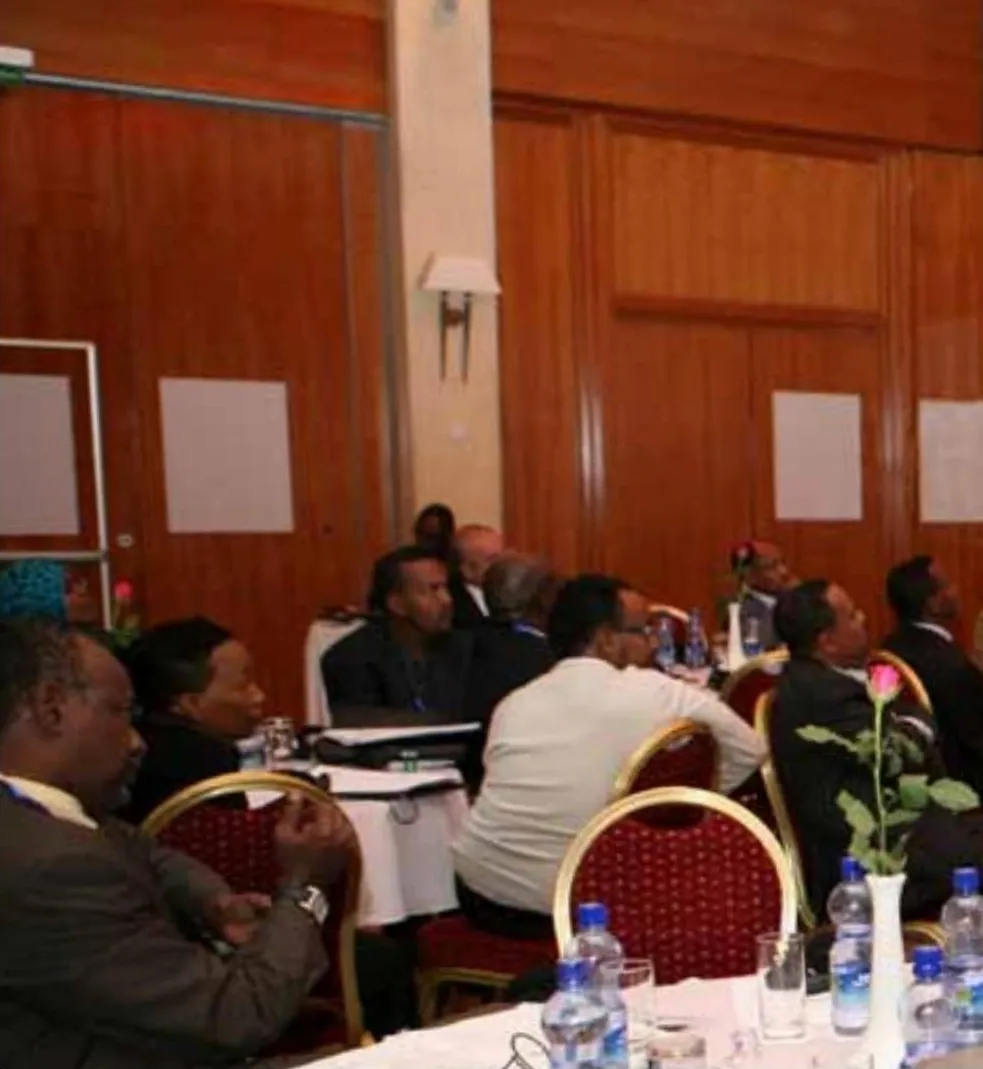
The result was a genuine co-creation. It held everything that mattered to the mechanism and its evolution, and the vital clues for the strategy ahead. The urgency was never far away.
There is tremendous loss of human lives in Turkana and we in the civil society are dismayed by the negligence of government in the protection of human lives. We are losing an average of 5 people in a day. What should we do?
Part V
A strategy told
as a story.
CEWARN decided what to take into the strategy, with Group Partners providing the structure. The Committee of Permanent Secretaries endorsed it without a single reservation.
The last step was largely CEWARN’s own. The team decided what to take into the strategy for the Committee of Permanent Secretaries. Group Partners provided the structure, with some objective facilitation remotely and in person.
The structure was the same eight questions Group Partners applies whenever a case has to be rationalised and articulated.
- What are our Strategic Outcomes?
- How will we measure them?
- What could get in the way of success?
- How would we describe our vision?
- What are the Critical Imperatives for achieving the vision and the outcomes?
- How will we achieve this?
- What is the roadmap for the journey?
- How do we need to work in the future to sustain the vision?
The vision was simple, and rather profound.
An IGAD region in which conflicts are resolved peacefully and justly and whose peoples live in shared prosperity.
The framework set out seven Strategic Outcomes for 2012 to 2019, among them the use of CEWARN’s decision support tools in making policy. Ten Critical Imperatives were to keep the plans honest. The analysis behind them named thirteen major trends driving peace and conflict in the region, ten challenges and ten strengths.
Strategy, at base, is a story about travelling from the present to a major goal set in the future, supported by a coherent rationale that guides choices and action. The framework was written to be that story, and to evolve with the needs of the member states and their peoples.
In July, a draft framework went to a validation and awareness meeting of officials from the member states and IGAD, with CEWARN’s main civil society partners.
The strategy was then submitted to the Committee of Permanent Secretaries, the most senior civil servants in government ministries. It was endorsed without a single reservation. Uganda’s First Lady was present, a powerful politician and policymaker in her own right. So were at least three government ministers and the region’s Committee of Ambassadors.
Part VI
From strategy
to practice.
With the strategy endorsed, the focus moved to 2013 and to turning it into plans. A workbook for the CEWARN network set out the thinking in its own words.
CEWARN and Group Partners regrouped at a team retreat to assess the operational implications of the strategy and draw up the first high-level plans for putting it into practice.
Endorsement of the process and its outcome had been universal. Questions of ownership and responsibility remained, and there was a lot more joining up to do. That meant returning to the principles of a living system as the team shaped its central operating model, and supported the CEWERUs and other partners in making aligned plans.
A workbook carried the story to the network.The Conflict System Workbook survives as a working draft. It begins with a genuinely wicked problem: how to understand differences and resolve them peacefully, and how to honour the basic rights of those close to us.
At the very heart of this sits human dignity, and the all too frequent loss of this most precious value.
Building peace is a mighty ambition, and building anything comes at a price. The workbook asks the network to become master builders. That starts with defining the system of conflict, and a taxonomy of its building blocks, from drivers to impacts. That common language would be vital to the strategy.
“Strategies are merely stories,” it says. This one was built from the grass roots. CEWARN had evolved from a group of organisations bound by a mechanism and protocol into a value network of equal partners, with a single-minded goal of delivering the mission.
The network describes what it has built as a Peace Architecture, in effect a “System That Identifies, Enables & Sustains Peace”. Dignity is a human right, and the business of the network is the early identification of threats to it. Its framework is simple but not simplistic: it simplifies without patronising and clarifies without dumbing down.
Data, the workbook says, is the new oil. Turned into information of value, it is the oxygen running through the network of partners. The workbook closes on a few vital numbers.

Along the way, Group Partners learned five lessons.
Use a flexible structure from the very start. Even the most creative people need a frame within which to think and deliver value. Frameworks are interconnected logic models that keep people aligned and create a positive tension that encourages critical, holistic thinking.
Plan to cope with the unexpected. Living systems involve a degree of chaos, so the work has to be aligned around principles rather than rigid rules. Watching the shifting dynamics and adjusting quickly is a core capability.
Respect the data. Consulting the collective is immensely powerful, but its insight only becomes valuable when it can be used meaningfully. That needs respect for the data, and a good understanding of its meaning and context.
Make the visual work hard. A visual makes it easier to arrive at a common understanding of a complex challenge. It has strategic value only when combined with structure and rigorous context.
Respect perspective. Real co-creation needs emotional attachment to the outcome and a genuine wish to understand a diverse group of stakeholders. It means suspending personal opinion and assumption, and seeing the world as others do.
Drawn from Group Partners’ publications on the CEWARN programme: an article from 2012, Presenting the CEWARN Strategy Framework (abridged version) and the Conflict System Workbook. Names, titles and figures are as they stood then.