


Part I
Rigged, and
rigged again.
Nigeria’s 2007 elections fell far short of basic standards for democratic elections. Before the 2011 polls, Tunji Lardner of WANGONeT wanted to examine them the way a detective examines a crime.
The 2007 Nigerian elections had fallen well short of basic international and regional standards for democratic elections. They were marred by poor organisation and a lack of transparency, by widespread procedural irregularities and significant evidence of fraud, by voter disenfranchisement and by numerous incidents of violence.All dates and figures in this story are as Group Partners and WANGONeT published them in 2011 and 2012.
As a result, the elections have not lived up to the hopes and expectations of the Nigerian people and the process cannot be considered to have been credible.
At yet another conference in Nigeria, the issue of rigging the 2011 elections was raised again. Tunji Lardner of WANGONeT, the West African NGO Network, wanted to break away from “predictable low-calorie thinking” and take a serious look back at 2007. He wanted to examine the hidden pathologies, identify concealed patterns and point fingers at the culprits.
He staged the event as if it were a criminal post-mortem investigation. It would go back to 2007 to look for latent clues and interview ‘persons of interest’, then examine the corpse of the elections and conduct the post-mortem before a live audience.
It was clear in my mind that the only way we could get people to look at old things differently, was to present them with a newer lens to view old, familiar but really unexamined phenomena.
The project was WANGONeT’s, sponsored by the UK Department for International Development (DFID), in partnership with Group Partners and Equality Foundation. Group Partners had never used its process quite like this before. The final title for the event said it all: How NOT to Rig an Election.
The work began with one question, asked together by WANGONeT and Group Partners.Group Partners calls this the exam question: the one question the whole piece of work has to answer.
How and what can we learn from past elections to influence the future of the Nigerian election system and avoid the historic problems of widespread rigging?
Tunji and his team spent many months and huge energy persuading others to support the vision. The leap of faith they took, and their belief in the process, owed much to the supporter and facilitator Adewale Ajadi, with whom Group Partners had worked several times before.
The project fills me with hope that if we can prioritise organisation and systems over the next 10 years we would truly be able to transform from a country of indigenes to a nation of citizens. 150 million empowered, networked creators of value, authentic in their being, inspired by their dreams, connected beyond creed and engaged to deliver excellence.
Part II
Every phase,
every stakeholder.
Months of reading turned four years of reports into one picture: nine phases of an election, each examined for the part five groups of people could play in its failure.
In preparation, the team read and analysed over four years of frustration and countless reports. It looked into the global context and came to understand the ongoing challenges and the daily barriers, down to the technological and infrastructural realities.
It is very easy to compare this system with other, more mature versions and to look at the evidence through an outsider’s lens. To really understand requires an impartial mind coupled with forensic rigour. With patience and respect for the context, a system emerges, one in need of care and rehabilitation. The clues are all there if we choose to see them.
The system that emerged takes a very different view of rigging. It is a systems view that looks objectively at every aspect of the process and breaks it down into logical, interdependent phases, seen from the perspective of different stakeholders. The research, conducted primarily through the lens of the 2007 elections, focused on five groups: the electorate, the politicians, the security agents, the judiciary and the administration, the Independent National Electoral Commission (INEC).
When a system is failing we are all complicit in different ways, or have the potential to be. It is only a system if we are all contributing to the same goal and outcome.
Nine phases were chosen, each representing events and activities that involve the stakeholders to varying degrees. There is a natural sequence, but the phases are not completely linear: some run in parallel and others overlap significantly. Each contributes to the next, so actions in one can affect the phases that follow, positively or negatively. Many of the implications carry a cumulative effect.
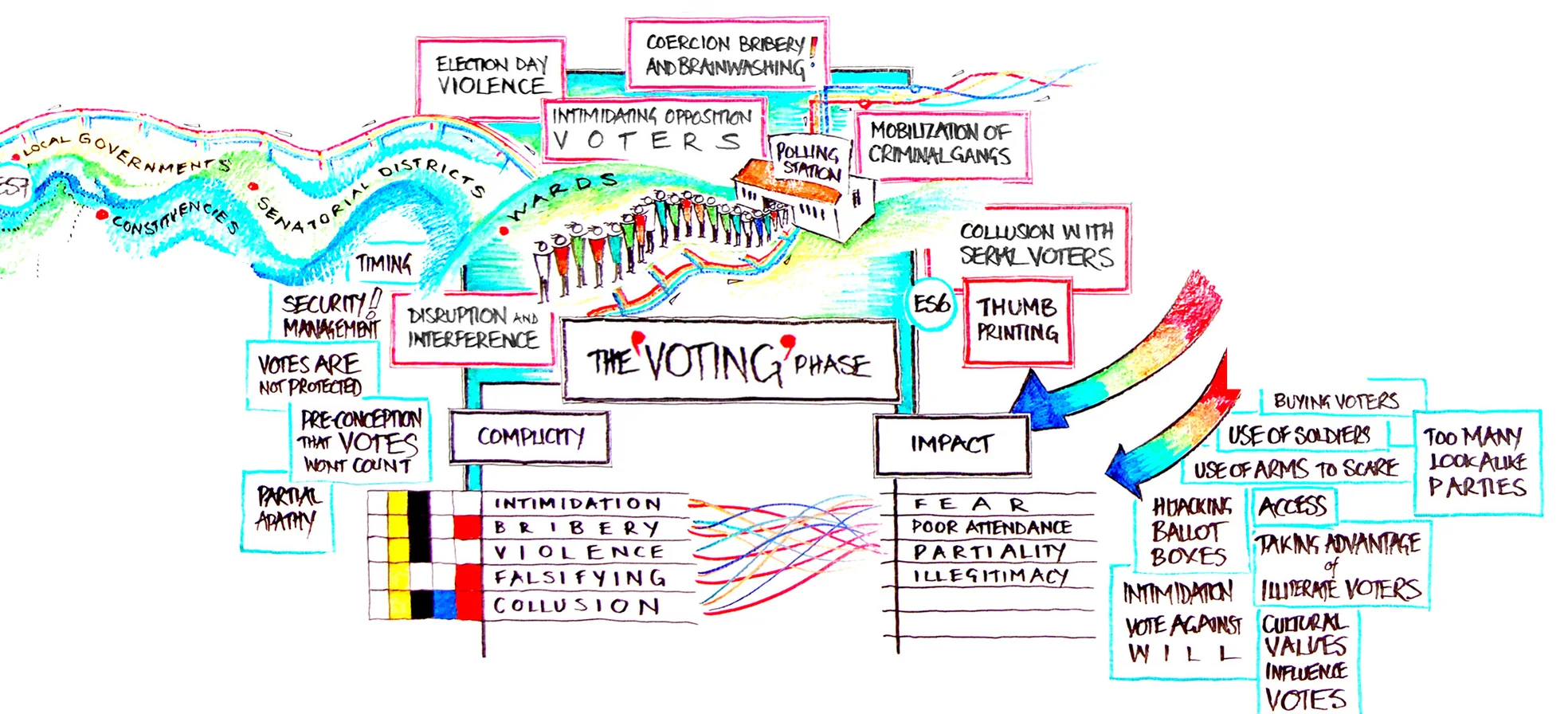
Every phase was built to the same architecture: its primary purpose, the insights into its weaknesses based on the 2007 elections, the potential for complicity in its failure by each stakeholder group, and the potential impact on the system.
Announcement. In reality the process starts with rumour and debate. Well planned communication builds understanding and confidence in the electorate. Bad communication brings confusion and early cynicism.
Registration. Knowing exactly who is entitled to vote, and placing a responsibility on every eligible citizen to register. Ballot papers are not commodities for sale.
Nomination. The electorate needs choice. Parties must follow a democratic process of their own when selecting candidates, free of favouritism and personal agenda.
Canvassing. Candidates must make clear what they stand for. A manifesto clearly and consistently communicated by the party and its candidate is an imperative.
Pre-voting. Equipment moved across rural and urban regions, secure polling stations, ballot papers and skilled people, all tested, with contingency in place.
Voting. Stations open when they say and for as long as they have promised. No citizen should feel intimidated or discouraged from turning up to vote.
Collating. Every ballot paper safely transported to the count, with spoiled and destroyed papers openly declared.
Counting. One fundamental objective: to count accurately the votes per candidate, with complete objectivity and total transparency of process.
Declaration. The system is not complete until all stakeholders agree that a fair and democratic process has been followed. Challenges and petitions must be dealt with in a legal framework that cannot be corrupted.
Part III
Reading
the clues.
The research papers supplied the evidence for every phase. Some of what they recorded about past elections was startling.
The insights for each phase came either from research carried out ahead of the event or from participants on the day. Everything captured in the framework was validated by the group, and was believed to give a fair representation of the challenges, based on the 2007 election.The main sources: the final NDI report on Nigeria’s 2007 elections; Political Institutions and Electoral Integrity, by Simmons Cooper Partners; a 2009 paper by Professor Yemi Osinbajo and David Kangah; and WANGONeT’s own research on politicians and police. Some of the weaknesses may already have had actions in place to correct them for 2011. They were included to give a complete picture of the system as it was perceived then.
Announcement. Delays in announcing the electoral calendar caused many parties, civil society organisations and citizens to question INEC’s capacity to run the 2007 polls. INEC did not produce a comprehensive election timetable, with firm election dates, until August 2006.
Registration. Unable to launch voter registration in January 2006 as planned, INEC began a pilot exercise in the Federal Capital Territory in May. As registration centres opened closer to people’s homes, some re-registered to avoid travelling far on election day, because in Nigeria voters must vote where they registered. INEC announced it would eliminate double registrations, denying those voters any chance to cast a ballot at all.
Canvassing. The Nigerian Election Debates Group, a coalition of more than 20 media outlets and civil society groups, invited 26 candidates to twelve 90-minute debates in Abuja, broadcast live on television and radio. Several key contenders failed to honour their commitments to take part.
Pre-voting. INEC did not begin publicising how polling would be organised until 8 April. A Supreme Court decision on 16 April, ordering a disqualified candidate back onto the ballot, turned logistics into “a nightmare”.
Voting. One paper judged that it would be “an abuse of language to use any of the epithets ‘free’, ‘fair’, or ‘credible’” about what took place on the 14th and 21st of April 2007.
Collating. In one investigation, a fingerprint expert and a team of ten others worked daily for almost three months and compared almost a million ballot papers. In each state surveyed they found extensive multiple thumb printing: one or two people, five at most, thumb printing hundreds and thousands of ballots in some locations.
Counting. Falsification is usually the work of the returning officer and his deputy, who receive and collate the results sent from polling stations. The research recalled an earlier governorship election in Ondo State, where a court compared the declared result with the evidence of the polling and party agents’ result sheets.
The falsification, the court found, was done at the level of the deputy returning officer.
Declaration. Election day violence was followed by public protests in many states. In some instances INEC’s national headquarters announced results that should have been announced in the states. In Delta State, the results were declared in Abuja before collation and counting had finished in the state.
Part IV
Seventy feet
of wall.
Nearly 200 people met the framework on a single wall and spent a day doing the detective work themselves. By the evening it belonged to them.
This type of event had never been staged before. On arrival, participants were confronted by a huge visual framework covering a 70-foot wall. It showed the guts of a new system, built from months of preparation behind the scenes by Group Partners and by Tunji, Ade and their team. For most of them, it was the first time they had seen the wall.
Nearly 200
people assembled to make ‘rigging’ history.
Slowly, over the course of the day, they did the detective work. They moved through each phase in turn, validating what was on the wall and then discussing in groups what it told them and what had been missed. Discussion was animated and participation complete: everyone had their say about every phase.
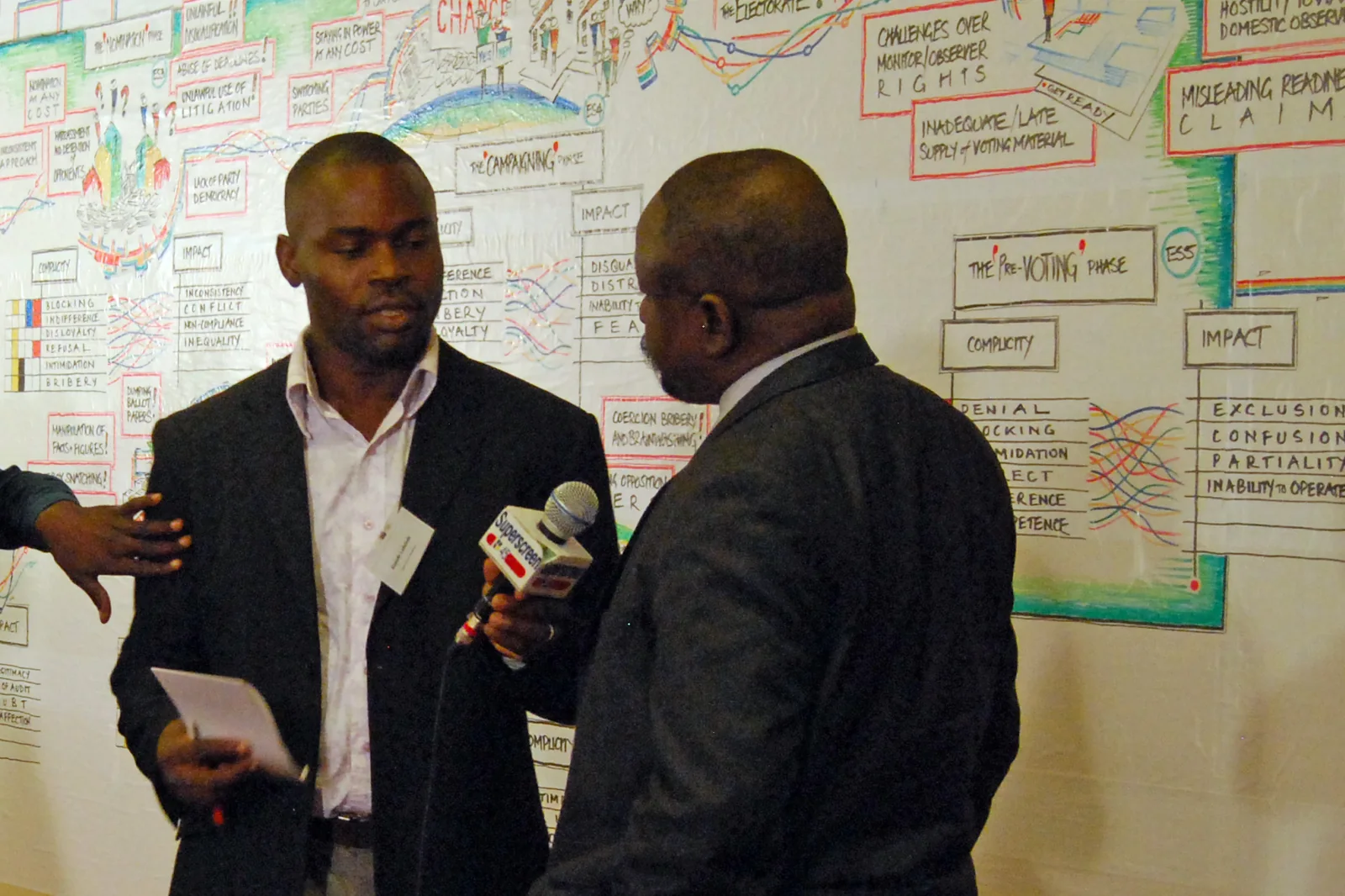
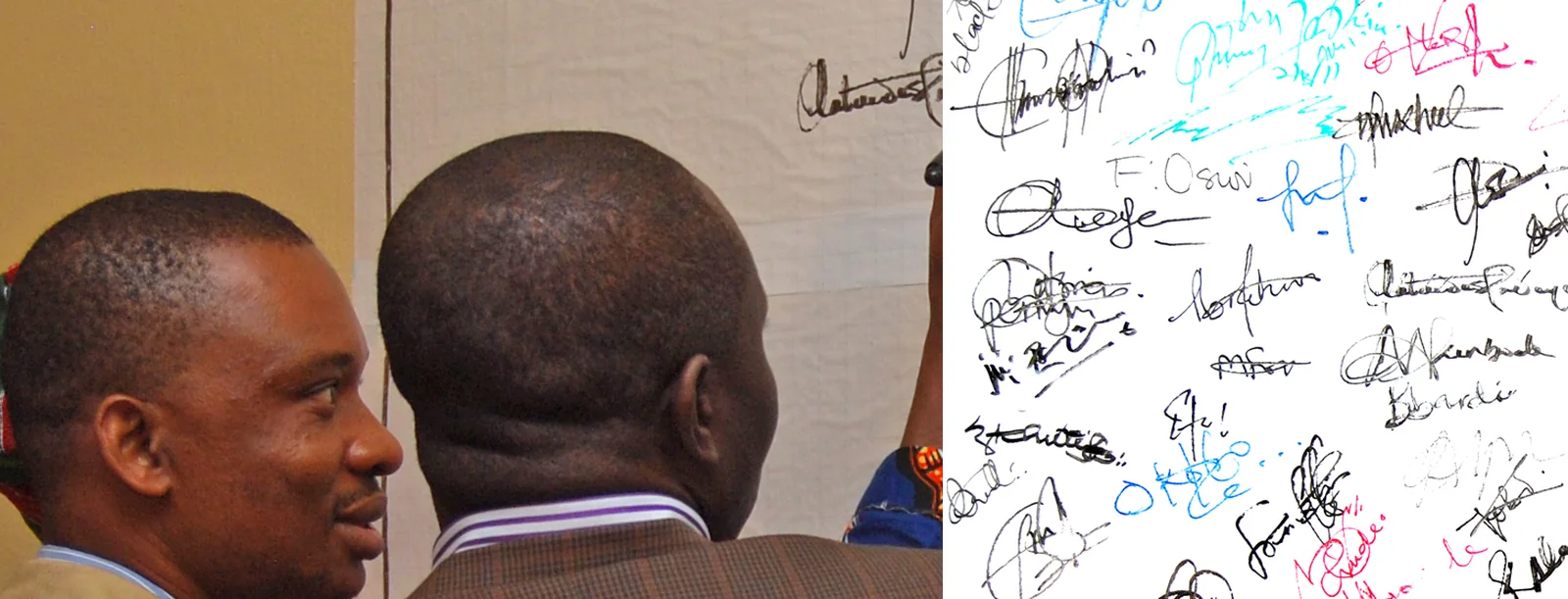
New insights and observations were added to the wall as the conversations were honoured, and ownership of the framework passed from a small core of people to the entire group. Each table nominated its most critical action. Many, if not all, of the participants signed the wall and made their feelings clear.
The incredible ‘system of thinking’ that the team built is one thing. Tackling the underlying causes and making them end is something else entirely.
The workshop was a lifetime experience. I have never participated in a workshop that took my breath from the beginning to the end. I didn’t want to blink to lose out.
The workshop was enlightening and revealing of the many characters, behaviours and actors often overlooked in our approach to preventing election rigging. Thank you for the visual thinking approach. It puts things in clear perspective.
Part V
A blueprint,
version 2.0.
The day ended with the draft of a Nigerian Electoral System Version 2.0 Blueprint, designed as a living system that governs itself.
Many themes emerged as the framework developed, with much debate about what to keep doing, what to start doing differently and what must stop. The big questions became what we must do, and how we do it. Everything heard on the day was either a stated issue or a clue to a solution.
Among the big thoughts were six, massively interlinked:
Clarity about each standing party and the issues it is fighting for.
Anything less than transparency is wholly unacceptable, and punishable by effective law.
Social media must become a platform for the collective conscience.
This is every Nigerian’s responsibility, and now is the time to stand up and be counted.
Politics and the security and administration systems must be separated in every sense.
The workshop’s findings should be consolidated into a new Nigerian Electoral System Version 2.0 Blueprint, for possible inclusion in the constitution.
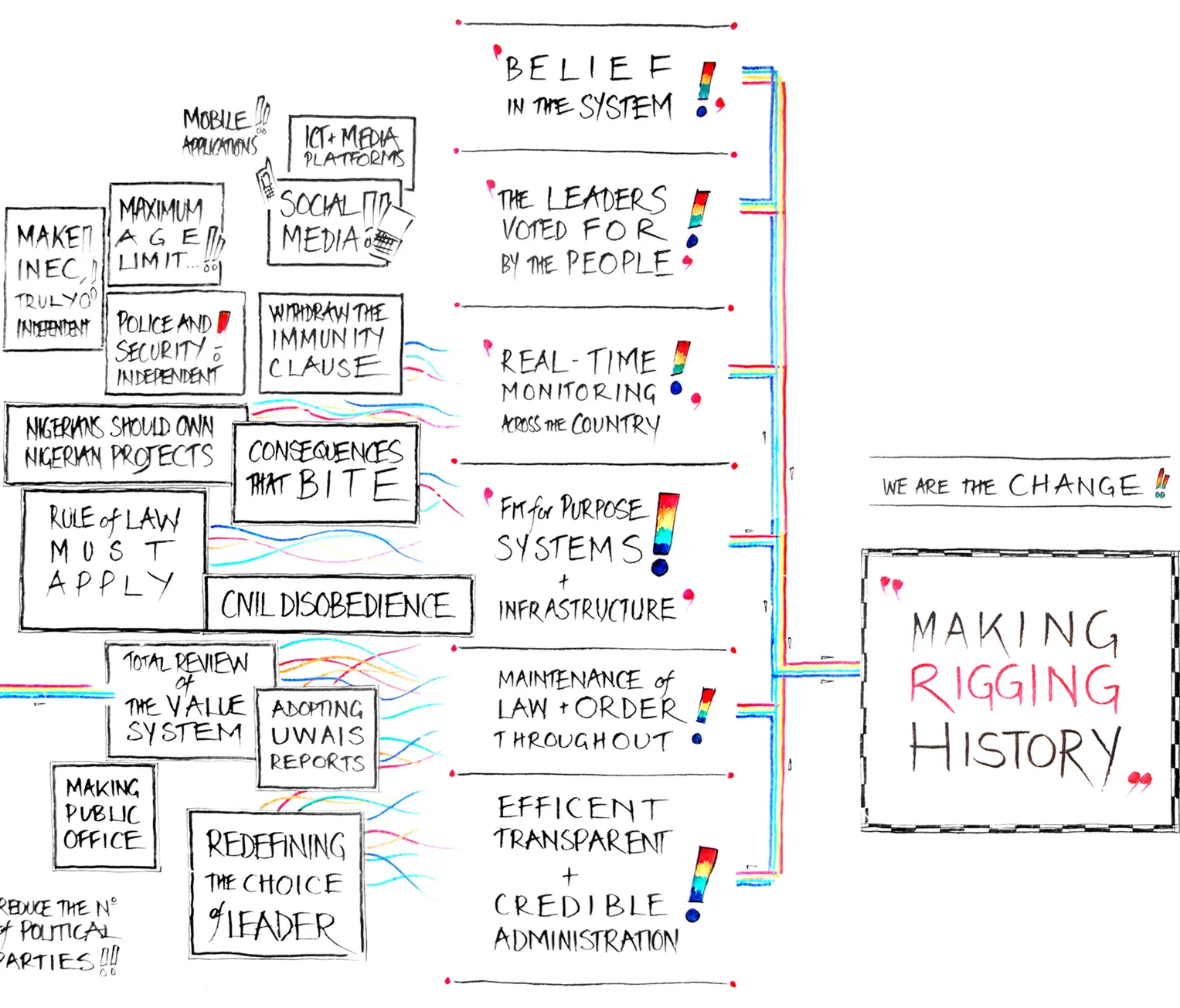
A living system cannot be built from rigid process and rules, yet it needs to govern itself and interoperate. It adapts to its changing environment and works at the level of the individual part and of the whole. Just as in a natural living system, the blueprint has an implied sequence and order.
Purpose. The reason this matters to everyone, almost the manifesto. Without a common purpose, nothing that follows can emerge in a unified way.
Promise. The covenant everyone signs up to, and the basis for governance. Nigeria has a Pledge already, and this would add meaning to it.The National Pledge: “I pledge to Nigeria my country, to be faithful, loyal and honest, to serve Nigeria with all my strength, to defend her unity, and uphold her honour and glory, so help me God.”
Culture. The shared identity and values that unite the system.
Contribution. Every member of the system has a part to play, and each must be very clear what it is.
Leadership. At many levels, showing up in the administration of the core processes, the governance of the promise and the enforcement of consequences when the system is compromised.
Exchange. Sharing across stakeholders, so that the system keeps learning and is able to evolve and adapt.
Organisation. Capability, skills, equipment, platforms and infrastructure. Until the purpose, the promise and the contribution are clear to everyone, the organisation of the system is sub-optimal.
Six imperatives would, if addressed, deliver a new system for the country: educate the electorate, equip the administration, change attitudes, redefine the legal framework, govern the system, and establish identity and purpose.
I learnt another dimension to problem identification and solving without adopting other high technical approaches to complexity.
Part VI
After
the vote.
The 2011 elections were widely recognised as a significant improvement. The violence that followed them showed how far there was still to go.
The event, and the still evolving blueprint, had a positive impact on the 2011 elections. They were widely recognised as a significant improvement on previous years and were reported as generally well managed, with the voters’ register seen as the most accurate to date.
Much progress was still to be made.
800
lives were claimed by the violence after the 2011 elections, which also displaced 65,000 people, mainly in the north of the country.
So this was far from the end of the journey. A good start had been made against great odds, and Tunji, Ade and the team continued the work on the ground to sustain the impetus of that week.
Sustaining change means owning each part as much as the whole. Look at the system of anything and it becomes massively detailed, which is at the root of why change is so tough. Everybody has to understand deeply the role of their own part in the big picture. That is not easy at a distance, so communication and camaraderie become big dimensions. Passion for the simplest thing is as vital as for the most complex.
We can define the outputs but the outcomes are with all of us. It is for Nigerians to decide what to do with this new way of looking at our system. The moment we look at Nigeria as a system we can go beyond the process of elections and think about democratic governance.
On the day, Group Partners found the singing of the national anthem extremely moving. Its second stanza, they wrote, sums this up better than anything they could write. It ends: “Great lofty heights attain, to build a nation where peace and justice shall reign.”
First published by Group Partners in April 2011 as How NOT to Rig an Election, a WANGONeT project sponsored by DFID in partnership with Group Partners and Equality Foundation, and in December 2012 as A Group Partners Case Study into the Nigerian Election System. Names and figures are as they stood then.