
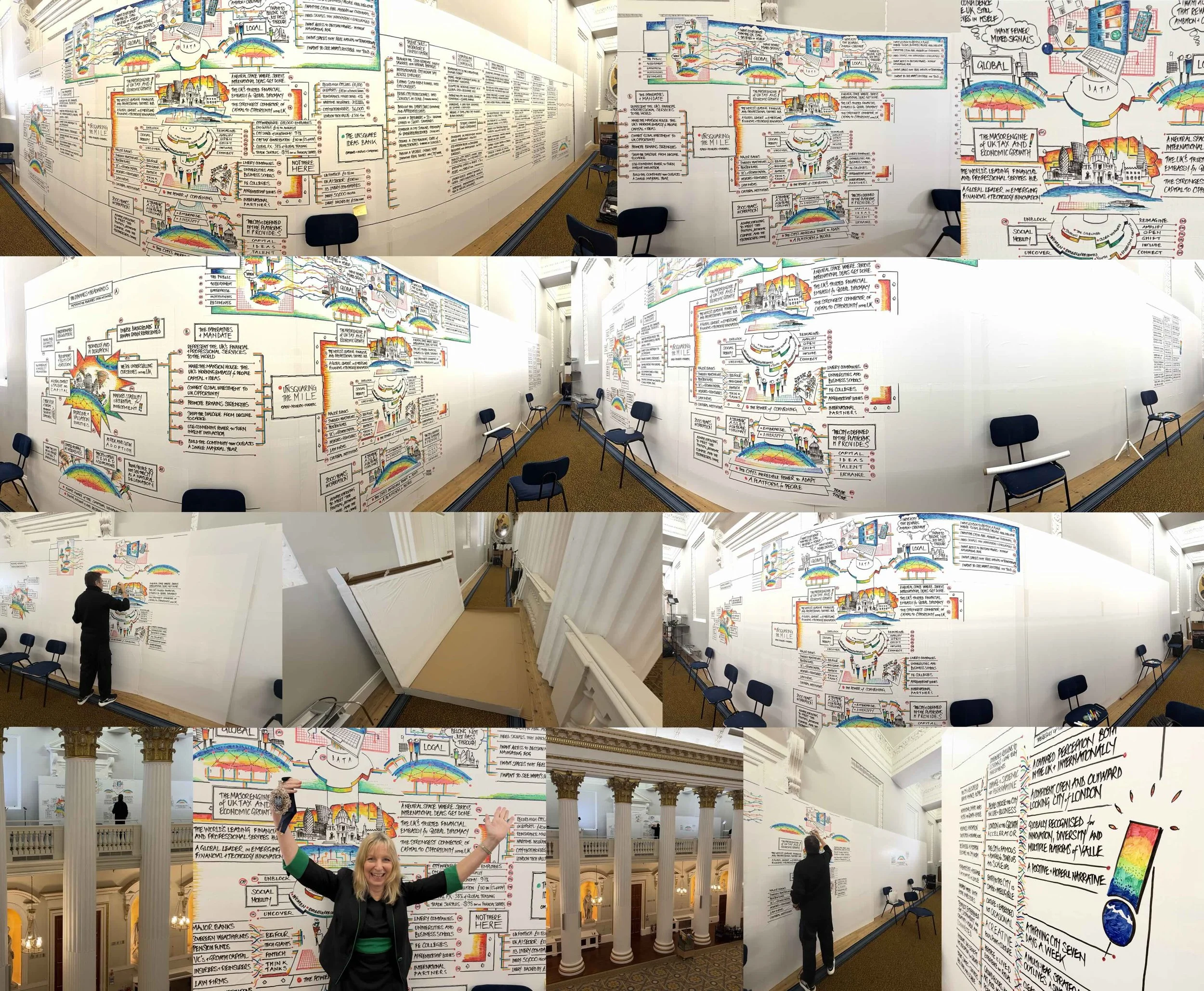
Welcome
The UnSquared AI System is at the foot of this page - ask it anything about UnSquaring.
UnSquaring The Square Mile
Nine hundred years of tradition. One woman's term to shift direction.
Dame Susan Langley is the first Lady Mayor of the City of London. Not the first woman, the first to carry that title. The distinction matters. It signals that this Mayoralty is not performing continuity.
It is a choice of change.
The City of London generates more tax revenue than any comparable square mile on earth. It houses the world's leading financial and professional services cluster. Its Livery companies hold nearly £5 billion in assets dedicated to charitable and public impact.
It sits on two thousand years of continuous adaptation - Roman, medieval, imperial, digital. And yet most Londoners have never set foot in it on a Sunday. Most young people cannot name a single route into a City career. Most of the country sees it as closed, opaque, and not for them.
That is the gap this agenda addresses. Not with slogans. Not with events. With a disciplined framework that maps the forces shaping the City, identifies where a one-year Mayoralty can actually intervene, and builds initiatives designed to outlast the term.
UnSquaring means making the Square Mile accessible, legible, reachable, and relevant to people who currently feel none of those things.
And by way of example - connecting apprentices to craft trades through the oldest professional network in the world. It means opening the City on Sundays. Mobilising 50,000 Livery members as an active workforce for City ambition, not a ceremonial backdrop. It means treating the Mayoralty's real power, convening and blessing, as a precision instrument, not a rubber stamp.
This site holds the working blueprint.
The strategic wall. The Long List (Module D): The scoring matrices. The Short List (See below) - The Focus List (See below) The initiative recipes - example below. The narrative architecture. None of it is fixed, but as a reference.
All of it is designed to move to change within twelve months. And the subsequent 24.
Scroll down. Or ask the UnSquared AI any question. It knows the whole framework.
PASSWORD: UNSQUARED-247
An Example Narrative -
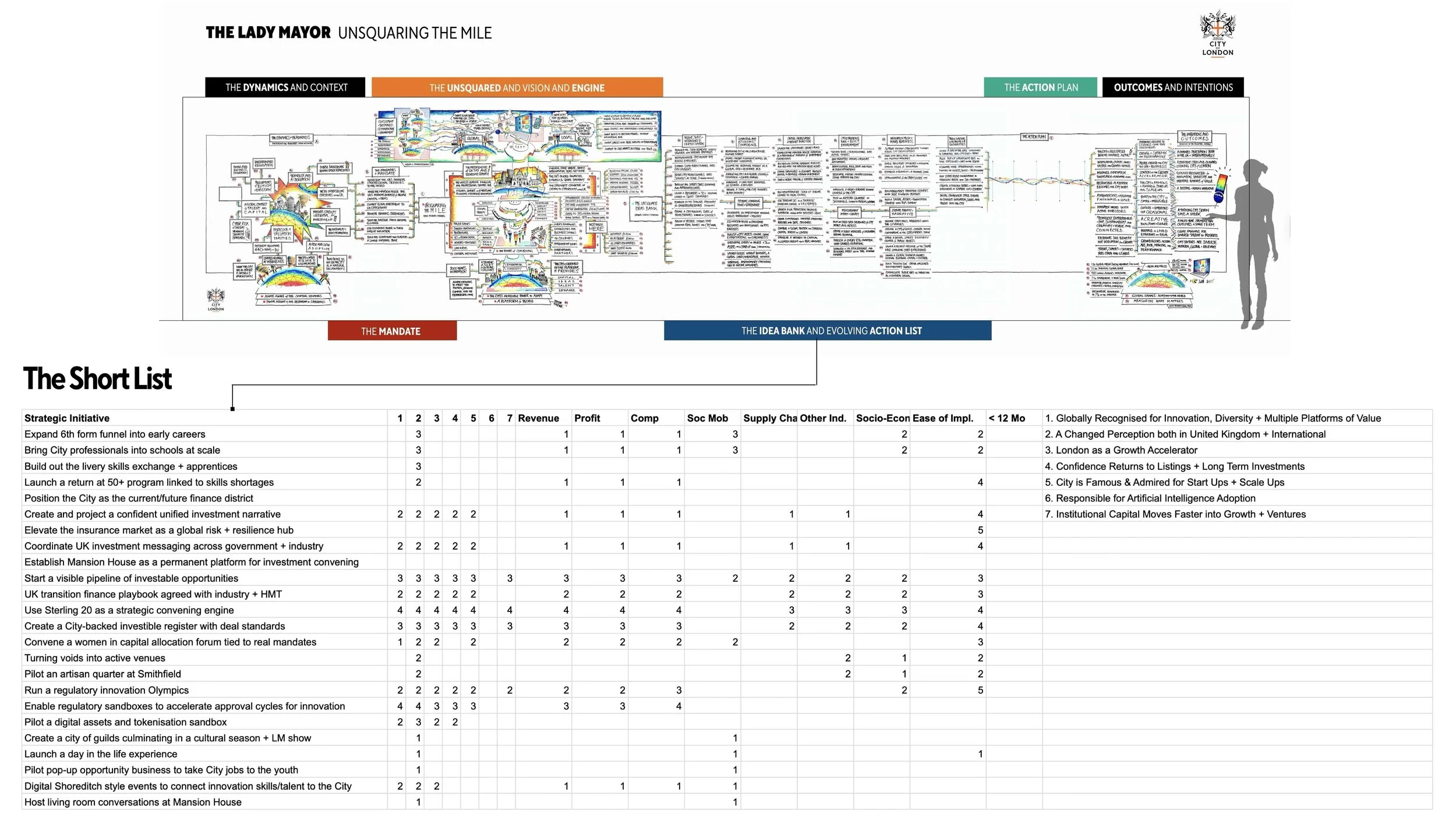
What Can Others Do To Deliver
Recipe Cards are the operational backbone of the UnSquaring the Square Mile agenda. Each card takes a priority initiative — such as the FSG Livery Mobilisation, the Lady Mayor's Livery Craft Apprenticeship Award, or City Sunday — and sets out precisely how it moves from announcement to delivery.
The format is deliberate: it separates what the Lady Mayor can convene and bless from what others must operationally own, defines measurable outcomes, identifies dependencies and risks, and sequences the work into timed phases.
The cards exist because the Mayoralty's power is ambassadorial and convening, not executive. Without clarity on who does what, civic initiatives stall at the point of good intention. These cards are designed to prevent that.
Looking At The Framework As A Whole
The model moves deliberately from context to commitment.
It begins by making the dynamics visible. The forces shaping the City, many outside its control, but all shaping outcomes. From there, it clarifies the mandate. What the role is, and crucially what it is not. That discipline prevents drift into symbolism, noise, or overreach.
Only once that grounding is clear does the framework open the space for ideas. Broad, diverse, sometimes uncomfortable. Held without premature judgment. This protects ambition in a world that tends to shrink it too early.
The ideas are not promises. They are options, kept visible so choices are made consciously rather than by habit.
Action then follows ownership. Initiatives are not scheduled because a calendar demands it, but because real partners step forward to carry them. Time becomes an outcome of commitment, not a constraint imposed upfront. This allows momentum to build without brittleness.
Finally, the framework lands in outcomes. Not outputs or events, but shifts in behaviour, perception, confidence, and participation. These outcomes are defined in advance so success can be recognised when it appears, and measured without self-congratulation.
Taken together, this is a system for navigating complexity without losing direction. It allows multiple initiatives to coexist, evolve, and connect, while still serving a single vision and set of intentions. It replaces fragmentation with coherence, control with convening, and noise with signal.
Do not read this as a plan to be executed. Think of it as a way of thinking. In a system as complex as the City of London, that is the only kind of plan that works.
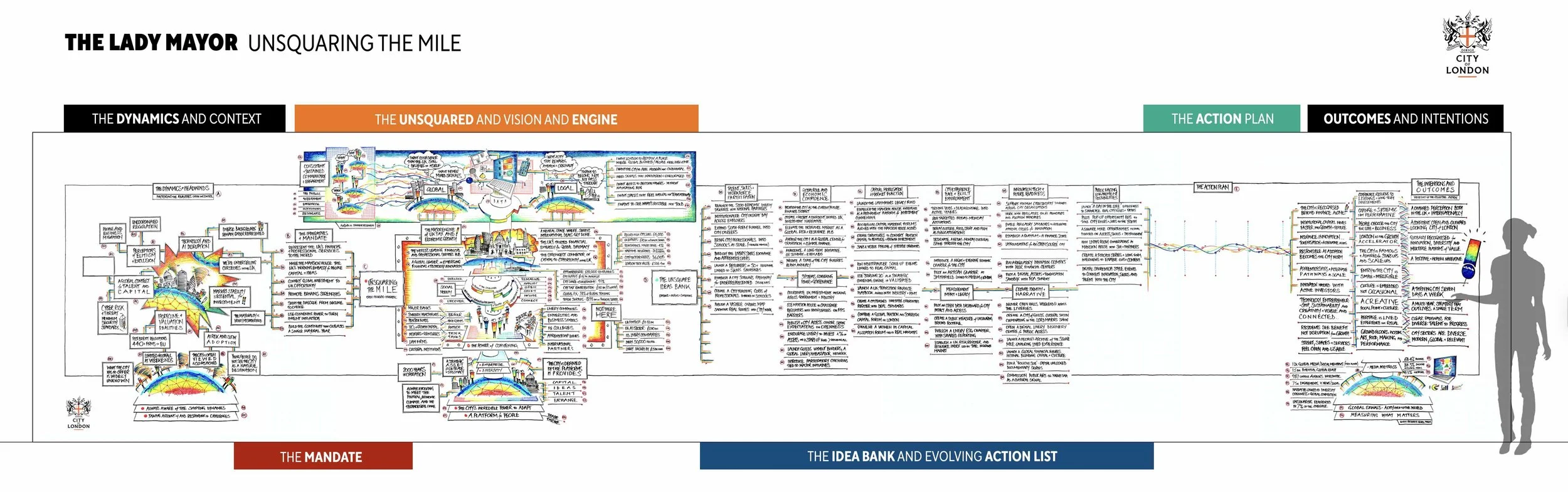
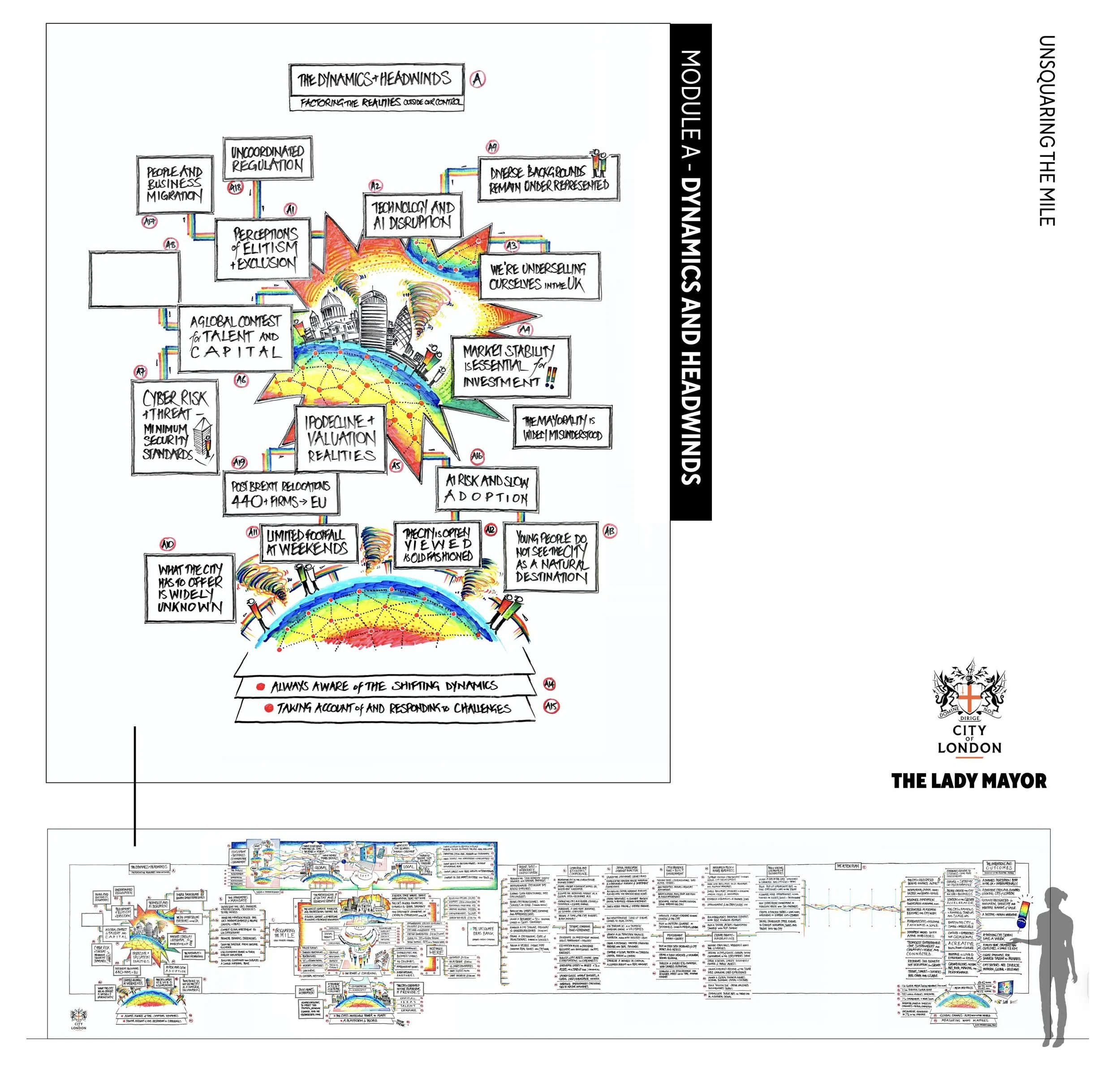
Module A - The Dynamics & Headwinds
Imagine the City as a system under pressure. Not because it is weak, but because the world around it is changing faster than the structures it was designed for.
At the centre of this image sits the City itself. Dense, interconnected, globally significant. Still extraordinarily powerful. But it is surrounded by forces that sit largely outside its direct control.
Start with the outer ring. These are the dynamics and headwinds. There is an intensifying global contest for talent and capital. Technology and AI are reshaping skills, speed, and value creation. Regulation is fragmented and often uncoordinated. Market stability, which investment depends on, feels more fragile. People and firms are more mobile than ever, and when confidence drops, relocation is no longer unthinkable.
Now move inward.
These pressures translate into perception. The City is still widely seen as elitist and exclusionary. What it offers is poorly understood beyond a narrow audience. Young people do not see it as a natural destination. Diverse backgrounds remain underrepresented. Even where the City is competitive, it routinely undersells itself, particularly within the UK.
The role of the Mayoralty itself is often misunderstood.
At ground level, these forces show up in everyday experience. Hybrid working hollows out footfall. Fridays and Mondays are quiet. Shops sit empty. Cyber risk rises. Firms rebalance operations. AI adoption is cautious and slow. Valuations reset. None of these issues are existential on their own, but together they change the rhythm, confidence, and feel of the place.
The point of the image is not to catalogue problems. It is to show that these forces are connected. Economic pressure shapes perception. Perception shapes talent flow. Talent flow shapes investment. Investment shapes vibrancy. And vibrancy feeds back into reputation.
At the base of the image is the response. Not control, because most of these dynamics cannot be controlled. Instead, awareness and action. Being explicit about the shifting conditions. Taking them into account rather than denying them. Responding coherently, rather than through isolated initiatives.
This is where convening, narrative, and openness matter. The task is not to defend the past, but to adapt the system. To open doors wider. To make the City intelligible, accessible, and relevant to people who currently feel excluded or indifferent.
The image captures a demanding but straightforward question. How does the City remain globally competitive while becoming more open, better understood, and more human at the same time?
That is the challenge this diagram is designed to hold.
Module B - The Imperatives and Mandate
Module A explained the forces acting on the City. This clarifies what the role actually is in response. At the top is the mandate.
The job is not to run the City, regulate markets, or manage institutions. It is to represent the UK’s financial and professional services to the world. That is the core purpose. Everything else flows from that.
The first imperative follows directly from it. Representation is not abstract. It means showing up internationally with clarity and confidence. Making the case for the UK as a serious place to invest, trade, insure risk, and do business. Not defensively, not apologetically, and not as a collection of disconnected voices.
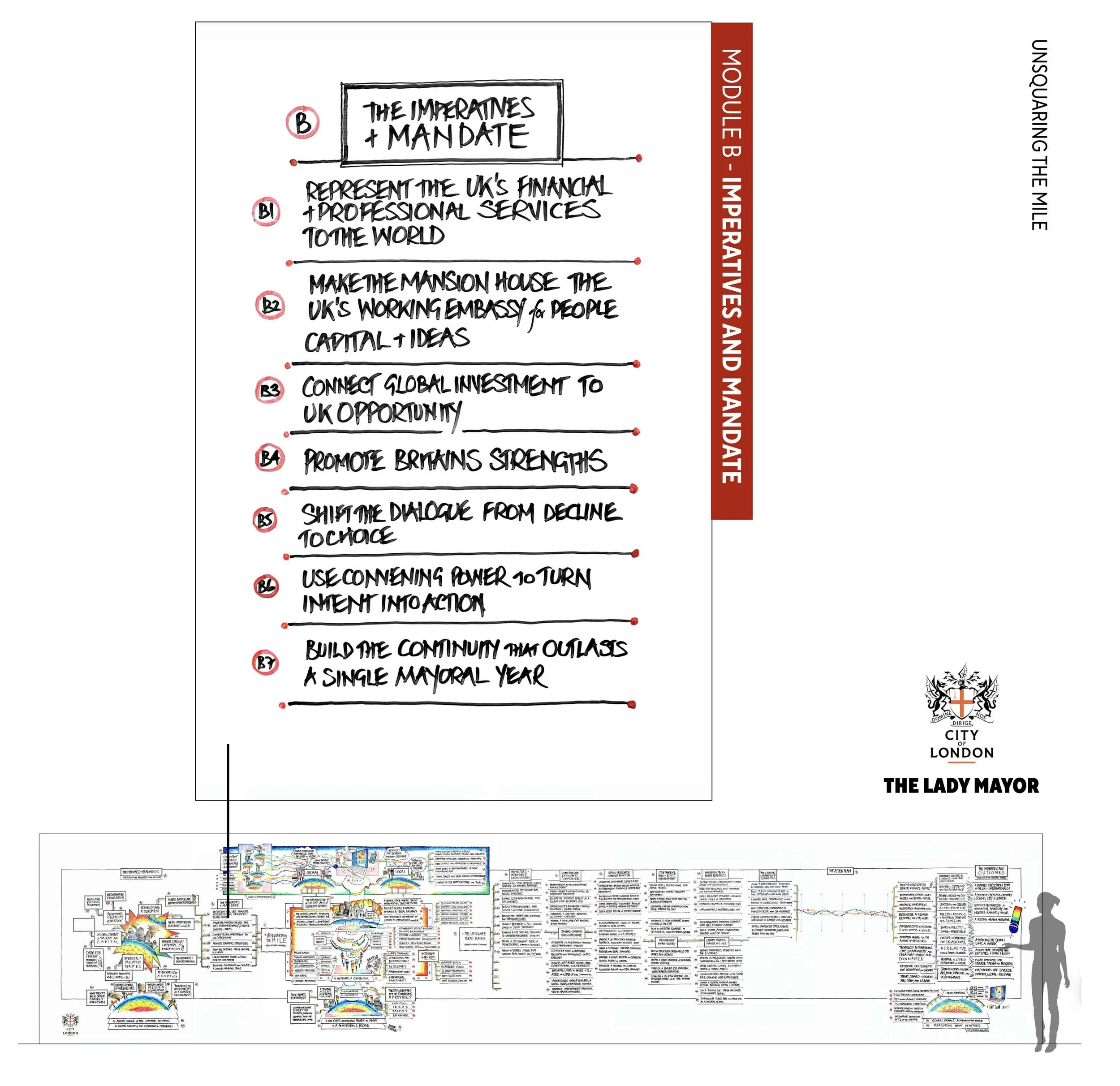
That leads to Mansion House. The instruction here is very specific. Make it the UK’s working embassy for people, capital, and ideas. Not a museum. Not a backdrop for speeches. A place where honest conversations happen, where relationships form, and where intent turns into momentum.
From there comes the practical task. Connect global investment to a UK opportunity. Not a generic promotion, but a real match. Capital to companies. Investors in growth sectors. International interest in domestic capability. This is where convening becomes a tool, not a slogan.
Alongside that, there is a need to promote Britain’s strengths. The UK has deep advantages in finance, insurance, law, risk, innovation, and talent. The problem is not a lack of substance. It is a lack of consistency and confidence in how those strengths are communicated.
Which is why one imperative is narrative. Shift the dialogue from decline to choice. Not denial of challenges, but a refusal to be trapped by pessimism. The message is simple: capital and talent still have options, and the UK remains a credible, compelling one.
Crucially, this role has no budget and limited formal power. So the real lever is convening. Use it deliberately. Bring the right people into the room. Create alignment. Turn shared intent into visible action, commitments, and follow-through.
Finally, the bottom line. Build continuity that outlasts a single mayoral year. This is not about one term, one personality, or one set of events. It is about establishing a direction, a rhythm, and a way of working that carries forward.
This image defines a disciplined role. Ambassadorial, connective, and long-term. Less about control. More about credibility, convening, and coherence.
Module C - Unsquaring the Mile. The System in Motion
This image brings the whole story together. It shows how the City actually works when it is functioning well, and what needs to be made visible again.
Start at the top. This is about communication and engagement. Not one-off messaging, but consistent, sustained dialogue with five groups: the public, government, enterprises, institutions, and residents. When those conversations fragment, confidence erodes. When they align, belief returns.
From there, the picture splits into two perspectives. Global and local. On the global side, the ask is confidence. Clear signals that the UK believes in itself. Predictability. Stability. A sense that ambition and originality are still rewarded. On the local side, the asks are more human. Belonging. Access. Spaces that feel modern, open, and navigable. Less ceremony, fewer barriers, more visibility of what is actually possible.
In the middle sits data. Not as an abstraction, but as connective tissue. Data turns anecdote into evidence. It links global signals to local experience. It allows decisions to be made with clarity rather than instinct alone.
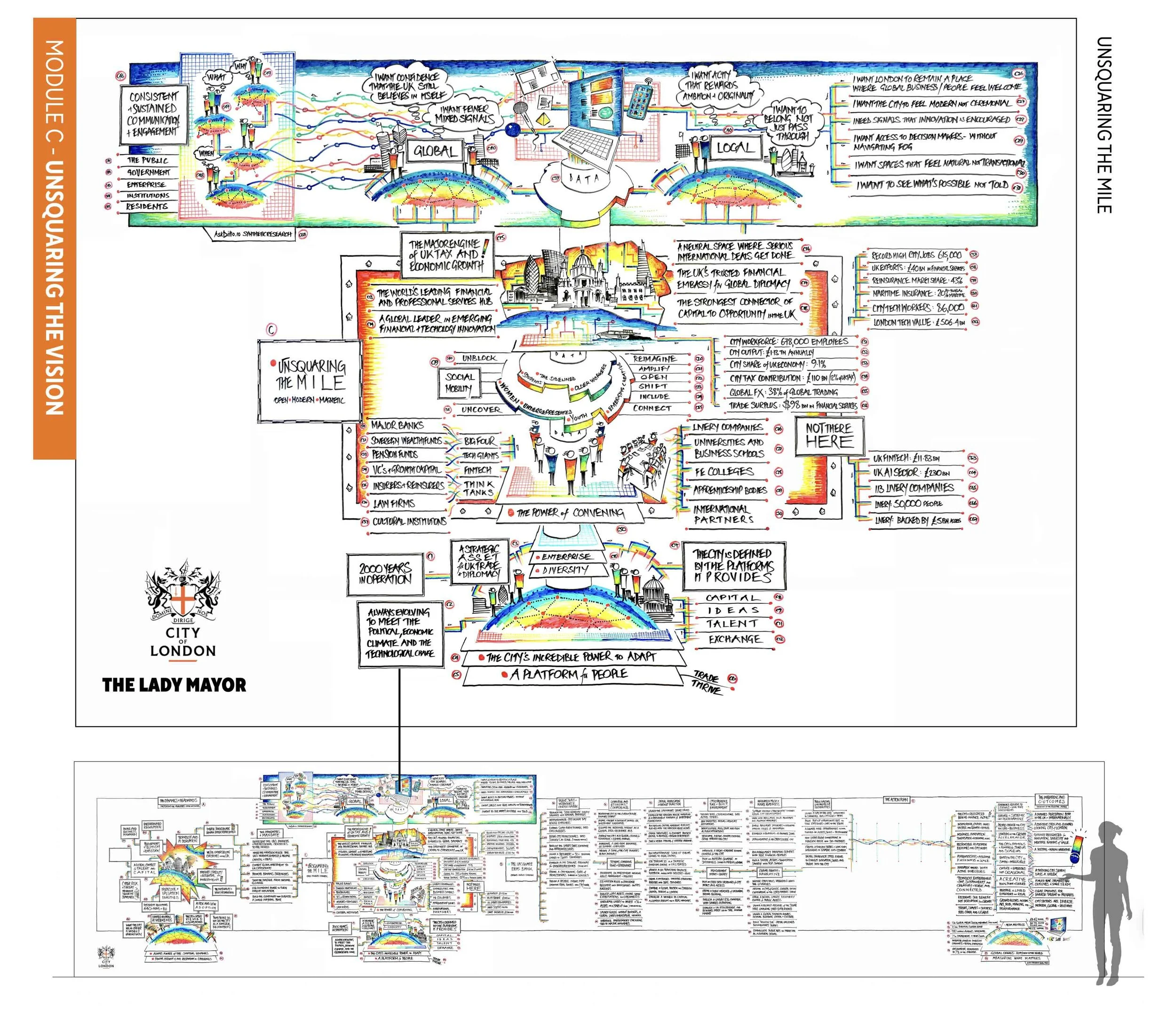
Drop down to the centre of the image. This is the core proposition. The City is a major engine of UK tax and economic growth. It remains the world’s leading financial and professional services hub. It is a global leader in emerging financial and technological innovation. These are not aspirations. They are facts. But they need to be translated into relevance and legitimacy for a wider audience.
This is where Unsquaring the Mile comes in. Not as branding, but as a system shift. Unblocking access. Uncovering opportunity. Amplifying what already works. Reimagining how people encounter the City. Opening doors that have become opaque. Shifting rhythm, inclusion, and participation. Connecting people who would not otherwise meet.
The mechanism that makes this possible is convening. Look at who is brought into the room. Major banks. Pension funds. Sovereign wealth. Tech firms. Fintech. Insurers. Law firms. Think tanks. Cultural institutions. Universities. Business schools. Colleges. Apprenticeship bodies. International partners. This is the City’s real power. Not command and control, but the ability to align capital, ideas, and talent around shared outcomes.
To the right is a simple warning. Not here is not theoretical. Capital, talent, and innovation have choices. Other centres are organised, confident, and hungry. The City cannot rely on inertia.
Now move to the foundation. Two thousand years of innovation. A place that has continuously evolved to meet political, economic, and technological change. The City’s assets are not just financial. It is diversity, diplomacy, enterprise, and exchange. It is a platform where people, capital, ideas, talent, and trade intersect.
At the base is the final statement. The City’s incredible power to adapt. A platform for people, not just institutions.
This image shows the City not as a fortress, but as a living system. One that only works when confidence, access, convening, and continuity are actively maintained.
That is what Unsquaring the Mile is really about. Making the system legible, open, and future-ready again.
Module D. The Ideas Bank - Long List
This image describes a possibility space.
It is deliberately long, dense, and uneven. That is the point. This is not a prioritised plan. It is a working inventory of ideas that could be activated, combined, sequenced, or ignored. Think of it as a bank, not a blueprint.
Start on the far left. This is the Unsquare Ideas Bank. It exists to hold options before judgement. Nothing here is assumed to be right. Nothing is assumed to be funded. The role of this module is to stop premature narrowing and to make sure the City is choosing deliberately, not defaulting.
From there, the ideas are grouped into themes rather than projects.
The first column is talent, skills, and workforce participation. These ideas are about widening the funnel into City careers. Making routes visible. Reaching people earlier. Bringing City professionals into schools. Opening access for under-represented groups. Treating skills, apprenticeships, and career pathways as infrastructure, not CSR. The underlying intent is simple. If the City wants legitimacy and longevity, it has to be intelligible and reachable.
Move across to global role and economic confidence. This cluster is about signalling. Restoring confidence in the UK as a place to invest, insure risk, and build long-term value. It includes clearer national narratives, long-term confidence signals, and using the City’s strengths in insurance, risk, and finance as assets of global relevance, not just domestic importance.
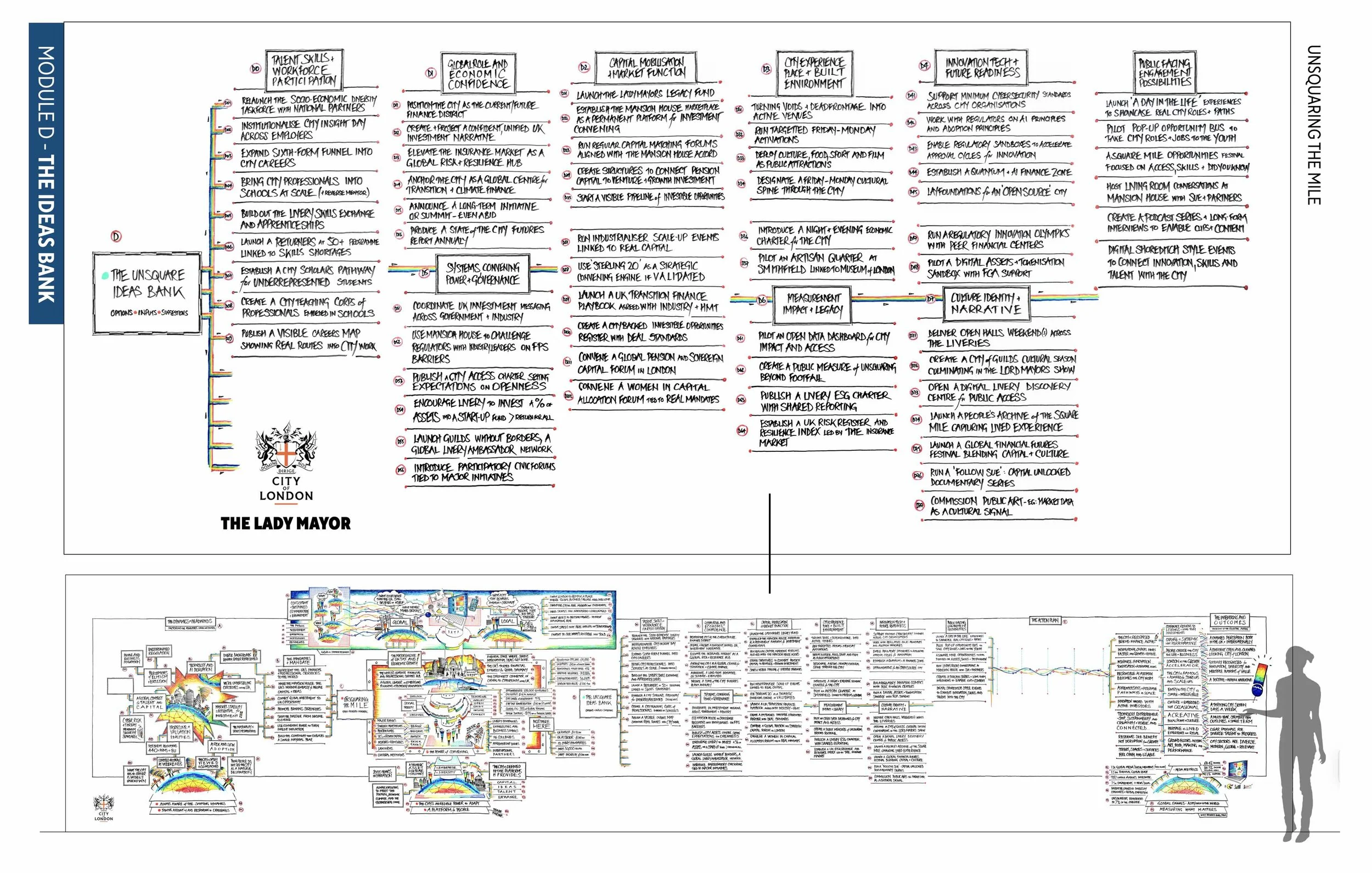
Next is capital mobilisation and market function. These ideas focus on turning convening into deployment. Mansion House as a working platform. Alignment with the Mansion House Accord. Structured mechanisms to connect pension capital, sovereign wealth, and private investment with UK opportunity. This is about reducing friction between intent and action.
Then comes city experience, place, and the built environment. These ideas address rhythm and visibility. Turning voids into venues. Activating Fridays to Mondays. Creating reasons to be in the City beyond work. Food, culture, sport, night-time economy. The intent here is not entertainment for its own sake. It is legitimacy. A city that feels alive is easier to believe in.
Move further right and you see innovation, tech, and future readiness. These ideas are about experimentation. Regulatory sandboxes. Open standards. Innovation challenges. Making the City a place where new models can be tested safely and credibly, rather than avoided or exported elsewhere.
Alongside that is public change, engagement, and possibility. These ideas are about making the City legible. Open days. Discovery centres. Visible data. Public narratives that show what the City enables, not just what it contains. This is where trust is built.
Running underneath all of this are two cross-cutting themes.
The first is measurement, impact, and legacy. Open dashboards. Clear indicators. Tracking what changes, not how many events happen. Ensuring that activity accumulates into evidence, not noise.
The second is a common narrative. Not slogans, but coherence. Making sure these ideas can be told as one story. A story about access, confidence, and adaptation. A story that survives beyond a single mayoral year.
The most important thing to understand about this wall is what it is not. It is not a commitment. It is not a shopping list. It is not a promise.
It is a structured reservoir of options, held in one place so that when decisions are made, they are made with range, context, and intent.
Module D exists to protect ambition before it is constrained by feasibility.
That is its role in the system.
Part 1. Explaining Module E. The Action Plan
Module E exists to show how the strategy moves from intention to action without collapsing into theatre.
Once priorities are chosen from the ideas bank, and once real partners step forward to own them, those initiatives begin to move into time. Not all at once, not centrally dictated, but through uptake by will. By institutions, businesses, liveries, cultural partners, educators, and investors.
This module represents that transition.
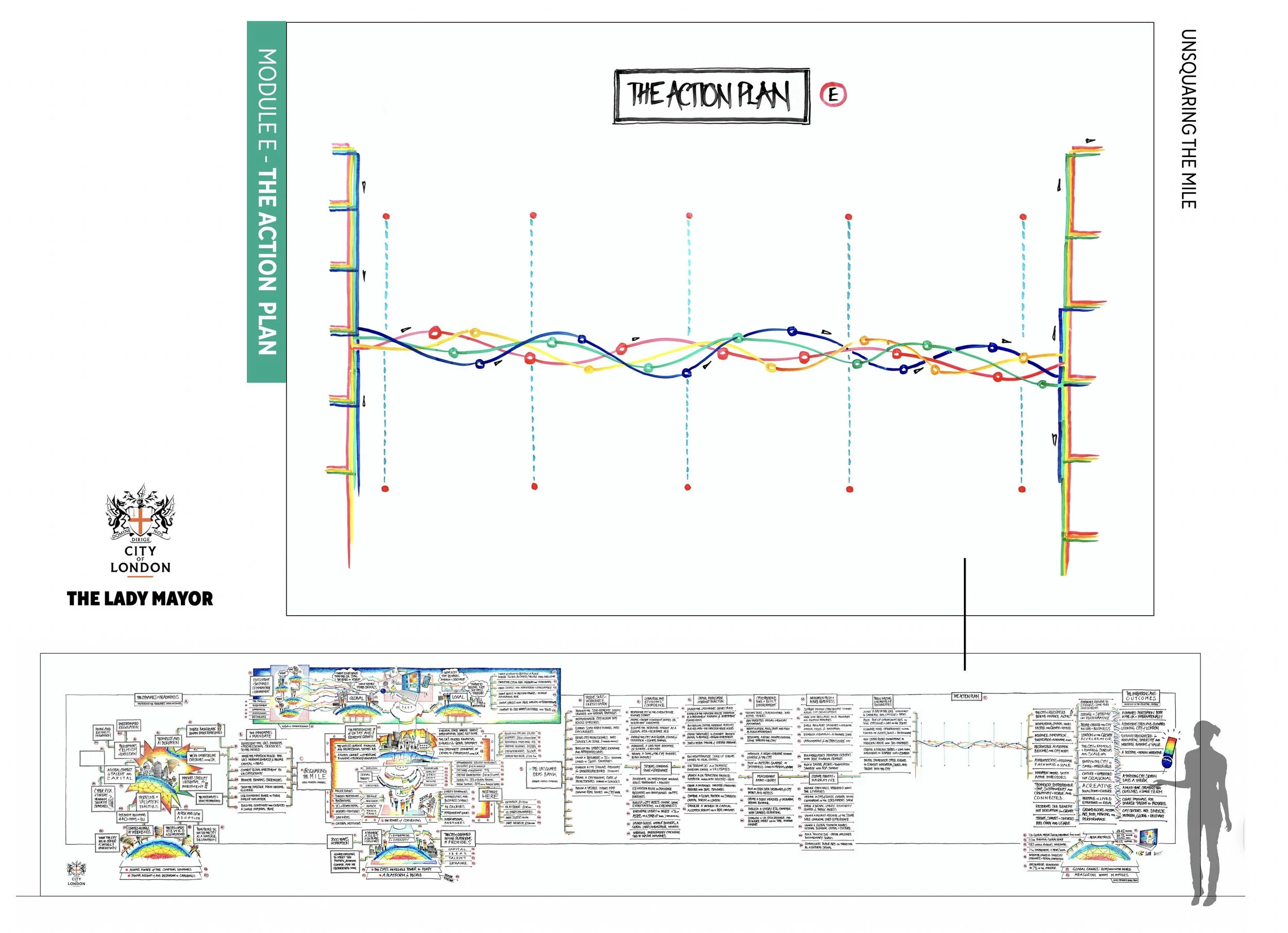
The coloured lines are not projects. They are streams of activity. Different initiatives are moving at different speeds, sometimes converging, sometimes diverging, sometimes pausing. That reflects reality. The City does not move in straight lines, and pretending otherwise only creates brittle plans.
The vertical markers represent moments of alignment. Convenings. Announcements. Launches. Milestones. Reviews. Points where intent becomes visible, and momentum is reinforced.
Only once initiatives are real, named, owned, and resourced do they earn a place on the calendar. The calendar is therefore an output, not an input.
This protects the strategy from two common failures. The first is premature scheduling, where dates are filled before substance exists. The second is over-central control, which kills ownership and slows delivery.
Module E makes one thing explicit. Action follows conviction and commitment, not the other way round. It is the connective tissue between strategy and outcomes. Nothing more. Nothing less.
Module F. Intentions and Outcomes
Module F answers the final question. The logic suggests that everything must add up to achieving these outcomes.
Start at the centre column. These are the core intentions. They are not slogans. They are shifts in how the City functions and is experienced.
Confidence returns, not as noise, but as long-term investment behaviour.
Change becomes systemic, not performative.
People choose the City for life as well as business.
London is seen as a growth accelerator, not a legacy incumbent.
The City regains status, not through nostalgia, but through relevance.
Access becomes simple and intelligible, not opaque and ritualised.
Culture is embedded, not occasional.
Creativity becomes visible and connected.
Heritage is lived, not entombed.
Ground floors work. Streets work. Public space works.
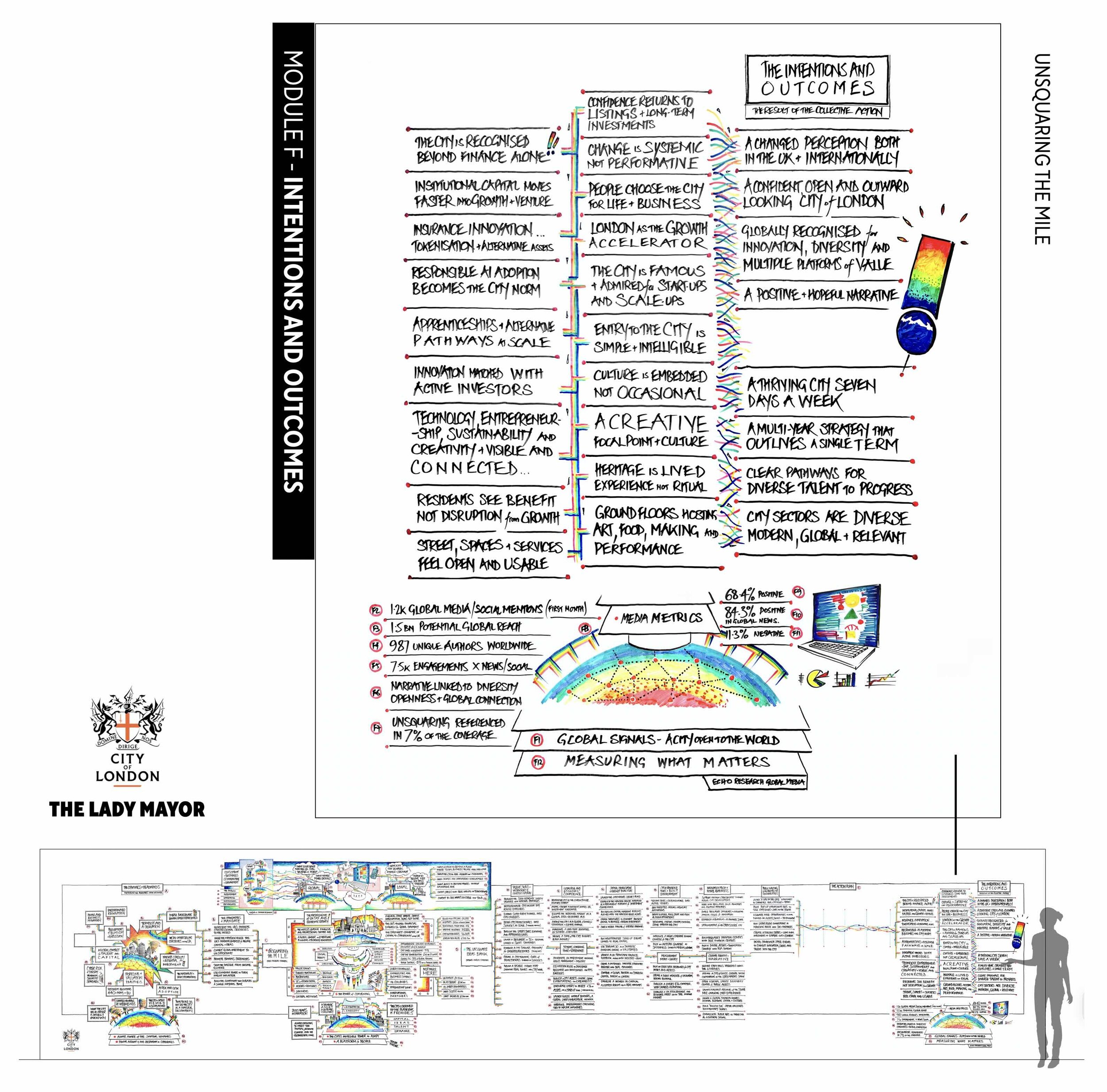
That is the internal logic of success.
Now look to the left. These are second-order effects. What becomes true if those intentions land?
The City is recognised for more than finance alone.
Institutional capital moves faster into growth and venture.
Insurance innovation and tokenisation become normal, not fringe.
Responsible AI adoption becomes the default.
Apprenticeships and alternative pathways scale.
Innovation hubs attract active investors.
Technology, sustainability, and creativity are visibly connected.
Residents experience benefit, not disruption, from growth.
Streets, services, and spaces feel open and usable.
These are not initiatives. They are consequences.
Now move to the right. This is the external narrative shift.
Perception changes, both in the UK and internationally.
The City is seen as open, outward-looking, and confident.
London is recognised as innovative, diverse, and multi-platform.
The story becomes hopeful, not defensive.
The City works seven days a week, culturally and economically.
There is a multi-year strategy that outlives a single term.
Clear pathways exist for diverse talent to progress.
City sectors are understood as modern and globally relevant.
This is where legitimacy is rebuilt.
At the base is measurement. Not vanity metrics, but signals that the world is responding.
Global media reach.
Authoritative voices repeating the narrative independently.
Engagement that links diversity, openness, and global connection.
Unsquaring referenced beyond the City itself.
Sentiment tracked, not assumed.
Signals from capital, talent, and partners that behaviour is changing.
This is how outcomes are verified. Module F is not an aspiration wall. It is a statement of what success looks like when strategy, convening, and continuity align.
Taken together, Modules E and F close the loop.
Strategy informs action.
Action accumulates into outcomes.
Outcomes reinforce confidence.
Confidence attracts commitment.
And the system continues.
That is the point of the framework.
ASK UNSQUARED
The dedicated UnSquared AI