
The Story of Drake's Strategy
Opening: Understanding the Market Dynamics (far left panel)
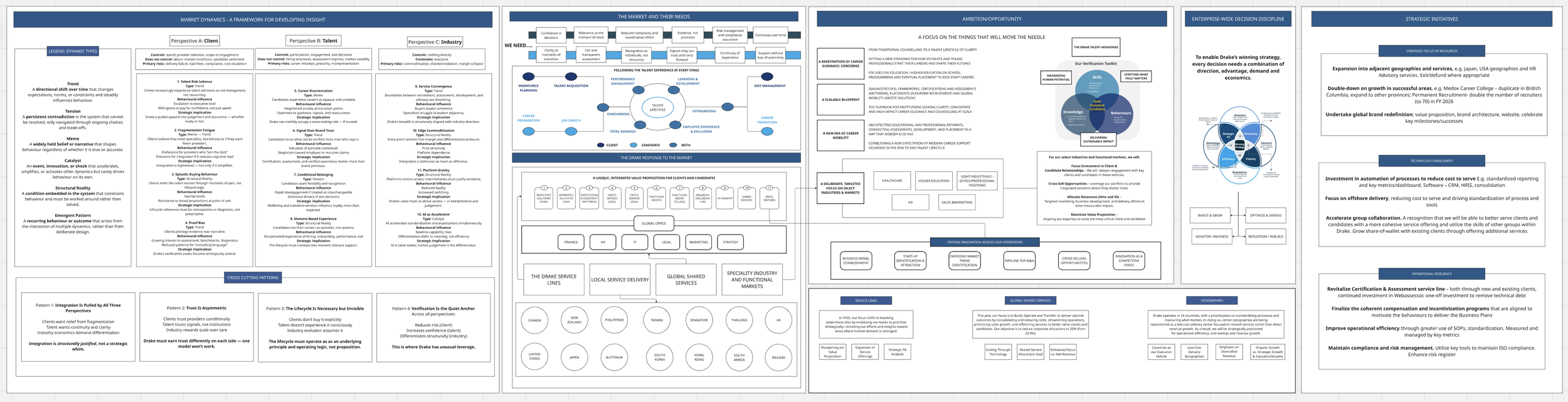
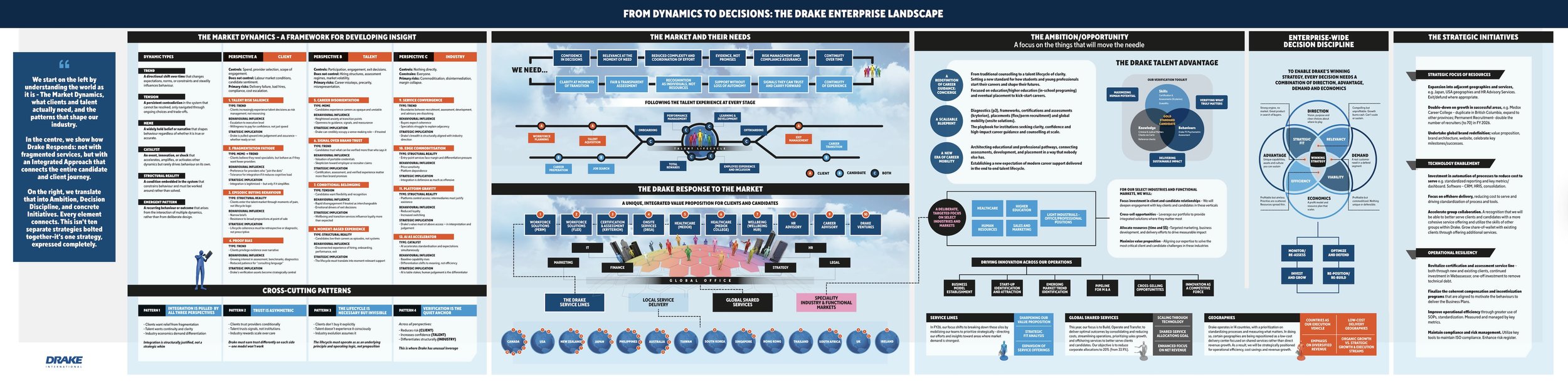
We start by grounding ourselves in reality. The market Drake operates in is shaped by forces we need to understand before we can respond to them. This framework identifies several types of dynamics: trends (directional shifts over time), constraints (persistent conditions that can't be avoided), catalysts (events that amplify other forces), structural realities (conditions embedded in the system), and emergent patterns (behaviours that arise from the intersection of multiple dynamics).
We look at these through three lenses: the Client perspective, the Talent perspective, and the Industry perspective. What matters to clients isn't the same as what matters to the people we're trying to attract and retain, and both of those sit within broader industry forces.
Draft Schema
Session Draft
The Cross-Cutting Patterns (bottom left)
From this analysis, four patterns emerge that cut across all three perspectives:
Integration is pulled by all three forces
Trust is asymmetric
The lifecycle is necessary but invisible
Verification is the quiet anchor
These aren't just observations—they're the strategic tensions Drake needs to navigate.
The Market and Its Needs (centre-left)
Moving right, we get specific about who Drake serves and what they actually need. This maps out the client types, the candidate journey, and the "we need to..." requirements that translate market dynamics into operational demands.
Drake's Response to the Market (centre)
Here's the pivot point: how does Drake respond? This shows the integrated value proposition—a single, coherent offering that serves clients and candidates across the journey. The circular diagram illustrates how different capabilities connect, rather than operating as separate silos.
Ambition/Opportunity (centre-right)
With the market understood and our response defined, what's our ambition? This section articulates Drake's strategic positioning—moving from traditional consulting to a more scalable, integrated approach. The visual shows the relationship between business growth, high-quality delivery, and operational capability.
Enterprise-Wide Decision Discipline (right of centre)
Strategy only works if decisions align. This section establishes the decision-making framework: what filters every choice needs to pass through, and how the Continuous Reinforcement Model operates across the organisation.
Strategic Initiatives (far right)
Finally, we land on action. What are we actually going to do? The initiatives are organised around:
Expansion into adjacent geographies and services
Doubling down on growth in successful areas
Global brand redefinition (the 75th anniversary work)
Investment in automation to reduce cost to serve
Focus on offshore delivery
Accelerate group collaboration
Revitalise certification and assessment
Finalise content categorisation
Improve operational efficiency
Maintain compliance and risk management
For the presentation:
"This document tells a complete strategic story.
We start on the left by understanding the world as it is—the market dynamics, what clients and talent actually need, and the patterns that shape our industry.
In the centre, we show how Drake responds: not with fragmented services, but with an integrated approach that connects the entire candidate and client journey.
On the right, we translate that into ambition, decision discipline, and concrete initiatives. Every element connects. This isn't ten separate strategies bolted together—it's one strategy, expressed completely.
The Story Of Integration
The Integration Framework — A Narrative Walkthrough
Establishing a Framework for Sensitive Integration: The Stabilising Mechanism
Changing how authority, identity, and value creation are distributed across a 75-year-old, founder-shaped system
The Opening Statement
Before we even get to the modules, the framework announces what it is and — just as importantly — what it's trying to protect. The quote on the far left sets the tone:
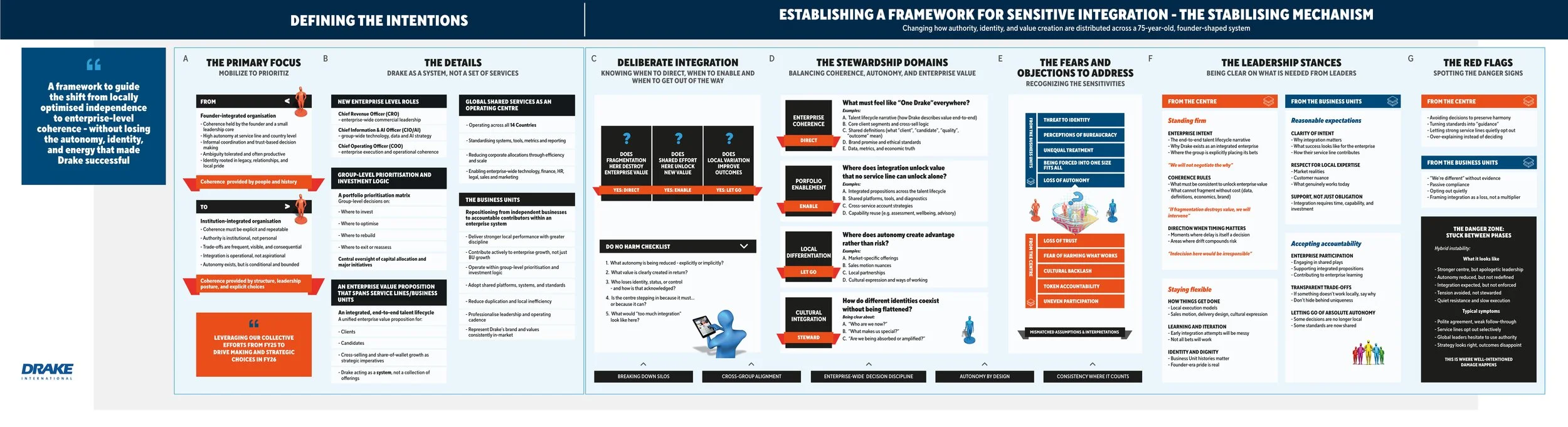
"A framework to guide the shift from locally optimised independence to enterprise-level coherence — without losing the autonomy, identity, and energy that made Drake successful."
That sentence carries the entire tension of the project. Drake isn't broken. The business units have been successful precisely because they've operated with independence, local knowledge, and entrepreneurial energy. The challenge isn't to fix what's wrong — it's to unlock what's been left on the table by operating as separate parts rather than as one system. And to do that without destroying the things that actually work.
This is the "and" at the heart of the framework: integration and autonomy. Coherence and identity. Enterprise thinking and local energy.
A — The Primary Focus: Mobilise to Prioritise
The first module defines the journey — the "from" and the "to."
From: A founder-integrated organisation, where coherence was held by the founder and a small leadership core. High autonomy at service line and country level. Informal coordination and trust-based decision making. Ambiguity tolerated and often productive. Identity rooted in legacy, relationships, and local pride. In this world, coherence was provided by people and history.
To: An institution-integrated organisation, where coherence must be explicit and repeatable. Authority is institutional, not personal. Trade-offs are frequent, visible, and consequential. Integration is operational, not aspirational. Autonomy exists, but is conditional and bounded. In this world, coherence is provided by structures, leadership postures, and explicit choices.
This isn't a criticism of where Drake has been. It's a recognition that what held the organisation together in the past — the founder's relationships, the informality, the shared history — can't scale or sustain itself forever. The shift is from something organic and personal to something designed and durable.
At the bottom of this panel, the call to action: "Leveraging our collective efforts from FY25 to drive making and strategic choices in FY26."
B — The Details: Drake as a System, Not a Set of Services
Module B gets specific about what changes in the machinery of the organisation.
New enterprise-level roles are introduced to create the connective tissue that was previously held informally: a Chief Revenue Officer to drive enterprise-wide revenue (not just service line targets), a Chief Information and AI Officer for group-wide technology and data strategy, and a Chief Operating Officer to ensure enterprise-wide operational coherence.
Group-level prioritisation and investment logic replaces local decision-making on capital allocation. A portfolio prioritisation matrix now governs where to invest, where to optimise, where to rebuild, and where to exit or sunset. Central oversight of capital allocation and major initiatives becomes the norm.
An enterprise value proposition that spans service lines and business units. Not ten separate pitches, but one integrated, end-to-end talent lifecycle offering — a unified promise to clients, candidates, and the market. Cross-selling and cross-serviceable growth become strategic imperatives. Drake acting as a system, not a collection of offerings.
Global shared services as an operating centre spanning all 14 countries — standardising systems, tools, metrics, and reporting; reducing operating allocations through efficiency and scale; enabling enterprise-wide technology, finance, HR, legal, sales, and marketing.
The business units are repositioned from independent businesses to accountable contributors within an enterprise system. This means delivering stronger local performance with greater discipline, contributing actively to enterprise growth (not just their own), operating within group-level prioritisation, adopting shared platforms and standards, reducing duplication and local inefficiency, professionalising leadership and operating cadence, and representing Drake's brand and success credibly in-market.
C — Deliberate Integration: Knowing When to Direct, When to Enable, and When to Get Out of the Way
This is the decision engine of the framework — the part that prevents integration from becoming a blunt instrument.
Three diagnostic questions sit at the top, each leading to a different posture:
"Does fragmentation here destroy enterprise value?" → If yes: Direct. The centre steps in, makes the call, sets the standard. This isn't optional — fragmentation in these areas actively damages the whole.
"Does shared effort here unlock new value?" → If yes: Enable. The centre creates the conditions, provides the platforms and support, but doesn't dictate the specifics. The value comes from working together, but the "how" can flex.
"Does local variation improve outcomes?" → If yes: Let go. Get out of the way. Local knowledge, local relationships, local execution — these are where the business units genuinely know better, and centralising would make things worse.
This trio is what makes the framework "sensitive" rather than just "integration." It acknowledges that not everything should be integrated, and the wrong kind of integration can do more harm than good.
Below this sits the Do No Harm Checklist — five questions that should be asked before any integration decision:
What autonomy is being reduced — explicitly or implicitly?
What value is clearly created or at risk?
Who loses identity, status, or control — and how is that acknowledged?
Is the centre stepping in because it must… or because it can?
What would "too much integration" look like here?
These aren't administrative hurdles. They're the conscience of the framework. They exist because well-intentioned integration efforts frequently do damage when no one stops to ask what's being lost in the process.
D — The Stewardship Domains: Balancing Coherence, Autonomy, and Enterprise Value
Module D maps out four domains, each with a different leadership posture, and each asking different questions of the organisation.
Enterprise Coherence → Direct. What must feel like "One Drake" everywhere? This includes a talent lifecycle narrative (how Drake describes, values, and serves), a core set of frameworks and structured tools, a shared definition of quality ("intent," "standards," "quality"), common practices and ethical standards, a brand, metrics, and data-centric truth, and pricing rules and delivery methods.
Portfolio Enablement → Enable. Where does integration unlock value that no service line can unlock alone? This covers integrated propositions across the talent lifecycle, shared platforms, tools, and capabilities, cross-service account planning, and capability reuse (assessment, wellbeing, advisory).
Local Differentiation → Let Go. Where does autonomy create advantage rather than risk? This includes market-specific offerings, sales method nuances, local authorities, and cultural expression and ways of working.
Cultural Integration → Steward. How do different identities coexist without being flattened? The diagnostic questions here are: "Who are we now?", "What makes us special?", and "Are we losing advantage or amplifying it?"
The bottom bar beneath this section maps a maturity spectrum that the whole framework travels: Breaking Down Silos → Cross-Group Alignment → Enterprise-Wide Decision Discipline → Autonomy by Design → Consistency Where It Counts. This isn't a linear progression so much as a set of stages that different parts of the organisation will be at simultaneously.
E — The Fears and Objections to Address: Recognising the Sensitivities
This module names what's in the room but often goes unsaid. It's split into two categories.
From the top (structural fears): Threat to identity. Perceptions of bureaucracy. Unequal treatment. Being forced into one size fits all. Loss of autonomy.
From the ground (emotional and practical fears): Loss of trust. Fear of harming what works. Cultural backlash. Token accountability. Uneven participation.
Below these sits a label: Mismatched assumptions and interpretations — a reminder that even when everyone agrees on the words, they may not agree on what those words mean in practice.
This module exists because integration efforts fail not because people disagree with the idea, but because they fear what it will mean for them personally. If you don't name the fears, they drive behaviour underground — passive resistance, quiet opt-outs, surface compliance with no real commitment. The framework says: we see these fears, we take them seriously, and they inform everything that follows.
F — The Leadership Stances: Being Clear on What Is Needed from Leaders
Module F is addressed directly to two audiences: leaders at the centre and leaders in the business units. It establishes a two-way contract.
From the Centre — Standing Firm:
Enterprise intent: The end-to-end talent lifecycle narrative. Why Drake exists as an integrated enterprise. Where the group is explicitly placing its bets. "We will not negotiate the why."
Coherence rules: What must be consistent to unlock enterprise value. What cannot fragment without cost (data, definitions, economics, brand). "If fragmentation destroys value, we will intervene."
Direction when timing matters: Moments where delay is itself a decision. Areas where drift compounds risk. "Indecision here would be irresponsible."
From the Centre — Staying Flexible:
How things get done: Local execution models. Sales motion, delivery design, cultural expression. Some routes will be messy.
Learning and iteration: Early integration attempts will be imperfect. Not all bets will work.
Identity and dignity: Business unit histories matter. Founder-era pride is real.
From the Business Units — Reasonable Expectations:
Clarity of intent: Why integration matters. What success looks like for the enterprise. How their service line contributes.
Respect for local expertise: Market matters. Customer nuance. What genuinely works today.
Support, not just obligation: Integration requires time, capability, and investment.
From the Business Units — Accepting Accountability:
Enterprise participation: Engaging in shared plans. Supporting integrated propositions. Contributing to enterprise learning.
Transparent trade-offs: If something doesn't work locally, say why. Don't hide behind uniqueness.
Letting go of absolute autonomy: Some decisions are no longer local. Some standards are now shared.
This is the social contract of the integration. It says to the centre: you must be clear, firm where it matters, and flexible where it doesn't — and you must respect that this is hard for the people living it. And it says to the business units: you can expect clarity, respect, and support — but in return, you must genuinely participate, be honest about trade-offs, and accept that some things are no longer yours alone to decide.
G — The Red Flags: Spotting the Danger Signs
The final module is the early warning system. It names what failure looks like — from both sides — and then identifies the most dangerous state of all.
Red flags from the centre: Avoiding decisions to preserve harmony. Turning standards into "guidance." Letting strong service lines quietly opt out. Over-explaining instead of deciding.
Red flags from the business units: "We're different" without evidence. Passive compliance. Opting out quietly. Framing integration as a loss, not a multiplier.
And then, in a dark panel that deliberately stands apart from the rest of the framework:
The Danger Zone: Stuck Between Phases — Hybrid Instability.
What it looks like: Stronger centre, but apologetic leadership. Autonomy reduced, but not redefined. Integration expected, but not enforced. Tension avoided, not stewarded. Quiet resistance and slow execution.
Typical symptoms: Polite agreement, weak follow-through. Service lines opt out selectively. Drake leaders hesitate to use authority. Strategy looks right, outcomes disappoint.
This is where well-intentioned damage happens.
That final line is the sharpest in the entire framework. The Danger Zone isn't about bad actors or wilful resistance. It's about the organisational no-man's-land where everyone agrees something should change, the structures are half-built, but no one commits fully. The old autonomy is gone but the new coherence hasn't taken its place. And in that gap, the worst outcomes emerge — not from conflict, but from ambiguity.
Reading the Whole
The framework reads as a complete argument, left to right:
A says: here is the shift we need to make, and here is what we must protect while making it. B says: here is what concretely changes in roles, governance, shared services, and the business units. C says: here is how we decide what to integrate and what to leave alone — with a conscience check built in. D says: here are the four domains, each requiring a different posture — directing, enabling, letting go, or stewarding. E says: here are the fears we must acknowledge, because they are real and they will shape behaviour whether we name them or not. F says: here is what we expect from leaders on both sides — a mutual contract of clarity, respect, and accountability. G says: here is what failure looks like, and here — most critically — is the half-committed middle ground where well-intentioned damage is done.
The framework's power is in its honesty. It doesn't pretend integration is painless, or that the centre always knows best, or that the business units should simply comply. It acknowledges that this is a 75-year-old organisation with deep identities, real expertise, and legitimate concerns — and that the path forward requires both firmness and sensitivity, applied in the right places.