

The Acora Session
Turning Everything We Do Into Opportunity
What follows is a structured, decision-grade synthesis of the session that draws on the pre-work interviews to clarify intent and resolve ambiguity.
1. Market Framework – What We Now Know
A. Core Market Insight (Shared, Not Contested)
Conclusion
Acora’s primary differentiation is not “Data & AI” alone, but: Data & AI as the growth and differentiation lever. Playbooks are the mechanism that turns capability into market credibility
The market does not buy tools or technology components — it buys confidence in outcomes, delivered through a repeatable, explainable approach.
This was consistently reinforced throughout the session and crystallised in the latter stages.
B. Market Segmentation & Routes to Market
Debates/Tensions
Confusion between:
RTV1/RTV2, Tier 1/Tier 2. “Enterprise” vs “Mid-market”. Whether RTVs describe markets, buyers, or sales motions. Risk of language becoming internally clever but externally incoherent
Emerging Conclusions
RTVs are routes to value, not markets:
RTV1 = Route to Board (problem framing, risk, value, operating model)
RTV2 = Route to Tech (architecture, platforms, execution depth)
Tiers describe client scale and complexity, not how they are sold to. Data & AI must be explicitly embedded in both RTVs — not treated as a specialist sidetrack.
Implication for the Market Framework
The framework must:
Separate buyer logic from delivery logic. Show how the same core capability expresses differently depending on the route. Avoid introducing any term that cannot be clearly explained in one sentence to a sales team
C. Plays and Playbooks
Clear Conclusion
Playbooks are the unit of value: Not propositions, not service lines and not products
A playbook is a codified recipe that tells the organisation: When to engage. Who leads. What gets deployed. What “good” looks like. What must already be true (prerequisites)
This was one of the strongest points of alignment on day two.
Constraint (Important)
Only three Data & AI playbooks will be created first. Cloud/Infrastructure playbooks are explicitly deferred. Rationale: prove focus and execution before scale
2. Strategic Framework – What Shifted
A. Strategy Maturity (Not Strategy Replacement)
Debate
Is there “a strategy” - or not? Is the problem communication, coherence, or substance?
Conclusion
The strategy exists, but It is not sufficiently understood/operationalised. It does not yet provide decision authority to enable effective working practices. It is interpreted differently across functions. Therefore, the task is strategy maturation and storytelling, not reinvention.
B. What Acora Is (and Is Not)
Clear Agreements
Acora is not: A classic product company. A speculative innovation lab. A vendor-replacement platform builder
Acora is: A “very smart advisor” with proprietary accelerators, glue, and insight. Embedded inside important/viable client ecosystems (especially Microsoft)
All build decisions must be: Client-driven. ROI-justified. Reusable in know-how, even if IP is client-owned.
This materially strengthens our Strategic Identity.
C. Decision-Making as Strategy
Major Insight (Hard-won)
The absence of a decision framework is the single biggest strategic failure point
Symptoms observed: Endless debate. No mandate. Resource conflict: “Tyranny of the billing code. People building things no one asked for
Conclusion
Strategy must be made executable through Irrevocable resource decisions. Clear ownership. Explicit (real) consequences
The decision framework operates far beyond a governance overlay — it is the strategy in action.
3. Actions, Commitments, and What Is Now Required
A. What Is Agreed (Hard Commitments)
100-Day Focus - Limit to three or four integrated priorities. No broad strategy broadcast until execution evidence exists
Playbooks First - Three Data & AI playbooks. Defined structure, version control, and ownership. Sales-usable, insight-led and, most definitely, not conceptual.
Decision Framework v1 - Bronze/Silver/Gold maturity. Explicit allocation of people and money. Reversible only with new evidence
Market Proof - Identify “next HSF” within six months. Legal is the first deep niche. Mid-market is the scalable horizontal motion
B. What Remains Open (But Now Visible)
Numeric targets (explicitly deferred — “we all fell over on the numbers”), Capacity trade-offs (what stops are needed to make this possible). Exact buyer definitions (Ideal Customer Profile) per RTV. How AI enablement of internal teams becomes tangible, not rhetorical
We don’t need to think of these as failures, but they are now named work, which is a material shift.
4. What This Means for Next
If the outputs are to have quality and durability, we must:
Lock language - Every term is defined once and used consistently. No ambiguity tolerated. Seek clarity over any concerns as a priority.
Make decisions visible - Who decides? On what basis? With what consequence
Separate - Market logic. Strategic intent. Operational execution
Be usable without you in the room - Sales. Delivery. New hires - for example
The Narrative
Our Aim:
Reflect what genuinely happened over the two days (not a consultant’s retrospective)
Show progression — how everyone’s thinking evolved, not just where it landed
Build confidence that the outputs now deserve to serve as guiding frameworks and actions for you to deliver.
It deliberately avoids jargon, attribution, or defensiveness. It should read: “This is what we learned together.”
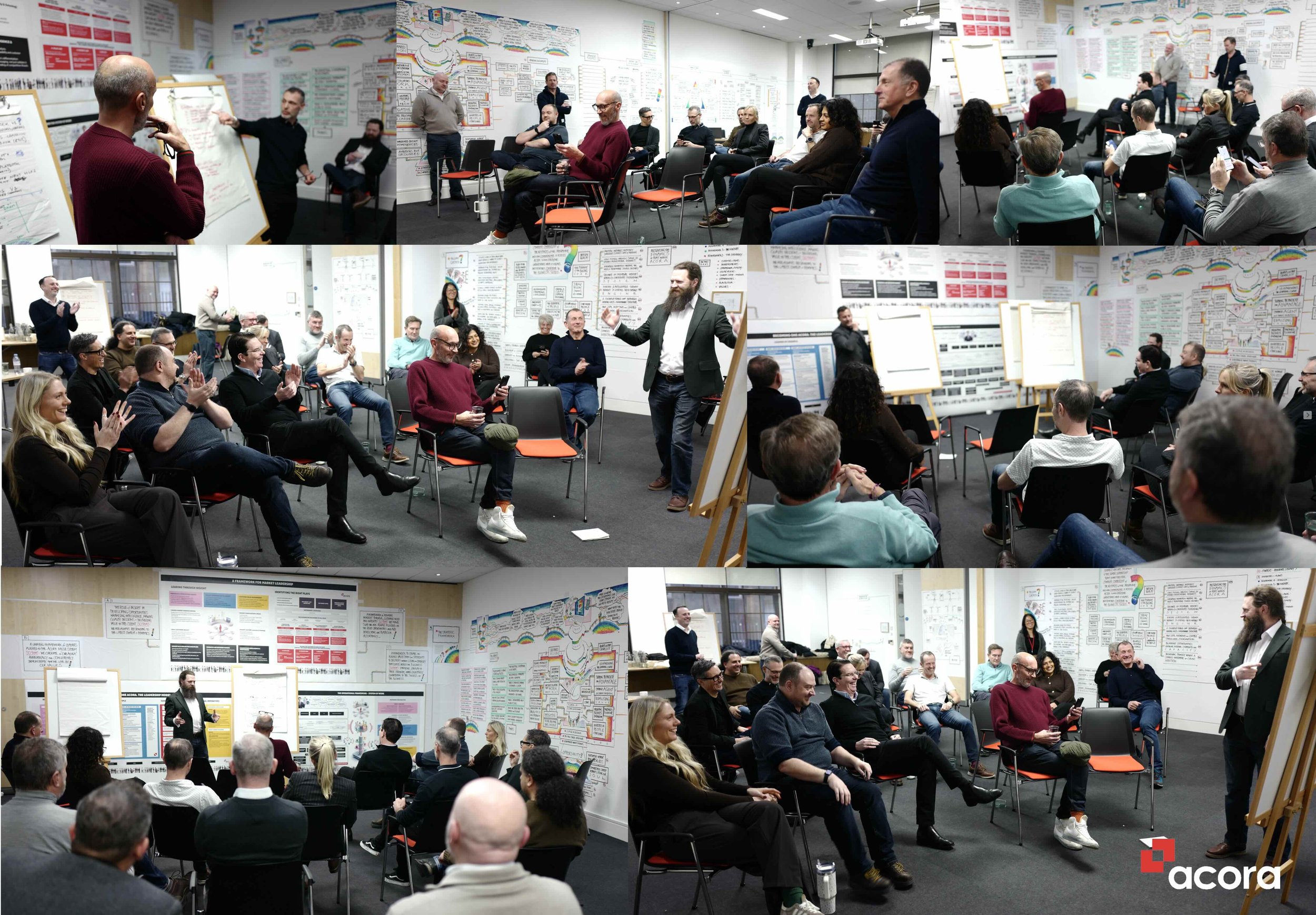
The Two-Day Session
Synthesis Narrative – What We Learned and What Changed
Why we came together
We came into this with a shared intent: to mature the strategy, strengthen leadership alignment, and ensure we could move forward with confidence rather than momentum alone.
The two days were never designed to produce a finished answer, but to achieve the right answers by testing assumptions, surfacing tensions, and, through that thinking and debate, deciding what really matters.
What follows is a synthesis of what we heard. It reflects what shifted, what settled, and what is now clear enough to act on.
1. What became clear about the market
From “capabilities” to confidence
A consistent theme across the two days was a reframing of how the market actually experiences Acora.
An Insight:
We do not win because we have isolated technical strengths. We win when clients feel confident that we understand their context, can guide them through complexity, and can deliver outcomes without creating new risk. That confidence is built through repeatable ways of working, not one-off brilliance.
This is where the conversation moved decisively from what we can do to how we show up — and why playbooks emerged as central rather than optional.
Routes to value, not competing strategies
Early discussions revealed significant confusion among routes to market, customer tiers, and internal structures. Rather than smoothing this over, the group worked through it explicitly.
What emerged was a shared and critical understanding that:
We are not choosing between different strategies
We are choosing how we create value in different contexts
RTV1 and RTV2 are now understood as routes to value — not markets, not silos, and not competing agendas. They represent different entry points into the same underlying capability, and both must be intentionally designed and supported.
This clarity removes a long-standing source of friction and gives the market framework a stable spine.
Focus as a strategic choice
The group made a deliberate decision to narrow its focus rather than broaden its ambition.
Instead of trying to “do justice” to everything at once, we agreed to:
Prioritise the creation of Data & AI playbooks. Prove they work commercially and operationally. Use them to build credibility, confidence, and momentum.
This was not a compromise. It was an explicit recognition that focus is how maturity shows up.
2. What shifted in our understanding of strategy
From having a strategy to making it executable
The workshop surfaced a subtle but important truth: the issue is not the absence of strategy, but the absence of shared interpretation and decision authority.
People are largely aligned on ambition and direction. Where things break down is in:
Translating intent into decisions. Knowing who owns what. Understanding how trade-offs are made
This reframed the strategic framework's purpose. Its job is not to inspire — it is to remove ambiguity and enable action at speed without constant escalation.
A clearer identity — and sharper boundaries
Over the two days, the group converged on a much firmer sense of what Acora is — and just as importantly, what it is not.
There was clear alignment that we are not trying to become a conventional product company, nor are we building speculative platforms in the hope that the market catches up. Instead, our strength lies in being a very smart advisor that combines insight, accelerators, and ecosystem integration to solve problems clients cannot easily solve themselves.
This clarity matters because it sets boundaries — and boundaries are what make strategy usable.
Decision-making emerged as the missing capability
One of the most consequential insights of the workshop was that many of the frustrations people experience are not cultural or personal; they are structural.
The absence of a clear decision framework has led to:
Endless debate without resolution. Unclear mandates. Resource tension. Work starts without a commercial anchor.
The group agreed that without a shared way to make and commit to decisions, no amount of vision or communication will hold.
As a result, the decision framework is no longer seen as governance overhead. It is now understood as the mechanism through which strategy becomes real.
3. What changed about action and accountability
The 100-day horizon as a discipline
The two days deliberately moved us away from abstract plans and toward earned priorities.
Rather than a long list of initiatives, the group agreed to:
Limit the first 100 days to a small number of integrated actions. Focus on execution before broad communication. Use evidence of progress — not intention — as the trigger for wider rollout
This reflects a shift from “alignment through announcement” to alignment through delivery.
Playbooks as the organising unit of work
By the end of day two, playbooks had moved from concept to commitment.
They are now understood as the primary way we will:
Enable sales. Create consistency without uniformity. Embed learning. Make our value legible internally and externally
Crucially, playbooks were not treated as static artefacts. They are living tools that will evolve through use — but they now have enough structure to be built, tested, and owned.
What is still open?
Not everything could be concluded in two short days, but that’s OK. With the work done in advance, and the engagement and ownership of the team as it now exists.
In particular:
Numeric targets need further work
Capacity trade-offs must be made explicit
Buyer definitions need to be tightened
Internal enablement needs to become tangible
What has changed is that these are now visible, named pieces of work, not background noise. That alone represents a material increase in organisational maturity.
4. What this means going forward
The outcome of the two days:
A shared understanding of what matters. A clearer sense of where the focus must sit. A commitment to discipline in decision-making. And a set of frameworks that are now strong enough to guide real action
The next phase is about turning this clarity into usable tools and then proving, through execution, that the organisation can do what it says it will do.
That is the real test of maturity, and the work of the last two days has meaningfully set us up to pass it.
The Acora Glossary Of Terms
An Insight‑Led Business
An insight‑led business turns data, experience, and customer signal into repeatable action. It doesn’t just “have reporting”; it uses insight to set priorities, shape strategy, and run the operation—so teams can answer what’s happening, why it’s happening, what we should do next, and what success looks like. The key is closed‑loop learning: sense → interpret → decide → execute → measure → improve, with insights embedded into everyday workflows rather than sitting in dashboards that nobody trusts or uses.
Decision Quality
Decision quality is the quality of the decision process, not just the eventual outcome. If a decision is an irrevocable allocation of resources (money, people, time, attention, brand risk), then high decision quality means: the decision is clearly framed, options are explicit, trade‑offs are acknowledged, assumptions and risks are surfaced, the right people are involved, and the owner/decision rights are unambiguous. A high‑quality decision can still have a bad outcome (because uncertainty exists), but low‑quality decisions reliably create chaos, rework, and “surprises” that were actually predictable.
A Playbook
A playbook is a codified set of the “plays we run”—the repeatable advisory and delivery motions that reliably create value for clients. A proper playbook doesn’t just describe activities; it defines when to run a play (triggers), why (client outcomes), how (steps and tools), who (roles and handoffs), and what good looks like (acceptance criteria, measures). It turns hard‑won experience into consistency and speed, while still leaving room for professional judgement and tailoring to the client context.
Prerequisites
Prerequisites are the foundational enablers that make every solution actually work in the real world—especially in Mid‑Market and Higher Mid‑Market environments where capacity is tight and fragility is expensive. They include the “tools, accelerators and glue” that allow solutions to be deployed, secured, monitored, supported, and improved: baseline security posture, identity and access, observability, automation, data governance, integration patterns, documentation, and operational runbooks. Treating prerequisites as first‑class (not an afterthought) reduces delivery risk, increases repeatability, and makes outcomes achievable at scale.
Principles
Principles are meaningful rules and heuristics that guide behaviour when the playbook doesn’t cover the situation. In a 750‑strong, growing, dispersed business, principles are not “wallpaper values”; they’re operational integrity in writing—clear enough to shape decisions, prioritisation, escalation, and collaboration. Good leadership principles are specific (“default to transparency”, “one accountable owner”, “disagree and commit”, “make work visible”, “fix the system not the person”) and they matter because they are used in hiring, promotion, recognition, and performance conversations—so people can predict what the organisation will reward and what it will not tolerate.
Internal Communications
Internal communications is the system for creating shared context so teams can act in alignment without constant meetings or guesswork. It makes strategy, priorities, decisions, progress, and changes visible—clearly, consistently, and through agreed channels and cadences. Effective internal comms separates informing from consulting from deciding, and it includes two‑way feedback so leaders can hear what’s actually happening and teams can raise risks early.
External Communications in Marketing
External communications (marketing) is the coherent story the market hears about who you serve, what outcomes you deliver, why you’re credible, and how you’re different—expressed in customer language, not internal acronyms. It aligns brand, demand generation, and sales enablement around a shared narrative and proof points (case studies, demonstrations, results). When done well, it reduces friction in selling because prospects can quickly understand “is this for me?” and “why trust you?” before the first meeting.
Culture
Culture is how people really behave when nobody is watching—the norms that get rewarded, tolerated, or ignored. It shows up in how decisions are made, how conflict is handled, whether teams share information, how leaders respond to bad news, and whether people feel safe to challenge assumptions. Culture is not what you say; it’s what your incentives, rituals, and leadership actions repeatedly reinforce—so a strategy succeeds only when the culture makes the desired behaviours the easiest path.
Measurement
Measurement is the feedback loop that tells you whether you’re winning or drifting. It translates intent into observable reality using a small set of metrics that are owned, reviewed, and acted upon—not vanity charts. Good measurement balances leading indicators (behaviours and early signals like adoption, cycle times, quality of pipeline, incident trends) with lagging indicators (revenue, margin, retention, customer outcomes), so teams can steer rather than explain failure after the fact.
Consequences
Consequences are the follow‑through that makes principles and measurement real. They include positive consequences (recognition, promotion, investment, autonomy) and corrective consequences (coaching, changed priorities, removing blockers, performance action) applied consistently and fairly. Without consequences, principles become optional and measurement becomes theatre; with consequences, people trust the system because expectations are clear and actions match words.
Silo Busting
Silo busting is the deliberate removal of barriers that stop value flowing end‑to‑end—from customer need to solution to run. It means designing shared goals, shared language, shared measures, and cross‑functional ways of working so teams don’t optimise locally while the customer experience suffers globally. Practically, it shows up as clear handoffs, fewer “us vs them” boundaries, and joint ownership of outcomes rather than isolated ownership of tasks.
Working As One Acora
“Working As One Acora” means operating as a single, integrated company rather than a collection of capable parts. It is the combination of shared strategy, common prerequisites, consistent playbooks, aligned measures, and clear decision rights—so customers experience one joined‑up team and staff can navigate the organisation without friction. It preserves specialist strength where it matters, but removes duplication, confusion, and internal competition by making collaboration the default and customer outcomes the shared scoreboard.