

THE WORKING RECORD
THE SIMPLE FRAME FROM NYC

IN WASHINGTON. D.C.
WHAT WE DID, WHAT WE DECIDED, AND WHAT HAPPENS NEXT
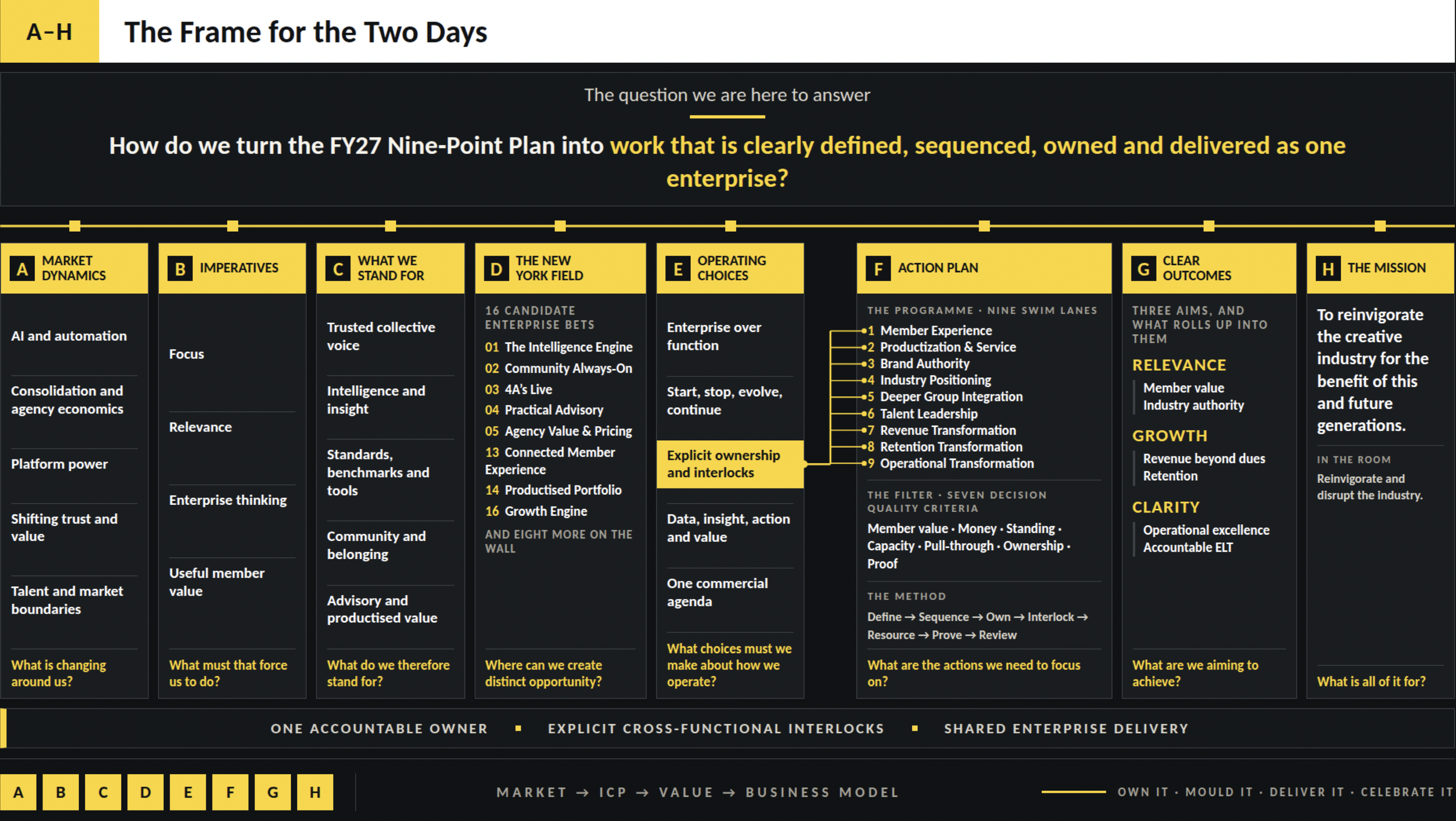
The work in DC started with a simple problem.
The 4A’s is doing too much.
Much of that work is good. Much of it began for good reasons. Some of it creates obvious value today. But taken together, the volume has become a problem.
People, time, money and attention are spread across too many things. New priorities arrive while old activity continues. Some work has become part of the furniture. Some is difficult to stop because somebody, somewhere, still values it.
That makes it very hard to create room for anything genuinely new.
So the ELT spent the day and a half putting the current business under much harder scrutiny. The purpose was not to produce another strategy.
It was to decide what deserves our resources.
A DECISION HAS TO CHANGE SOMETHING
One definition became central to the work:
“A decision is an irrevocable allocation of resources.”
That gave us a useful test.
If we say something matters but don't move people, time, money, or attention behind it, we have merely expressed an intention.
If something matters more, something else may have to receive less.
That is the discipline we are now introducing into the business.
The Decision Criteria
WE LOOKED AT THE WORK AS ONE ENTERPRISE
We began with the work already happening across the 4A’s.
Surveys. Events. Forums and committees. Advisory. Learning. Research. Member services. Growth. Partnerships. Policy. Content. Technology. Finance. Data. Internal operations.
And much more.
The list was long partly because it contained very different kinds of things.
Some were products. Some were services. Some were channels. Some were capabilities. Some were infrastructure. Some were internal activities. Some were propositions that may belong in the future business.
The first job was therefore to stop looking at the organisation only through individual Business Units and look at the whole.
That changed the conversation.
WE AGREED ON THREE BASIC STATES
KEEP
We are consciously continuing this work and allocating resources to it.
BLUEPRINT
We need to do more work before deciding its future.
KILL
We stop doing it in its current form.
There is also an important fourth condition:
KEEP + BLUEPRINT
Some activities have current commitments that need to be honoured while we properly reconsider their future form.
That distinction matters.
A Blueprint is not another word for approval. It means the work deserves a proper decision.
THE BLUEPRINT IS WHERE THE REAL CHOICE GETS MADE
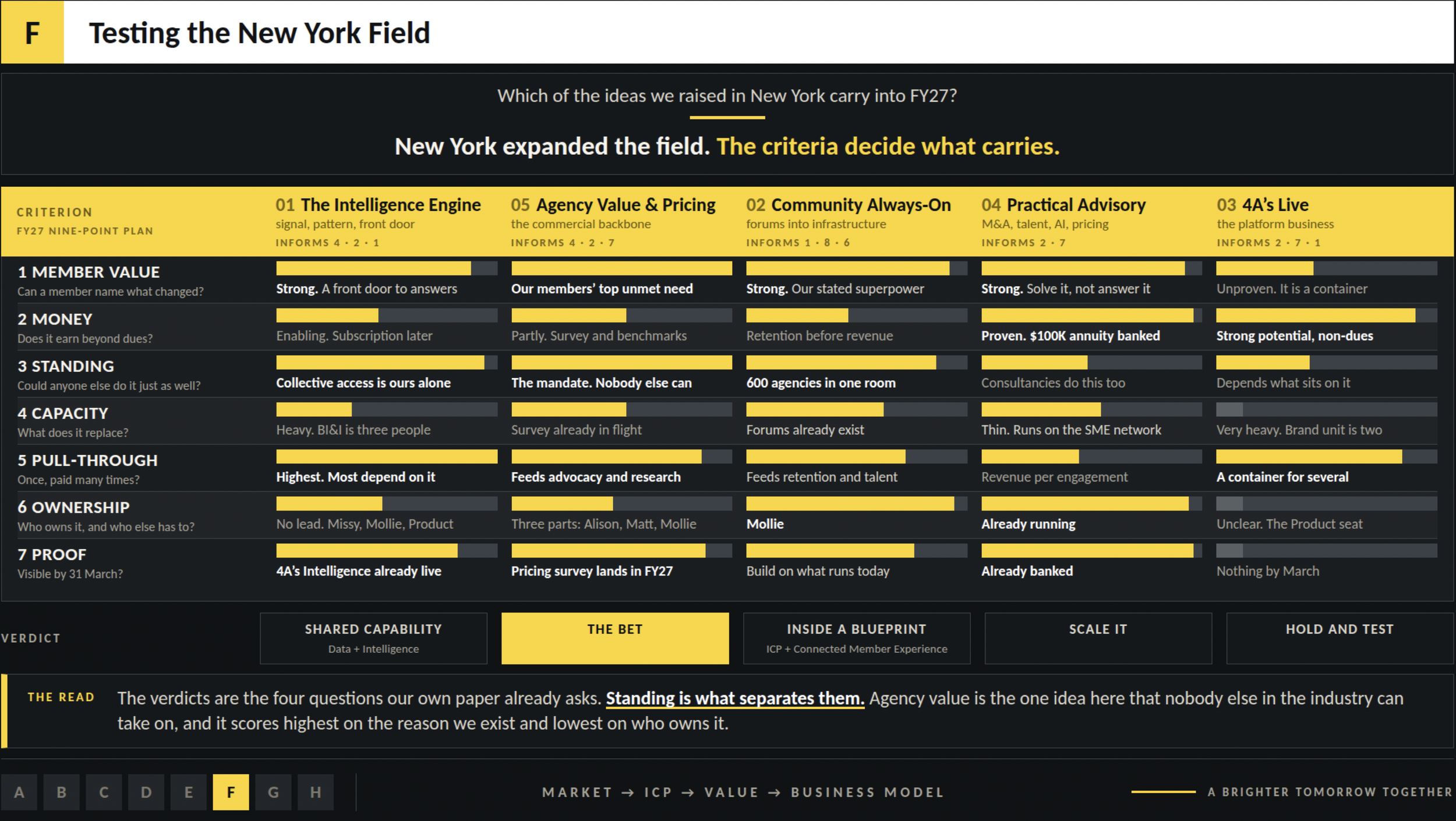
The Blueprint process will ask a few hard questions.
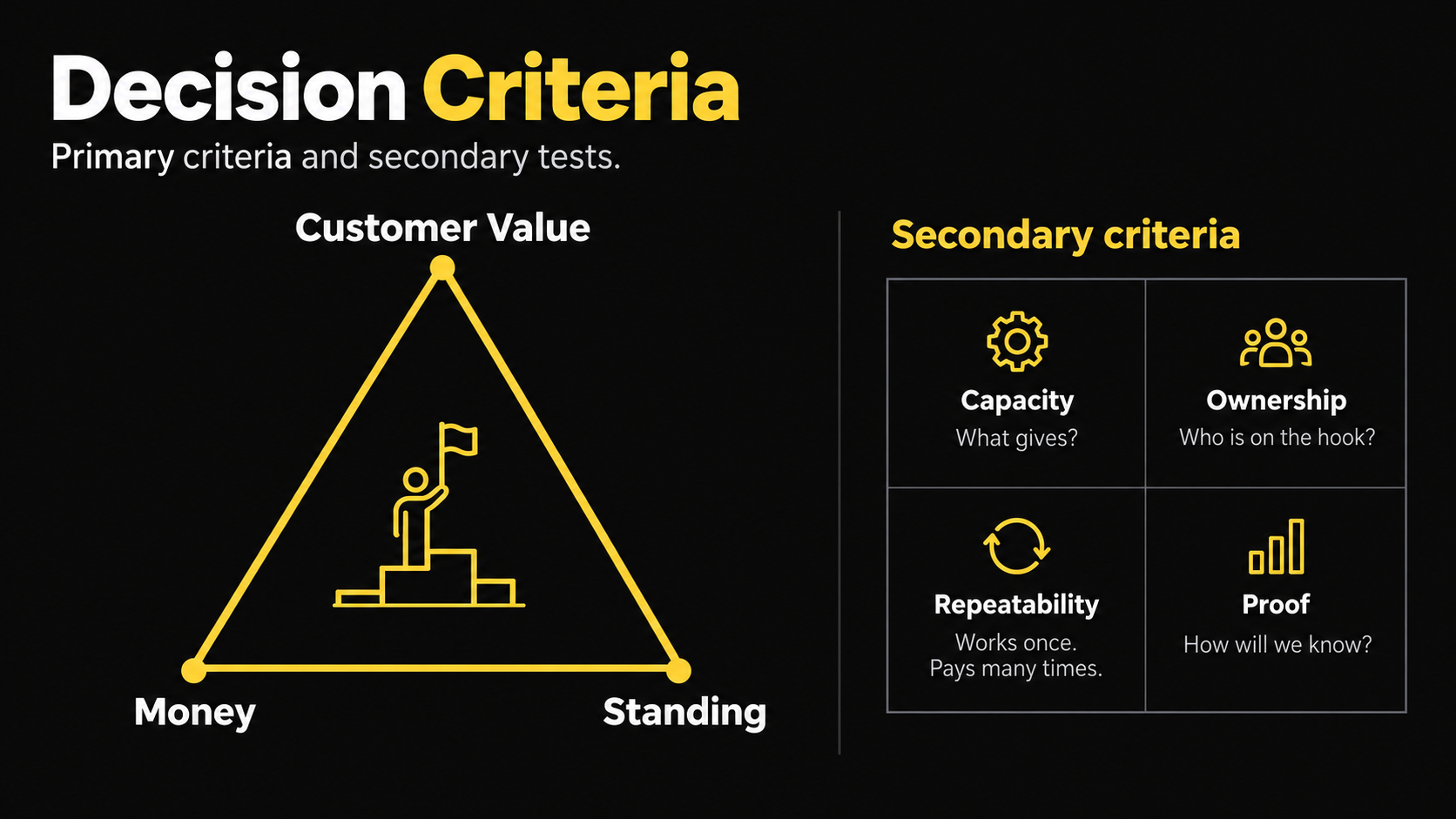
Does this create real Customer Value?
Does it make economic sense?
Do the 4A’s have a credible reason to be doing it?
Do we have the capacity?
Who owns it?
Can it work repeatedly and at a useful scale?
How will we know whether it works?
Some examples tested against the Blueprint
The answers need to be clear enough for a small team to recommend and for the ELT to decide.
The Blueprint itself should be simple.
Where possible, one page.
Enough definition to make the case.
Enough evidence to challenge it.
Enough clarity to know what happens next.
EXISTING WORK DOES NOT GET A FREE PASS
One of the most important agreements was to treat current activity with the same seriousness as a new idea.
“We have always done this” is not a reason to keep doing it.
Neither is:
“Someone might miss it.”
Or:
“It only takes a little time.”
Small pieces of work become large when they multiply across an organisation.
This became especially clear in the discussion around communications.
An individual email may not consume much.
Dozens of emails, posts, papers and one-off requests do.
So we're pausing non-business-critical communications while we work through the wider customer, content, and communications strategy.
Where communications are required to fill an event, generate revenue, serve a current customer obligation or support another business-critical need, they continue deliberately.
The difference is intent.
CAPACITY WILL MAKE SOME OF THE DECISIONS FOR US
The ELT did not leave DC with a huge pile of red marks.
That does not mean everything survived.
It means much of the harder work now sits inside the Blueprint process.
Once each proposition has to show the people, time, money, ownership and proof required to make it successful, some will not stand up.
That is expected.
The organisation cannot do everything properly.
Capacity is therefore part of the decision, not something to worry about afterwards.
The answer may be to stop.
It may be to simplify.
It may be to automate.
It may be to partner.
It may be to reorganise the work.
It may be to invest more because the opportunity deserves it.
We should stop pretending more work can simply be absorbed.
WE WILL WORK ACROSS BUSINESS UNITS
Most of the significant work won’t fit neatly inside one BU.
A member journey touches Growth, Member Services, Product, Brand, CRM, Data and Operations.
An event can involve Product, Revenue, Partnerships, Content, Finance and Member relationships.
Intelligence depends on data from across the enterprise.
That is why the next stage will use small cross-functional teams.
These are the Interlocks.
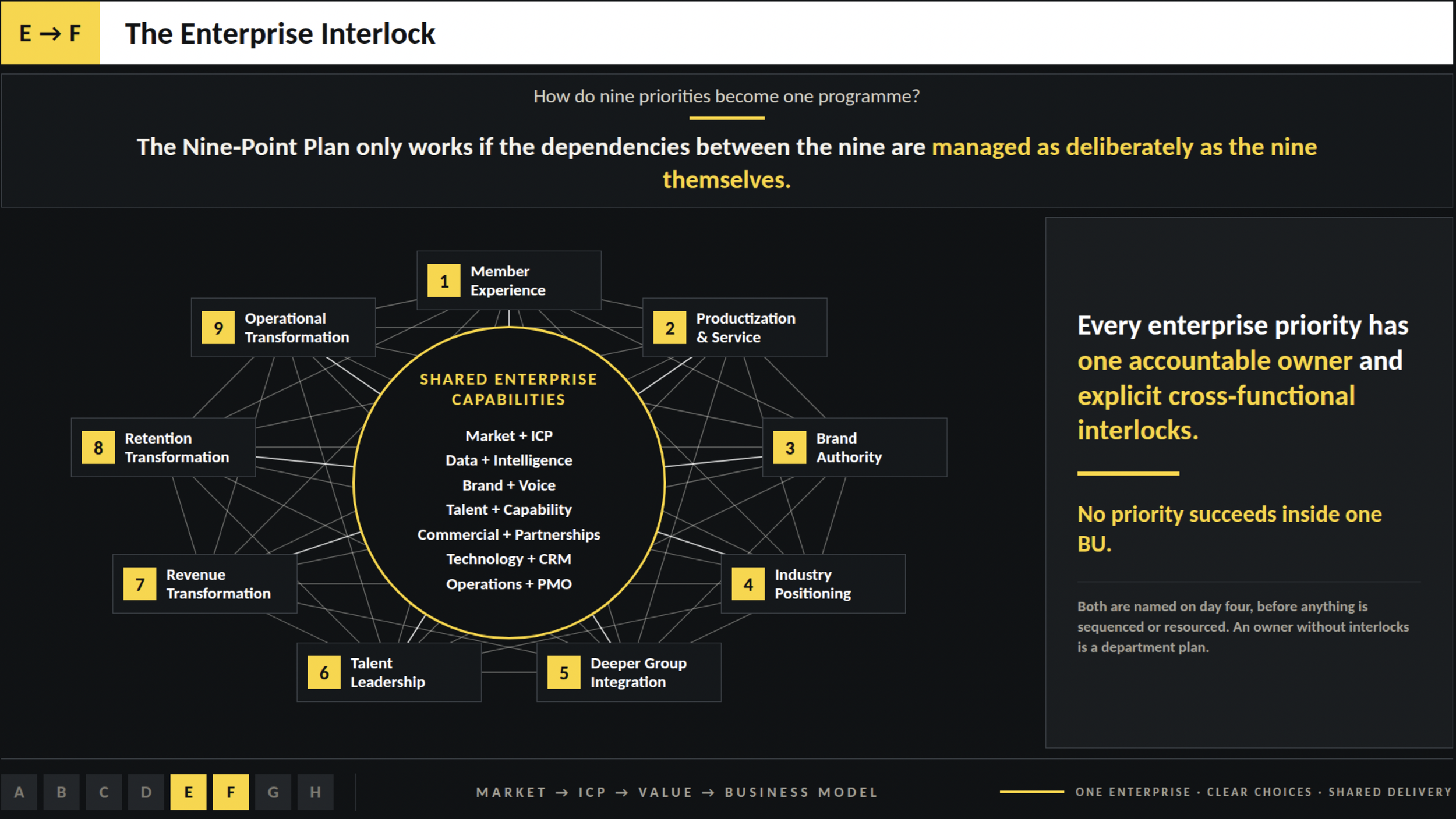
They will normally contain three or four people with the knowledge required to make a recommendation.
There will still be clear ownership.
Cross-functional does not mean nobody is accountable.
THE ELT HAS A DIFFERENT ROLE TOO
The ELT is increasingly expected to operate as one enterprise leadership team.
That means looking beyond the activity inside each individual BU.
It also means challenging Blueprints as a group.
Does the case add up?
Are the dependencies understood?
Is the resource really available?
Is the proof credible?
Are we protecting activity because it matters or because it is familiar?
Use the same language and criteria across the organisation.
That is how we reduce ambiguity.
THE WORK WILL BE SEQUENCED
There are too many Blueprint candidates to work on simultaneously.
They will therefore be prioritised.
Some are urgent.
Some have dependencies.
Some have natural moments in the calendar when current work finishes and the next version can be considered.
Some will have to wait because the same people are required elsewhere.
Sequence is part of the decision.
Everything cannot be first.
TECHNOLOGY HAS TO DO MORE OF THE HEAVY LIFTING
A strong theme through the work was the need to make the 4A’s more technology-enabled.
That does not mean removing the human side of the organisation.
It means asking whether people need to be doing work that technology can do better, faster or repeatedly.
The O-1 visa process provided a simple example.
A process that once required substantial manual effort can now be handled largely through technology, with human judgement retained where it matters.
That is the direction of travel.
Automate the repeatable.
Make useful knowledge easier to access.
Connect data.
Create self-service where it improves the experience.
Use people where expertise, judgement, relationships and trust create the value.
This thinking should be present inside every Blueprint.
THE FUTURE MODEL MAY BE MORE LIKE A PLATFORM
Several discussions began pointing in the same direction.
4A’s Intelligence. Refractor. Community. Templates. Data. Research. Advisory. Learning. Customer information.
The possibility is a more connected system in which customers can access much more of the 4A’s value directly, while deeper human support remains available where it creates additional value.
That idea still needs careful development.
We are not launching a giant “platform project.”
The immediate discipline is simpler:
Every Blueprint should ask how the proposition could become easier to access, more connected, more scalable and less dependent on repeated manual work.
THE BUSINESS COMES BEFORE THE STORY
The work also clarified the relationship between the business and the Brand work now underway.
The organisation needs to decide what it will do, for whom, and how the value works.
That gives the Brand and CX work something real to express.
Some things, such as the website and customer experience, will clearly be influenced quickly by the Brand work.
But business decisions don't need to wait for a new story to begin.
The Blueprints create the substance.
Brand helps make that substance understandable and valuable in the market.
WE NEED BETTER EVIDENCE
A recurring weakness in the current model is that some activity is easier to describe than to evaluate.
That has to change.
Every Blueprint should clearly define success.
What should move?
What will we measure?
What is the economic contribution?
What does the customer actually do differently?
What evidence would make us continue?
What evidence would make us stop?
Revenue matters.
So does engagement.
So does retention.
So does acquisition.
But activity itself is not proof.
THE CURRENT LIST IS SMALLER THAN IT FIRST APPEARS
One useful moment came late in the work.
The full list still looked large.
But only a much smaller number of items had actually been given an unconditional KEEP.
The rest still require some form of Blueprint, redesign or further decision.
That changed how we interpreted the list.
The Blueprint work is the transformation work.
It is not a promise that everything survives.
EVERYTHING ELSE IS OFF THE ACTIVE LIST
This needs to be understood clearly.
The priority list below is the current working list.
Activity outside it should not simply continue by default.
There will be legitimate cases where an existing commitment needs to be completed, or a business-critical need arises.
Those cases should be surfaced.
They should not quietly become a route back to the old workload.
This reset only creates capacity if we actually stop carrying work we have decided not to prioritise.
THIS IS NOW AN OPERATING DISCIPLINE
The biggest outcome from DC is therefore not the list itself.
It is a new way of dealing with the list.
Choose.
Test.
Resource.
Own.
Measure.
Review.
Stop when the evidence says stop.
The aim is a 4A’s that knows what it is doing, why it is doing it and what it has chosen not to do.
The following roadmap is where that discipline starts.
THE AGREED WORKING PRIORITY ROADMAP
The roadmap separates work we are carrying now from work deliberately held in a PAUSE/BACKLOG.
Not all active work is equal.
Some is committed delivery.
Some is immediate business need.
Some is strategic work that now has to be developed.
The backlog stays visible, but does not automatically consume resources.
THE AGREED WORKING PRIORITY ROADMAP
This is the working list that emerged from the session.
The left-hand side of the roadmap records the work we are carrying now.
The separate PAUSE/BACKLOG holds work that remains visible but will run through the agreed evaluation criteria and sequencing before activation.
The spreadsheet also marks activity against four business effects:
Revenue/Demand Generation
Acquisition
Retention
Value Engagement
PRIORITIES
Pilot: 4A’s Intelligence Phase 2
Pilot: HR Concierge, connected to Intelligence
Pilot: 4A’s Refractor launch, including out-takes from forums, committees and other sources
Event: Jay Chiat + two demand-generation emails only
Event: StratFest + two demand-generation emails only
Event: GenJam + two demand-generation emails only + measurement
Event: ANA/IAB/4A’s Summit + two demand-generation emails only
Forums: quarterly leadership meeting
Committees: quarterly meetings
Committees: Gold Standards launch
Data repository, partner engagement and HR framework.Partnerships: Committee Engagement Strategy / Gold Standards
Partnerships: Proximity and Performance webinar
Partnerships: Busy Isn’t Valuable webinar
Partnerships: preparation for four October events
Prioritise and reduce to two or three.Product: Strategy
CRM/LIT: revenue-gap lead-generation efforts and securing seats
Foundation: execute the $250K gap plan
Survey: Compensation Survey data collection and synthesis
Survey: Deliverable Cost Survey data collection and synthesis
Member Support: 4A’s.4sight launch + one email per content rollout
Member Support: Member Services front lines only
Member Support: O-1 visa transition
Member Support: attrition modelling and retention management
Member Support: Publicis thought leadership
Member Support: Omnicom membership retention and growth
Member Support: WPP thought leadership
Member Support: Dentsu thought leadership
Member Support: Edelman thought leadership
Member Growth: Stagwell membership procurement
Member Growth: prospecting efforts
Finance: AP/AR/Spend Governance updates
Finance: Systems & Integrations updates
Finance: Modular Membership Renewal
Finance: AGI Membership Renewal
Finance: automate collection emails
4A’s Strategy: Vision and Brand Positioning
4A’s Strategy: Audience Definition and CX Strategy
4A’s Operations: Long-Term Operating Model and Evaluation Criteria
4A’s Operations: Clean up Asana
4A’s Talent: AI Fluency
4A’s Talent Strategy
Reset Data Strategy
ANA Podcast?
FIT Partnership
Dues Model: strategic pause and all-up analysis in January / February
Government: AI Disclaimer Guidance
Government: Data
Government: Small Business
New CRM Strategy
Decisions
Website RFP
PAUSE/BACKLOG
All items below remain visible. They will run through the agreed evaluation criteria and be sequenced before activation.
Pilot: Community Platform launch
Pilot: I’m New Here Phase 2
Partnerships: The New YouTube webinar
Partnerships: DEI Prohibitions in Federal Government Contracting webinar
Partnerships: Blockgraph webinar for September
Currently on hold.Partnerships: webinars for November and beyond
The new vision and strategy may affect these.Partnerships: new tier-level development
The new vision and strategy may affect this.Member Support: emails and social content not listed in the Priority column
To be removed from the CX Strategy.Member Support: thought-leadership and SME emails
To fall out of the CX Strategy.Member Support: all white papers
To fall out of the Vision and CX Strategy.Member Support: one-offs from Member front lines
To be vetted and mapped.Committees: website enhancements
Revisit with the Community Platform.Member Growth: Dues Model evolution
To fall out of the Vision and Strategy.Member Growth: Module definition
Dependent on Dues Model evolution.Member Growth: thought leadership for members beyond the top five
Foundation: Foundation Evolution
To fall out of the Vision and Strategy.Foundation: Foundation Website Phase 2
Dependent on Foundation Evolution and the Website RFP.Foundation: Strategic Growth
Potentially affected by the Vision.Foundation: pilots and events
Potentially affected by the Vision.LIT: Custom Programs
Define and prioritise.LIT: Advanced Intelligence Learning
Events: Decisions, February and March
Events: integrate Open Water into Nimble, tied to JCA in Q4
Events: MPF, June
Events: Face of Talent, August
Surveys: Strategy
Operations: Timesheet Tool
Member Communications: Scam white paper and website content
Website RFP
To follow Vision and Strategy.Forums: follow-ups coming out of Forums
Finance: Automation and Integration
Medium- and low-priority work.Product: New Product Development
To fall out of the Vision and CX Strategy.Product: Definition and MVP Plan
Offerings and intersection.Member Support: Member Portal in Nimble / Website
Member Support: Engagement Insights Dashboard
4A’s Operations: intranet-like solution pilot
AD-ID Distribution Fee
THE DISTINCTION
PRIORITY means it is on the current working list.
PAUSE/BACKLOG means it remains visible but isn't activated until it's evaluated, sequenced, and resourced.
That distinction is the list.