
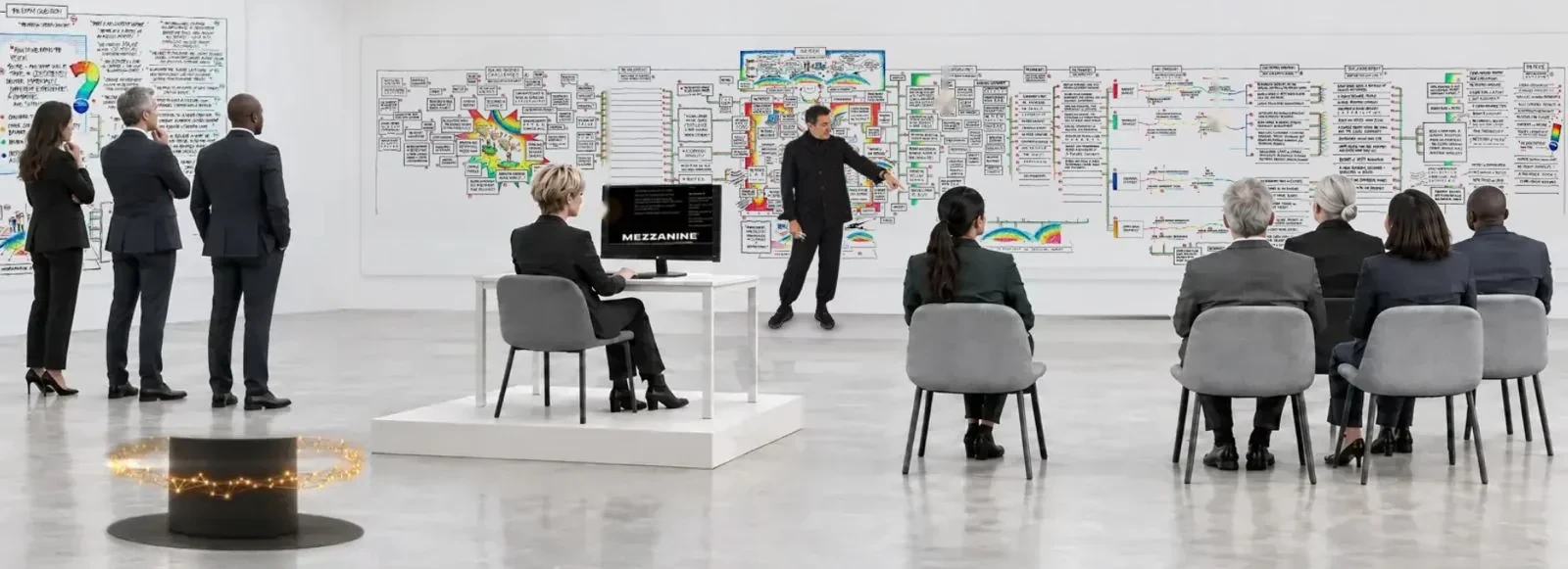

A nice drawing
and a lot of opinions.
Draw anything on a wall and people will gather round it. That part is easy. The hard part is knowing why each box sits where it does and what breaks if it moves. Without that you have a nice drawing and a lot of opinions. Framework Science is the part of our work that makes the drawing answerable to something.
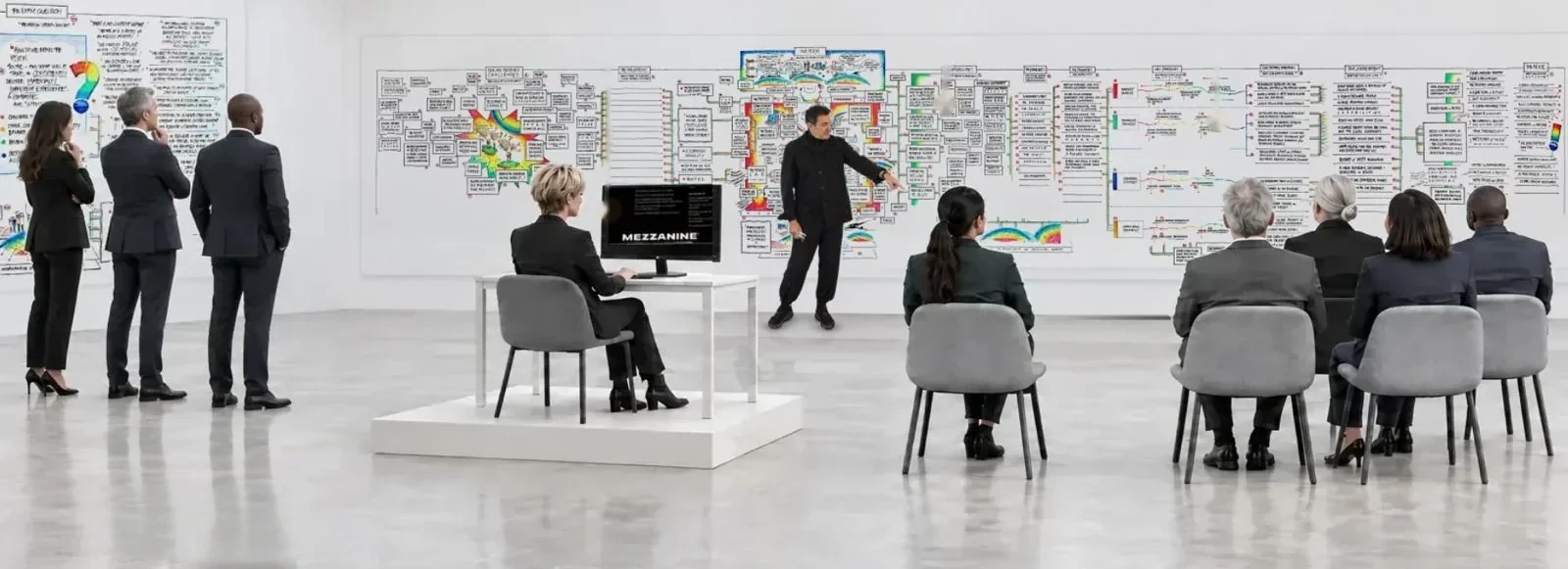
A framework is how we hold complexity in a logical way. The front page of our site says it in two lines: the clarity to understand complexity, and the structure to act on it. Every organisation is a system, whether it feels like one or not. Our job is to make that system visible, and then to make sure the picture of it is honest.
Science is a big word, and we use it on purpose. Back in 2016 we wrote that science is both an intellectual and a practical activity, the systematic study of the structure and behaviour of a particular field. Our field is work, in the widest sense: everything an organisation does to get where it wants to go. Framework Science is the growing study of which patterns in that work hold true.
What a framework
actually is.
A framework is a set of connected modules. It runs from the reality around the organisation to the outcomes it commits to. The modules are not fixed. We add one when the question demands it, and the governing question rules the lot. Everything on the wall answers to that one question, and anything that cannot is either missing a reason or does not belong.
We often call the finished thing a blueprint. We like the word because it evokes a rigorous engineering diagram. It is a map of the entire operation, with every part that needs building and the relationships between them clearly drawn. We make it very visual and easy to read, but it still carries everything needed to build the future operation. Large pieces of work often need several blueprints nested together, the way an architect shows a side elevation beside a plan.
Every contribution is typed. When someone speaks in a session, what they say lands somewhere and is named for what it is. Fact, assumption, hypothesis, choice or constraint. That simple discipline does a lot of quiet work. Opinion can no longer arrive dressed as evidence, and everyone can see which parts of the plan rest on what the team actually knows.


Put as one sentence, the whole drawing is an equation. If you want to achieve H and G, you need to solve for A while building towards C, taking account of D, E and F, and then going back to B. One test sits under all of it, and it stays the same: do the choices add up to the outcomes we intend? If an outcome has no initiative driving it, either the outcome comes off the wall or the team needs another initiative.
The same themes,
the same cracks.
Across decades of assignments, the same themes run through almost every case. Every organisation has people, products, processes and systems. Each has its own dynamics and a leadership team. Because it is people, maturity varies from level to level. Cracks appear where people hoard information, or where systems fail to work as intended. Markets shift as well. However hard you watch the trends, someone out there is disrupting.
Cracks are where the opportunities are. Everyone suffers from them at some point. Framework Science is, in large part, a record of where they tend to appear and what they tend to mean, so we can go looking for them early and with some confidence about what we will find.
It also helps us tell when a strategy is being justified after the fact. There are tells. The room glides through hard questions with no friction at all. Every piece of evidence points conveniently in one direction. People can recite the strategy but struggle to explain the reasoning. Leaders think it is finished while the people delivering it know it is not, and their view is almost always the more accurate one. See three or more of those and you are watching a strategy being justified.
Written down,
and handed over.
The rules are written down. That matters more than it sounds. A method that lives only in one person’s head is a talent. Written down, it can be tested and improved, and we keep refreshing it as we learn. The same Framework Science that shapes the sessions sits beside the work as it goes on, in Mezzanine, so every new piece of evidence is read through the same lens.
It is the science behind Structured Visual Thinking. The two need each other. Drawing without the rules is clever drawing. The rules without the drawing are theory nobody can see. Together they give a leadership team a picture it can reason about and a logic it can trust.
Clients can take it with them. Everything we do is meant to be educational. We transfer the capability, and if a client wants it, the Framework Science behind the work goes with them. Busy people need the confidence to see that they work in a system, and the fluency to keep that system honest once we have left the room.
I still draw with a pen. The science is the reason I trust where the line goes.