
Watch the sequence unfold
Pause here for a few seconds and watch the whole system draw itself in order. The sequence is the point: first the exam question, then the business equation, then the roadmap. Getting that order right is how organisations avoid solving the wrong problem brilliantly, or losing the same battle over and over again.
The question under the question.
Most leadership teams turn up with a question already in hand. It tends to be the one that feels right, which is a different thing from the one that is right. They live with the problem every day, nose pressed against it, so they answer whatever is in front of them. It is how perfectly capable people end up solving the wrong problem really well.
So we dig before we draw anything. The obvious question sits on top. Underneath it there is usually a better one, and under that a better one again, each a little more honest than the last. We keep going until we hit the question that, answered properly, would make this the most valuable strategic work the organisation has ever done.
That is what we call the exam question. We shape it with the sponsor, test it in the interviews and then hand it to the team, who have to own it. It keeps everyone pointed the same way, and it has a useful habit of flushing out anyone quietly running a different agenda. More often than you would think, the question we were given turns out to be wrong. That is always worth finding out early.
The test I come back to most is whether the question is big enough to be worth the cost of answering it properly, or whether it has been trimmed to fit what people are prepared to pay. The trimmed one is always easier to say out loud.
The order is the argument.
The exam question hands down to eight modules, A to H, laid out left to right. We never argue them in that order, and that is the bit people find odd at first. The order you discuss them in is what forces the logic. Get it right and the business case builds itself. Get it wrong and you have eight interesting conversations and no case at all. We call the whole thing the business equation.
What you see here is the generic version. Every framework we build is cut to fit its exam question, so modules get added, renamed or bent a little to make space for the conversations that particular question needs. The one thing that stays put is the tension in the logic: the pull between the outcome a team wants and everything working against it. That part is fixed.
We always start with H, the outcome. It is the prize, the handful of results the team agrees to go after. Settle the destination first and people stop arguing about the route.
Next comes G, the signs of achievement, the things we would expect to see along the way if it is working. It makes the end measurable before anyone starts to feel the pressure.
Then we jump to the far left, to A, and that is where the tension comes in. These are the forces nobody in the team controls. If they could, the outcome would be a lot easier. The gap between A and H is, more or less, the business case.
C, the vision, gets drawn with all of that in plain sight. D is the opportunities, everything we could possibly do. E is the operation, and what has to be true for it to carry any of it. F is where the opportunities run through the decision criteria and come out the other side as bets.
B, the mandates, we leave until last. Name the rules at the start and they box the thinking in. Name them at the end and they read as the price of the outcome, and a team that has just watched the price being worked out is far more willing to pay it.
Holding it all together is one rule: nothing goes into the vision that the operation cannot deliver with everything lined up and intact. A bet the operation cannot carry is a wish with a nice slide.
The plan view.
Once the equation is done, the roadmap takes over. The equation is the what and the why. The roadmap is the when: the bets that came out of F, laid down across three years, quarter by quarter, as one continuous stream.
We pinched the idea from Charles Minard, who drew Napoleon's march on Moscow as a band that got thinner as the army died. Each bet is a strand in our stream, and it swells and thins with the effort it needs. New initiatives come in as tributaries. Finished work peels off to a milestone. The whole thing gets fatter as the system grows.
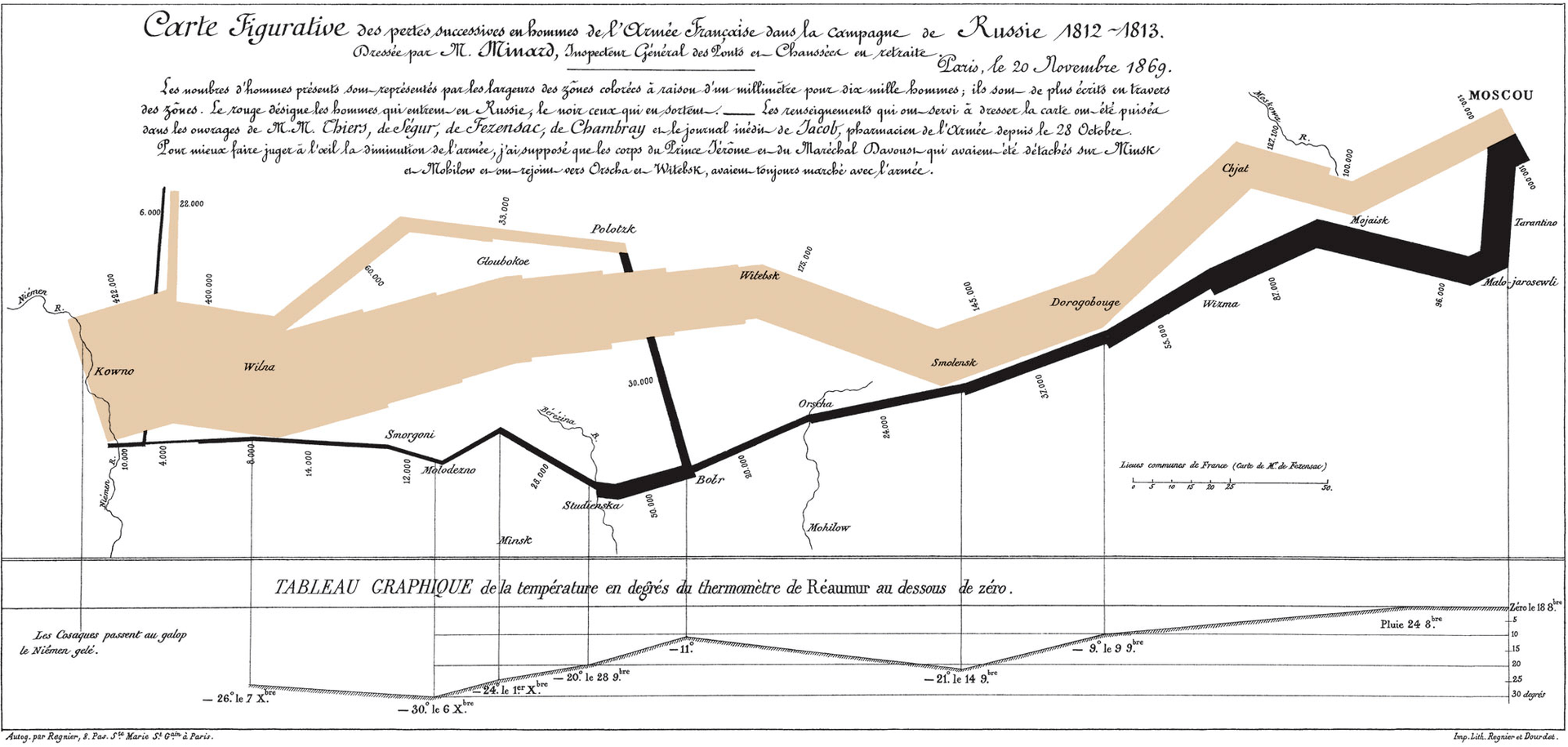
Napoleon called strategy the art of making use of time and space, which is where the line at the top of this piece comes from. Ground you can win back. Time you cannot. A roadmap is our attempt to take the second half of that seriously.
Things stop as well, and the roadmap shows it. A plan that only ever adds is one nobody quite believes. As the work moves on, some initiatives get dropped, and we mark each one where it ends. Choosing what to stop is as much a decision as choosing what to start.
The further out you look, the thinner the certainty. Horizon one is packed with named initiatives, horizon two has fewer, and horizon three is mostly direction. That is just honest, and people trust a plan more when it admits as much.
Running underneath everything is value delivered. It goes up, with the odd setback, which is what real value tends to do.
What the team keeps.
Both pieces finish in exactly the same place, a grid of nine rows of four. Same rows, same squares filled. If the plan and the argument ever drift apart, that is where you will spot it first.
That grid is really the agreement. Every row is something the team has committed to: black for done, white for still to come. It is the smallest picture of the whole strategy, and it is usually the one people remember on Monday morning.
All of it belongs to them. The team digs out the question, argues the equation through and lays down the roadmap. We keep it honest and draw it as they go. What they leave with is their own thinking, in their own order, and in our experience it stays with them long after we have packed up the pens.