


The three-week
half-life.
Strategies rarely fail because something is visibly wrong with them. They fail when the reasoning is no longer in the heads of the people who have to run the plan. Nobody quite understands the roadmap or their own capacity to act. From a distance it all still looks complete.
A workshop is an event, and the thinking you want to keep has to live somewhere. The day job returns. Within weeks, months of reasoning lives in three heads while everyone else has some impressive pictures. The cause is structural. Left without a permanent home, good thinking has a half-life of about three weeks.
Then the strategy lives in a book and gathers dust. Everyone still refers to it and nobody implements it. On the surface everything looks in place, with nothing behind it: no change in mindset, and nobody using the new systems. That is why we built Mezzanine.
What Mezzanine
actually is.
It began as a long development programme, a decade old and probably more. It started when we realised that the same patterns and rules kept turning up across the conversations we were having. We felt it should be possible to build a system around them. The first version was software, a platform with a dashboard, and for a while it was called an operational platform.
It is a space for the leadership team, and the technology that keeps it alive. From inside it, the team can look at the whole of the work: its outcomes and signs of achievement, its vision and operating model, its culture and plan, and the imperatives and rules beneath them. We worked hard to make sure it never became one more piece of corporate software. Most of our clients already have plenty of those.
Today AI does a lot of the heavy lifting. It summarises, and it brings together large amounts of disparate and complex information, using a knowledge graph and other technologies that were simply unavailable when we started building. It only uses what is held inside Mezzanine, so it never reaches into the open internet or another client’s work. Its job is to surface gaps and contradictions. A person decides what to do with them, and anything it drafts stays a draft until a practitioner has reviewed it.
It fills as
the work happens.
It is up on day one. Mezzanine starts the moment an assignment is accepted, which is why clients who want it sign up early. Our own assessments, built into it, go out across the enterprise. They give a litmus test of where people feel they are, with open text for the things nobody will say in a meeting. By the time we walk into the first session, that evidence is already on the table.
Every session is recorded, and the insights are typed up. We are after the insights and key points, which matter far more than a verbatim record of a general chat. They go straight into the part of the framework being discussed, so they land somewhere useful. Every change is dated and nothing is overwritten, right down to each earlier version of the question.
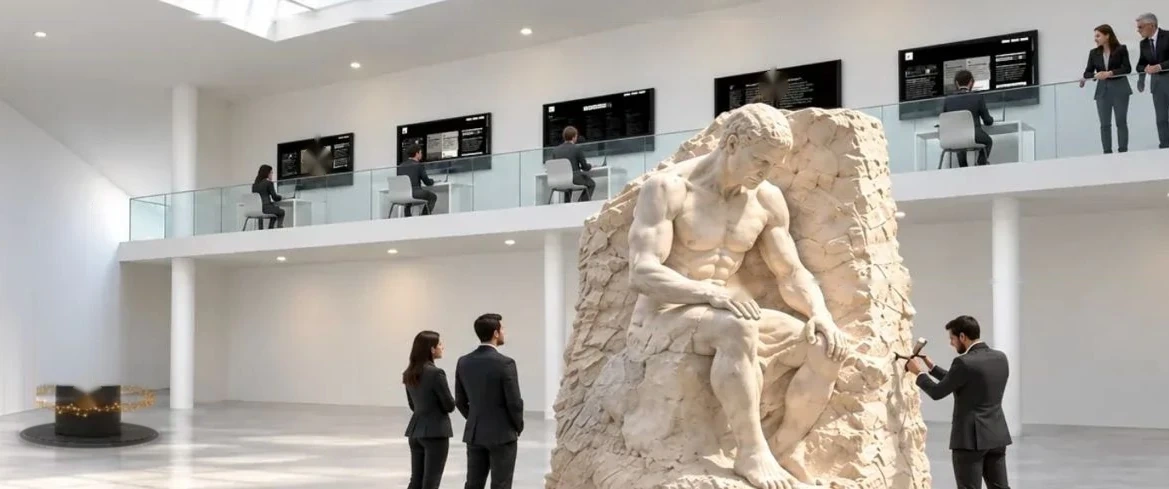
It compounds. What changes is added, and what no longer serves is taken away, so the work becomes a living statue (and a moving one). Session by session, more of the answer comes out of the stone, and everyone can see it happening. The same Framework Science that shapes the sessions sits alongside, so each new piece is read through the same lens.

The keys
to the car.
Mezzanine won’t make a team care. Workshops and tools make no difference unless people commit to their role. It always comes down to mindset and behaviour. Where the commitment is there, Mezzanine stops it fading.
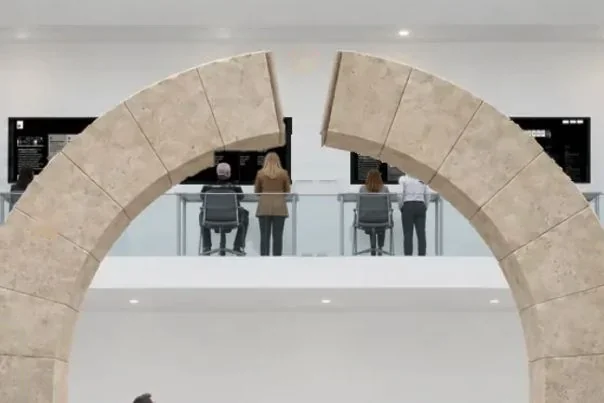
It holds the keystone. The keystone is a single version of the truth: one source of the plan that everyone keeps contributing to. It keeps people informed and shows what needs to happen next. Where a client chooses it, the question sits at the top of every page.
It is optional, and we mean that. Plenty of senior teams are perfectly able to carry the work on by themselves. Where a client keeps Mezzanine, we can stay on as observers with a view into the system, to help keep everyone honest. Occasionally someone will want to change a significant decision with a piece of information that does not fit. Then we push back, politely: that does not fit, for these reasons, so let’s have another conversation.
It hands the leadership team the keys to the car. They can keep the strategy fresh in their own language, without leaning on outside consultants forever. That was always the point. I would far rather be asked back than be needed.