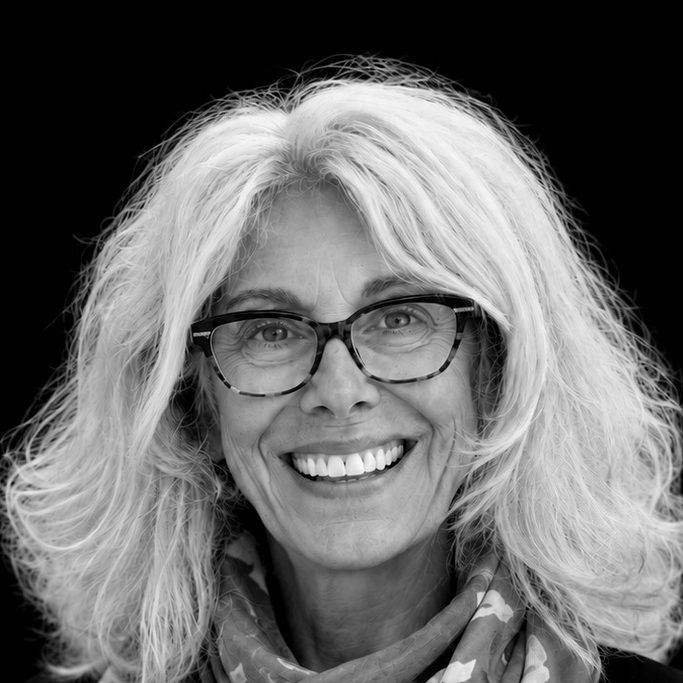
“I work on the second before you let a machine decide for you, and what you teach it in that second.”
A broadcasting family
Media runs in the family. Nicoletta’s father worked at EIAR, the Italian radio company that became RAI. He liked to tell her that he had invented the name RAI himself, when radio made way for television. She was never sure it was true, and she always believed him. The story taught her that “naming things matters, that giving something a name is a creative act.”
She trained in set and costume design at an Italian academy of fine arts and worked as a designer for the stage and the screen. Then she moved to the United States. She filed stories for RAI’s TG2 news and for its Mixer programme, and took a master’s degree in computer graphics at the New York Institute of Technology, studying how radio and television would meet the online world.
At RAI Corporation in America she worked as a reporter and producer, covering news across North and Central America. She co-wrote Cosa Nostra, a nine-hour documentary on organised crime in America, and was executive producer of Harlem Meets Naples at the Apollo Theater.
She is fluent in three languages and has made her home in Italy, America, Switzerland and France.
The future of media
Nicoletta was early to the internet. She studied how to compress sound and video for the network, and she conceived and built RAI’s first website with Organic Online, the team behind Hotwired. In her words it was “number 37 in all of Italy”, at a time when the internet did not yet exist for most people.
As head of information systems at RAI Corporation she ran trials of streaming and new distribution formats, and she managed the multimedia coverage of the World Television Forum at the United Nations.
Back in Rome she led RAI’s trials of interactive content on digital terrestrial television, then ran its Interactive TV Content Factory, taking an interactive strategy across every platform the broadcaster used. She taught interactive television at the University of Florence and at Sapienza in Rome.
“Three generations of media between my father and me. Radio. Television. Internet. And now artificial intelligence.”Nicoletta, Rebel Ethics notebook
In Geneva she joined the European Broadcasting Union, the alliance of public service broadcasters, and became Head of Strategy and Future Media. She was responsible for its new and future media work and helped shape the strategy for the EBU Media Lab. She built partnerships with Google, YouTube, Facebook, Twitter and TED, and curated TEDxTransmedia.
She became a familiar voice on the subject, speaking and moderating at MIPCOM, IBC, EPFL, ETH Zurich and universities in China.
Why ethics arrives late
Then she stepped away. Nicoletta gave up her post at the EBU and a significant salary, and went back to university to understand something that did not yet exist. She completed the executive programme at Singularity University and later served as its ambassador in Geneva.
Her doctorate in philosophy at the European Graduate School was called Exponential Ethics. Its idea is simple once you see it. “Technology grows exponentially, but ethics moves linearly. That means one thing: ethics always arrives late.” She remembers writing it for an audience that did not yet exist.
The thesis became her book Exponential Ethics, supported by the Rockefeller Foundation, which also hosted her as a resident at its Bellagio Center. A Chinese edition followed from Jinan University Press in Guangzhou. Her Italian book L’Etica è Donna, on ethics, inclusion and technology, shared second place in the Premio Nadia Toffa.
She taught ethics and emerging technology for years as an adjunct professor at Webster University in Geneva, and at Jinan University in Guangzhou and FHNW in Basel. She founded the ethical framework for Hyperloop Transportation Technologies, and her talks run from the ethics of nano, bio, info and cogno technologies to robotics and gender, including Let’s talk robots at TEDxCarthage.
- BookExponential Ethics, with a Chinese edition
- BookL’Etica è Donna
- ManifestoEducating a Superintelligence
- PaperFertility: The Missing Code for AGI, Springer
- PaperPause Protocol, for agentic AI governance
- NovelForthcoming with Heraion
The pause
For years she worked on AI ethics in theory, through papers and frameworks. Something was missing. Parents would stop her after talks and ask what they should actually do when their twelve-year-old used ChatGPT for homework. “I had no answer. I had theory.”
Her father had his own answer. As a centenarian he would listen and then say the same thing every time: “Why don’t people just stop for a moment and think?” After he died she stopped being purely theoretical and started to build.
The result is Ethics of Example, a framework built on the idea that AI learns what it means to be human from how we behave with it. Its first practical tool is the Pause Protocol, a calibrated pause placed inside the interaction so that the human moment of decision survives the speed of the machine. She has run it with families at the Collège du Léman in Geneva with Women in AI Switzerland, and every family left with a toolkit and a written agreement on AI use at home.
Today she is an ethics expert for the European Commission, where she has reviewed more than fifty AI projects, and she sits on the board of the Women’s Brain Foundation. She advises Women in AI Switzerland, has presented her work at the AAAI conference in Singapore and writes the Rebel Ethics notebook in three languages.
She is part of the Group Partners Expert Network, where her work on human agency sits close to the heart of what Group Partners does.
The path
From set design in Italy to the ethics of artificial intelligence.
- Academy of Fine Arts
Studies set and costume design, then works as a designer for theatre and television.
- New York
Stories from America for RAI’s TG2 and Mixer. Master’s degree in computer graphics, New York Institute of Technology.
- RAI Corporation
Reporter and producer, co-writer of Cosa Nostra, then head of information systems. Builds RAI’s first website.
- RAI, Rome
Senior manager for interactive trials on digital terrestrial television, then head of the Interactive TV Content Factory.
- European Broadcasting Union
Head of Strategy and Future Media in Geneva. Curator of TEDxTransmedia.
- European Graduate School
PhD in philosophy on Exponential Ethics. Singularity University executive programme.
- Webster University
Adjunct professor in Geneva, with teaching at Jinan University and FHNW.
- Bellagio
Resident at the Rockefeller Foundation’s Bellagio Center. Exponential Ethics published.
- Women’s Brain Foundation
Member of the board.
- European Commission
Ethics expert, reviewing research and AI projects.
- Ethics of Example
Founder. Creator of the Pause Protocol.
In her own words
“Every interaction is an educational moment, and we don’t even know it.”
“I remember the feeling: writing something I felt was urgent, for an audience that didn’t yet exist.”
“I was theorizing. He was just doing it.”
“I couldn’t keep doing theory. I had to build it. That’s why I can talk about it.”
“A weekly space where I write about the ethics we don’t yet have a language for.”
“Every talk is written for the specific audience it’s given to.”