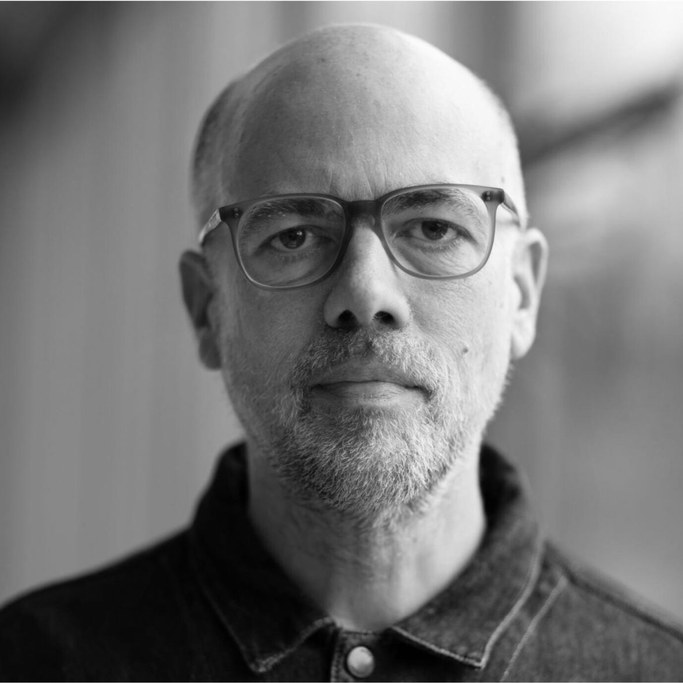
“Ideas need room to grow before we know what they are for.”
From the ground up
Jan trained as a landscape architect at the Technische Universität Berlin and began his career designing and building public spaces, from courtyards to whole regions.
He worked at Martha Schwartz Partners, and in 2004 he co-founded Treibhaus Landschaftsarchitektur in Berlin with three fellow designers, after the group had won the Lenné Prize in 2003 and the Schinkel Prize in 2004. He later ran his own practice in Damascus.
Those years grounded his work in the relationship between ecological processes and the business of design and construction. They also taught him how much a place depends on its budget, and on the people responsible for using and caring for it.
Into virtual worlds
At Squint/Opera Jan moved from physical places into virtual ones. He joined as a senior producer and became Managing Director, and he helped the company grow from 25 to 100 people. He founded its New York studio and set up an internal research and development lab.
Teams under his direction created immersive environments and simulations that helped clients explore future scenarios and understand complex proposals. They included programmes for new cities such as NEOM and Toyota Woven City, whose launch film was part of Bjarke Ingels’ presentation at the Consumer Electronics Show in Las Vegas in 2020.
“Hyperform marks the first time we can feel and sense a spatial condition before it gets built.”Jan Bunge, Dezeen, June 2019
In 2019 he co-founded SpaceForm, with investment from BIG and UNStudio. It gave teams a shared, real-time 3D environment in which to explore proposals and test ideas, so that everyone involved could build a common understanding of what they were planning to make. He later served as a Director and Partner of Squint/Opera, and he still works with the studio on its virtual twin ecosystem.
Simulating living systems
Jan develops partnerships for Lucidminds, an Amsterdam research collective, and its GUS platform for simulating trees and ecosystems. GUS models how trees and forests grow under different climate and maintenance conditions. It helps teams see how planting and management choices could affect ecological performance over the years that follow.
The work joins his landscape background to the practical use of simulation in deciding where money goes and how a place is looked after.
He is an advisor to GAIA Lab on applications in the built environment. In Barcelona he sits on the executive advisory board of a master’s programme at the Institute for Advanced Architecture of Catalonia, where he also teaches.
Decisions that hold
Today Jan is establishing MULTIBALL, his advisory business, and co-founding the Invisible Dynamics Foundation, which maps open-source solutions for sense-making. The work carries his experience of shaping places and exploring possible futures into the question of how institutions turn proposals into commitments.
With a group of close collaborators he is developing a practical approach to capital allocation for living infrastructure. It connects ecological evidence to investment. It also ties that investment to the people responsible for delivery and to funded, continuing care.
Central to it is the DecisionRecord, a maintained model of a consequential choice. It links the evidence behind a decision, and the assumptions it rests on, to the authority to act and the obligations the decision creates. It also states the conditions that would call for a review.
His particular focus is the restoration and enhancement of nature, including the part it plays in managing flooding and drought at the scale of infrastructure, and in managing heat. He sets out his thinking on the shape of ideas, an open map of the ideas behind the work and the essays that argue them.

The path
From public spaces to the decisions behind them.
- TU Berlin
Graduates in landscape architecture.
- Martha Schwartz Partners
Designs and builds public spaces as a landscape architect.
- 2004
Co-founds Treibhaus Landschaftsarchitektur in Berlin, after the Lenné Prize in 2003 and the Schinkel Prize in 2004.
- Damascus
Runs his own landscape practice.
- 2012
Joins Squint/Opera in London as a senior producer.
- 2013
Becomes Managing Director. The company grows from 25 to 100 people and opens a New York studio.
- 2019
Co-founds SpaceForm, with investment from BIG and UNStudio.
- 2020
Director and Partner of Squint/Opera, the year its Toyota Woven City film launches at CES.
- 2024
Founds MULTIBALL and co-founds Yokai Systems, which uses video games to help tackle climate change.
- 2025
Takes on partnerships for Lucidminds and its GUS platform, and advises GAIA Lab.
- 2026
Publishes the shape of ideas, a map of 86 ideas and 59 essays.
- Now
Co-founding the Invisible Dynamics Foundation. Joins the Group Partners Expert Network.
In his own words
“Nature-based solutions become infrastructure when ecological responsibility survives the project team, the contract, the organisation and the people who first made the promise.”
“A decision that cannot be reconstructed cannot be properly challenged.”
“A checkable decision basis should be worth more than an uncheckable one.”
“Hyperform marks the first time we can feel and sense a spatial condition before it gets built.”
“The settings we create shape what gets a chance to emerge.”